 Image: Hyundai press kit
A feature-rich, well-built city SUV that excels as a calm urban commuter, provided buyers accept its modest highway pace.
The Hyundai Exter is a tall, feature-loaded micro-SUV built on the Grand i10 Nios platform, priced from Rs. 7.13 lakh to Rs. 12.08 lakh ex-showroom. It impresses with six standard airbags, a sunroof, dashcam and a refined 1.2L petrol, but its lifeless steering and modest highway pace mark it as a city-first car.
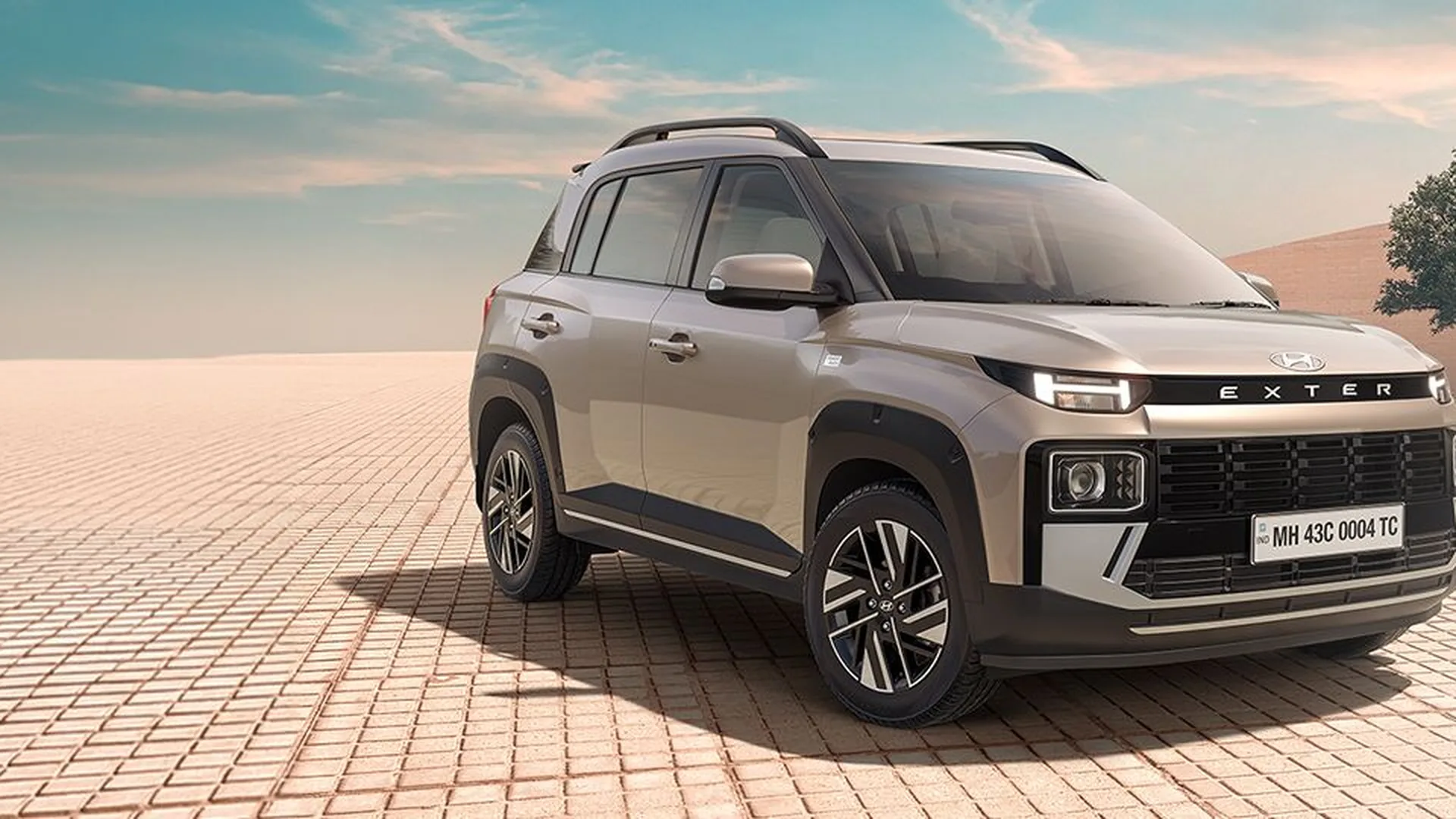
The Exter wears Hyundai's parametric design language boldly: H-shaped DRLs and tail-lamps, a shimmering grille insert, fake skid plates and pronounced wheel cladding. It stands taller than both the Grand i10 Nios it shares its platform with and the rival Tata Punch, with 185 mm ground clearance and flared arches lending genuine SUV stance. Faisal Khan notes the body cladding lacks symmetry where it breaks between the front and rear sections. The 175/65 R15 diamond-cut alloys look proportionate but several reviewers felt 16-inch wheels would have filled the arches better. Panel gaps are slightly inconsistent in places, unusual for a Hyundai. Nine colour options including three dual-tone schemes are offered. The design will polarise: you will either love it or find it busy, but you will notice it.
The dashboard is lifted largely unchanged from the Grand i10 Nios but executed in all-black with body-colour accents on the AC vents. Fit, finish and material selection lead the segment, with leatherette-wrapped steering, contrast stitching and an illuminated USB port adding a premium feel. The 8-inch touchscreen pairs with a 4.2-inch colour MID offering three theme colours, and features such as wireless charging, ventilated glovebox, dashcam with three recording modes and 90-plus voice commands are genuine segment-firsts. Gripes: front headrests are fixed, there is no centre armrest front or rear, the steering offers tilt but not telescopic adjustment, and Android Auto is wired only. Hard plastics on the lower dash are evident but acceptable at this price.
TeamBHP's owners report precise build, excellent ergonomics and a cabin that feels solidly screwed together, though scratchy plastics are present throughout as expected at this price. Doors shut with a reassuring thud and the roof rails feel rugged rather than cosmetic. Safety hardware is the headline: six airbags, ESC, VSM, hill-hold, three-point seatbelts for all five occupants, ISOFIX mounts and a seatbelt reminder for the middle rear passenger are standard across the range, a first in the segment. Global NCAP results are awaited but Hyundai claims the structure uses additional high-strength steel reinforcements over the Nios. The eight-year, 16-update map and Bluelink subscription, plus optional five-year service packages, address ownership peace of mind well.
A single 1.2-litre four-cylinder petrol does duty, producing 83 PS and 113.8 Nm, paired with a 5-speed manual or 5-speed AMT; a CNG variant drops output to 69 PS and 95.2 Nm. The motor is genuinely refined, idling so quietly it can feel stalled, and it pulls cleanly in city traffic. Performance is linear rather than exciting: 0-100 kmph takes around 12.6 seconds in the manual and roughly 13.5 seconds in the AMT, with a flat spot above 4,000 rpm. The AMT is among the better units in the segment and the segment-first paddle shifters genuinely help mask shift shocks. With four occupants and luggage on a highway gradient, the engine feels strained, and a turbo-petrol option would have made it a true all-rounder.
Tuned soft for Indian city roads, the suspension absorbs broken tarmac and small potholes with a composure the Grand i10 Nios cannot match. Low-speed ride is plush and the 185 mm ground clearance shrugs off speed breakers without scraping. Push harder and the trade-offs surface: bigger bumps at speed transmit a jolt into the cabin, and with a load over poor roads the rear feels loose. High-speed stability is acceptable rather than reassuring, with noticeable body roll through corners and pronounced understeer near the limit. The MotorBeam team rate ride comfort above the Tata Punch. The steering is exceptionally light for parking but utterly devoid of feedback at speed, while braking has improved over older Hyundais though the last bit of bite is missing.
Pricing runs from Rs. 7.13 lakh for the base manual to Rs. 12.08 lakh ex-showroom for the top AMT, with dual-tone schemes adding around Rs. 32,000-34,000. The base price matches the Tata Punch but the Exter offers materially more equipment at every variant, and the AMT is available across nearly the entire range rather than just the top trim. Within the Hyundai family, buyers stretching to Rs. 10 lakh might also weigh up the Hyundai Venue, which offers a turbo-petrol and a more grown-up drive. Against the Kia Sonet and Mahindra XUV 3XO, the Exter sits a class below in size but undercuts them on price while matching them on features. For a first car or a calm city commuter, the value equation is genuinely strong.
TeamBHP's review and owner community praise the well-tuned suspension, refined 1.2L petrol, 185 mm ground clearance and feature-rich cabin with six standard airbags. Concerns flagged include scratchy interior plastics, thin tyres limiting handling, and a rear bench best suited to two adults rather than three.
Read full forum review →"Crazy loaded with features and better than the Punch thanks to its four-cylinder engine, but driving dynamics disappoint."
"Top-notch interior quality and sensible variant spread; will dent Nios and i20 base sales more than the Punch."
"A genuinely calm city commuter for one or two, but lacks the maturity to be a true family all-rounder."
"First-gen Gen-Z SUV built on the proven Hyundai-Kia K1 platform, aimed at wonder-and-exploration buyers."
"Ride quality is clearly better than the Tata Punch and safety kit is uncompromised across every variant."