
Hyundai Venue vs
Hyundai Exter
A feature-rich city runabout against a grown-up SUV with genuine performance options.
Most buyers decide here. Read this before anything else.
- You commute on the highway at least twice a week and want the confidence of a turbo petrol or diesel engine.
- You have a family of four and need rear passengers to feel like they booked the car too, not just tolerated.
- You drive in hilly terrain or on uneven state highways where wider tyres and a stiffer platform make a real difference.
- You care about resale value and want a car whose badge commands a premium in the used-car market three years from now.
- You want Level 2 ADAS and dual 12.3-inch screens and refuse to compromise on tech just because the car is under 4 metres.
- You are buying your second car and the first one taught you that underpowered engines get old very fast.
- You drive almost entirely in a dense city and a calm, linear engine that never startles you in slow traffic is exactly what you want.
- Your parking spot is tight and every centimetre of length matters when you are reversing into a basement.
- You are a first-time buyer and Rs. 10-11 lakh on-road is genuinely your ceiling, but you still want a sunroof and six airbags.
- Your household already has a highway car and this Exter will handle school runs, grocery trips and the occasional weekend outing.
- You prioritise fuel economy above all else and the 1.2L Kappa's real-world 17-18 kmpl fits a monthly fuel budget you have already planned.
- You want CNG capability because your city has good infrastructure and you want to cut running costs to the bone.
The Venue scores 7.8/10, the Exter 6.9/10. In real life, they are built for different people.
The Venue's 1.0L turbo delivers 120 PS and 172 Nm, making four-up overtaking feel effortless. The Exter's 83 PS naturally aspirated motor takes roughly 12.6 seconds to 100 kmph in the manual, which Namaste Car described as adequate in the city but noticeably breathless on expressways. For anyone clocking 200-plus kilometres on a weekend trip, the Venue's engine options are a meaningful upgrade.
The Exter is shorter and sits on a well-understood platform that urban drivers find easy to place in tight spots. Sahi Gaadi's comparison noted that the Venue is 6 cm wider and carries a longer body, which adds to its road presence but costs you in multi-storey car parks. If your commute ends in a cramped basement, the Exter's compact footprint is a daily convenience.
The Exter's top-end S Connect variant lands at roughly Rs. 11.15 lakh on-road, delivering a sunroof, dashcam, six airbags and wireless connectivity. Sahi Gaadi pointed out that at a similar price, the Venue sits in its second or third trim with noticeably fewer features. The Exter gives a first-time buyer the full feature checklist without climbing into the Venue's pricing territory.
The Venue's newer K1 platform, diesel automatic option and Creta-level tech position it as a more aspirational product in the used-car market. Hyundai Exterts, while well-built, share their underpinnings with the Grand i10 Nios, which buyers in the resale market price accordingly. Arun Panwar noted the Venue's segment-rare diesel automatic as a feature that holds value precisely because alternatives are scarce.
Scores shown inline. "Best for" tells you who each result matters to.
| Axis | Hyundai Venue | Hyundai Exter | Best for |
|---|---|---|---|
Design |
The second-generation Venue wears a properly squared-off stance, with quad-beam LED headlamps, a dark chrome grille and a full-width LED tail-lamp. Utkarsh Negi noted the shorter front overhang and wider wheel arches give it genuine SUV credibility rather than the jacked-up hatchback look its predecessor wore. The K1 platform's extra width is visible from the rear, where the car looks planted and confident. 7.8 / 10 |
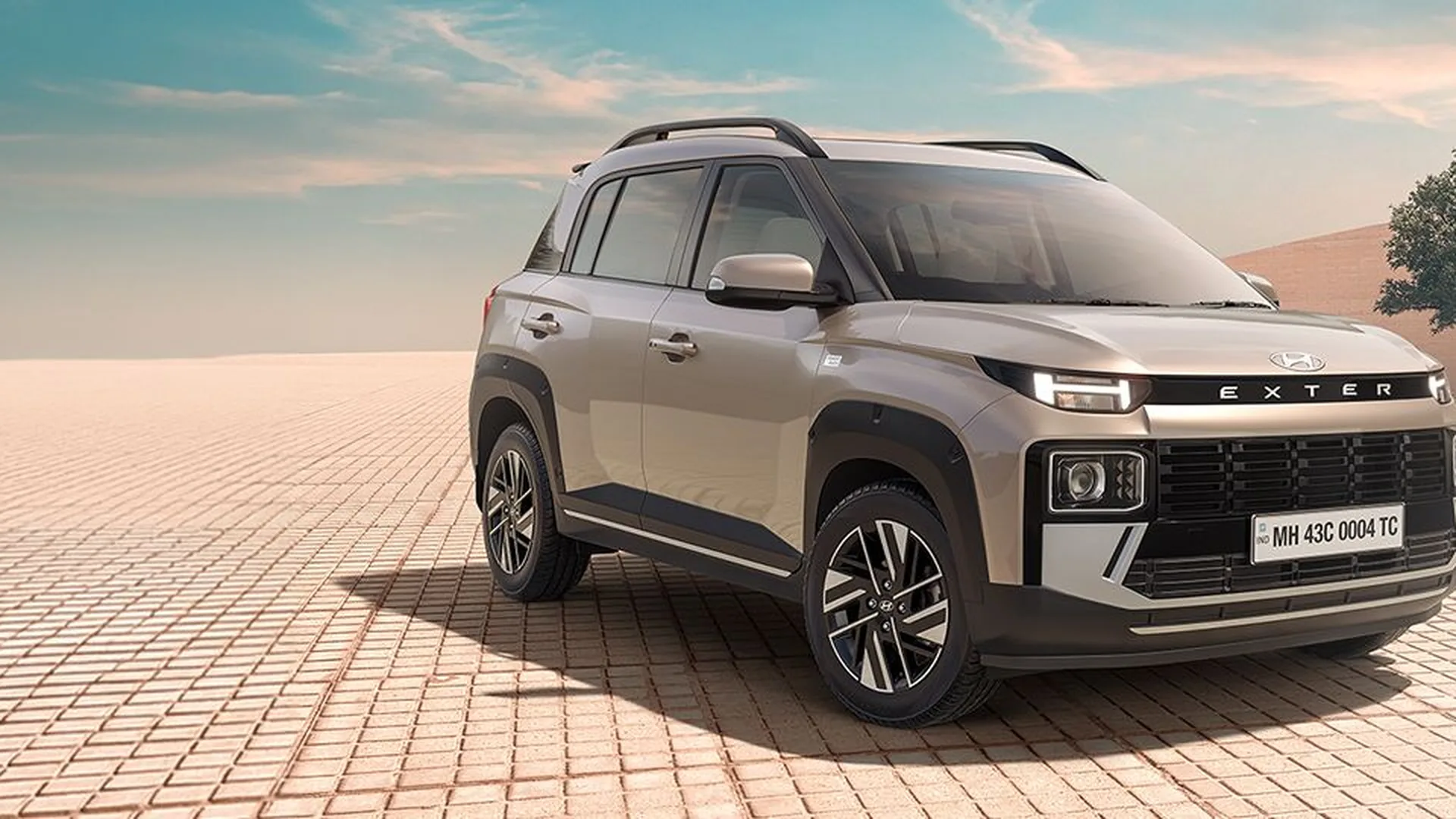
The Exter uses Hyundai's parametric design language with H-shaped DRLs, a shimmering grille insert and pronounced wheel cladding. Faisal Khan noted the body cladding loses symmetry at certain angles, which dilutes an otherwise bold face. It stands taller than the Tata Punch and reads as an SUV on the street, but the detailing is busier than the Venue's cleaner lines. 7.5 / 10 |
Buyers wanting SUV presenceVenue reads more maturely from the kerb
|
Interior |
Dual 12.3-inch curved screens dominate the Venue's dashboard, accelerated by Nvidia for sharper graphics, with wireless CarPlay connecting in seconds. Hyundai has kept physical climate and shortcut buttons, which Arun Panwar praised as the right call in a segment that often goes touchscreen-only. The D-cut leather-wrapped steering and Creta-inspired layout make the cabin feel a segment above its price. 8.0 / 10 |
The Exter's dashboard is carried over from the Grand i10 Nios but executed in all-black with body-colour vent accents. MotorBeam noted that fit, finish and material quality lead the micro-SUV segment, with contrast stitching and an illuminated USB port adding a premium feel. The 8-inch touchscreen and 4.2-inch colour MID are functional but feel modest next to the Venue's panoramic display. 7.8 / 10 |
Tech-forward urban buyersVenue's dual-screen setup is a genuine step up
|
Performance |
The Venue's engine lineup spans an 83 PS 1.2L base, a 120 PS 1.0L turbo with six-speed manual or seven-speed DCT, and a 116 PS diesel with a new six-speed torque converter automatic. Arun Panwar called the diesel automatic a segment-rare weapon that no rival currently matches. Even the base turbo manual is meaningfully quicker than anything the Exter offers. 8.0 / 10 |
A single 1.2L four-cylinder producing 83 PS and 113.8 Nm is the Exter's only petrol option, paired with a five-speed manual or AMT. MotorInc described the motor as genuinely refined at idle, and it pulls cleanly in city conditions. The 0-100 kmph time of around 12.6 seconds tells the full story: this engine is built for calm urban use, not highway pace. 6.8 / 10 |
Drivers who enjoy drivingVenue's turbo and diesel options are in a different league
|
Ride Quality |
The new K1 platform gives the Venue a more composed ride over broken roads, with the wider track adding stability at highway speeds. Utkarsh Negi noted the suspension tuning has moved away from the floaty feel of the first generation toward something more controlled. It handles speed bumps tidily without the crashiness that some turbo-platform sub-4M SUVs exhibit. 7.5 / 10 |
The Exter rides on the Grand i10 Nios platform with 185 mm ground clearance, and multiple reviewers including Gagan Choudhary found it comfortable over typical city surfaces. The relatively narrow 175/65 R15 tyres on top trims absorb urban imperfections well. Highway stability at 100 kmph is acceptable but the Exter feels more settled at city speeds than at expressway cruise. 7.5 / 10 |
Mixed city and highway useVenue's wider platform feels more composed at speed
|
Build Quality |
The Venue's K1 platform brings structural rigidity that Hyundai's own Creta benefits from, and the panel gaps and door shut quality reflect that investment. Arun Panwar observed that the wider body makes the car feel more substantial in daily use. The longer wheelbase also reduces the hollow feel that compact SUVs sometimes develop over time. 7.5 / 10 |
For a micro-SUV, the Exter's build quality is consistently praised across reviewers. MotorBeam highlighted that panel fitment and interior material quality lead the segment, besting rivals like the Tata Punch at equivalent price points. The Exter feels solid despite its smaller footprint, which is a genuine achievement at its price. 7.5 / 10 |
Segment-relative valueBoth score equally on build quality; Exter punches above its class
|
Value for Money |
The Venue's top-end pricing tests patience, as Arun Panwar noted, with fully loaded variants crossing Rs. 15 lakh ex-showroom. The mid-range S+ turbo trim is where the value equation works best, delivering the screen, ADAS and turbo engine without paying Creta money. Buyers who want everything at the top trim will feel the pinch. 7.0 / 10 |
Sahi Gaadi's comparison made the point clearly: the Exter's top S Connect variant at around Rs. 11.15 lakh on-road delivers a sunroof, dashcam, six airbags and wireless connectivity that would cost significantly more in the Venue lineup. For buyers who want maximum features per rupee in the Rs. 10-12 lakh bracket, the Exter's value proposition is difficult to argue against. 7.5 / 10 |
Feature-per-rupee buyersExter tops out with more features for less money
|
Practicality |
The Venue's extra width and longer wheelbase translate to noticeably more shoulder room for rear passengers and a larger boot. Sahi Gaadi confirmed the Venue reads as more spacious inside despite dimensions that are only moderately larger on paper. The 216/60 R16 tyres from the second variant onward also give the car more ground clearance confidence on rough approach roads. |
The Exter's tall roofline gives it good headroom for its footprint, and the upright seating position suits city driving where ease of ingress matters. Namaste Car noted that the rear bench is adequate for two adults but three across is a squeeze on longer journeys. The 391-litre boot is decent for a micro-SUV but falls behind the Venue in absolute cargo terms. |
Four-up family buyersVenue's extra width makes rear passengers meaningfully more comfortable
|
The Venue scores 7.8/10 and the Exter 6.9/10, from 7 independent creators. The overall number is only part of the story here: the dimension breakdown is where the real comparison lives.
Sahi Gaadi: Hyundai Exter vs Venue - Car Comparison - Dimensions, Size, Features - बेहतर कौन?