 Image: Tata press kit
The facelifted Punch adds a much-needed turbo engine, CNG+AMT combo, 5-star safety and 360° camera at competitive pricing, making it the most well-rounded micro-SUV available.
The 2026 Tata Punch facelift finally gets the 'punch' it was missing, with the Nexon-sourced 1.2L turbo petrol (120 PS/170 Nm) joining the lineup alongside an industry-first CNG+AMT combo. Backed by a 5-star Bharat NCAP rating, six airbags standard, 360° camera and refreshed styling, it starts at ₹5.59 lakh and tops out at ₹12.23 lakh (ex-showroom Mumbai for CNG AMT). However, the gearbox in the turbo variant and sluggish CNG AMT performance remain sore points.
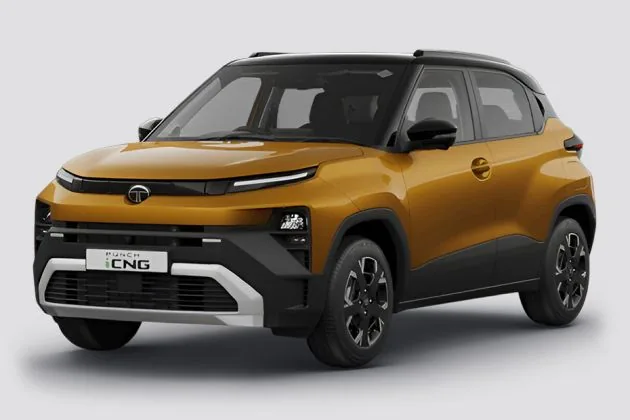
The 2026 Punch facelift brings a more mature, Nexon-inspired face with a slim LED DRL strip, vertically stacked LED headlights and a redesigned bumper featuring a bull-bar-style insert. At the rear, a new connected LED tail lamp strip runs the width of the tailgate, giving it a more modern stance, though some note it makes the Punch look 'less Tata' from behind. The overall length has grown by 49 mm due to bumper revisions, while width, height and the 2.45 m wheelbase remain unchanged. Ground clearance is up to 193 mm. New 16-inch dual-tone alloys (195/60 R16 Goodyear Triple Max 2) look sharp in motion, while lower variants continue with 15-inchers. Tata offers four new colours including Scientific Blue and Caramel. Sheet metal is unchanged in profile, and Easter eggs, rhinos hidden around the cabin and exterior, are a nice touch. Reviewers broadly agree the facelift looks handsome, though the Punch has lost some of its 2021 individuality.
Inside, the cabin layout is familiar but meaningfully updated. A new two-spoke flat-bottom steering wheel (shared with other Tata models), a 10.25-inch touchscreen with quicker response, a new 7-inch digital instrument cluster and a fresh white dashboard trim lift the ambience. Front seats now feature extended under-thigh cushioning, a genuine improvement for taller drivers. You get wireless Android Auto/Apple CarPlay, wireless charging, 65W USB-C fast charging, ambient lighting, auto-dimming IRVM (on CNG, oddly not on turbo petrol), a small sunroof, and six airbags standard. The big criticism across reviewers is the new touch-based control panel below the AC vents, icons are small, feedback is poor and operating it on the move is distracting. The rear seat offers adequate space for two adults, has rear AC vents, 15W USB-C charging and improved under-thigh support, but misses a middle headrest, cup holders in the armrest and a 60:40 split. Boot is 366L (petrol) or 210L (CNG).
Build quality is largely as expected for the segment, hard plastics dominate but the fit and finish feels solid overall. Some panel gaps and minor irregularities (like the fuel lid not closing on its own on the CNG tester) were flagged, and the roof liner feels flimsy when pressed. The doors open a full 90 degrees, great for ingress but a liability in tight parking. Safety is the standout: 5-star Bharat NCAP for both adult and child protection, six airbags standard across the range, ESP, ISOFIX mounts, TPMS standard, hill-hold assist and a 360° camera on top variants. Tata also conducted an in-house car-to-truck crash test at 50 km/h with the passenger cell remaining intact. Features are generous for the segment, blind view monitor, auto headlamps, rain-sensing wipers, cruise control (on turbo/non-CNG variants), paddle shifters on AMT and connected car tech. Missing: rear discs, no 60:40 split seat, and only two rear parking sensors.
Powertrain choice has expanded dramatically. The headline act is the 1.2L turbo petrol borrowed from the Nexon, 120 PS and 170 Nm, paired exclusively with a 6-speed manual. Tata claims 0-100 km/h in 11.1 seconds; real-world testing yielded 12.5-12.67 seconds, hampered largely by a notchy gearbox that refuses to slot cleanly into third gear. The turbo transforms the Punch into a genuinely peppy car, though the clutch is springy with poor feel. The naturally aspirated 1.2L three-cylinder (87 PS/113 Nm) continues with 5-speed manual or AMT. The CNG variant produces 73.4 PS and 103 Nm and is now available with AMT, an industry first in the segment. However, the CNG AMT is visibly sluggish, struggling to hit 100 km/h (0-100 in ~21.6 seconds), with pronounced head-nod between AMT shifts. Expect around 9-12 km/l in city and 15-16 km/l on highway for turbo; CNG delivers approximately 20 km/kg real-world.
The Punch retains its reputation for big-car stability in a small package. Ride quality is supple at most speeds, though the turbo variant's stiffer suspension makes low-speed ride feel firmer than the CNG/petrol NA versions. High-speed stability is excellent, reviewers consistently praise how composed and 'bigger than it is' the Punch feels on the highway. The steering is light at low speeds and weighs up nicely, making city driving effortless. Body roll is present but handling is confidence-inspiring for a tall micro-SUV. The 193 mm ground clearance and claimed 400 mm water wading capacity make it well-suited to Indian roads and monsoon-flooded streets. Brakes are adequate for part-throttle use but feel less reassuring under hard panic braking, and rear drum brakes are a noted omission at this price. Road and wind noise are reasonably controlled. Turning radius is not the best despite the compact size.
Pricing is where Tata has played its master stroke. The base petrol starts at ₹5.59 lakh (ex-showroom), only about ₹10,000 more than before, while the top-end manual petrol goes up by roughly ₹30,000. The turbo petrol top-end sits at ₹11.4 lakh on-road Mumbai, with the CNG AMT being the most expensive at ₹12.23 lakh on-road Mumbai. CNG commands a premium of around ₹1-1.12 lakh over equivalent petrol variants, and the CNG AMT premium over CNG manual is ₹61,000, reasonable given the convenience. With 26 variants across petrol manual, petrol AMT, CNG manual, CNG AMT and turbo manual, there's a Punch for every budget. Given the 5-star safety, feature load and new engine options, the Punch offers strong value, though reviewers caution that the turbo variant's price overlaps with Nexon's lower trims, and buyers wanting automatic turbo will be disappointed. The CNG AMT is pitched as ideal for cab/fleet use.
teambhp-text">TeamBHP's community has historically praised the Punch for its solid build and safety credentials, and the facelift's addition of the turbo engine and CNG+AMT combo is likely to be welcomed as addressing the car's biggest weakness, a lacklustre NA engine. Long-term owners have flagged concerns around Tata's after-sales service consistency and niggling quality issues, which remain the primary dealbreakers for prospective buyers even as the product itself becomes more compelling.
"Loves the new turbo engine for finally giving the Punch its 'punch', but is severely frustrated by the notchy gearbox, especially shifting into third, and calls the CNG AMT sluggish; still believes the Punch will sell in huge numbers."
"Appreciates the updated materials, design and interior upgrades, but strongly dislikes the new touch-based control panel calling it a poor implementation that hurts daily usability."
"Highlights the Punch CNG AMT as a segment-first feature and praises the improved front seats with better under-thigh support, though notes the small sunroof and limited rear headroom."
"Finds the Punch far more desirable than before thanks to big-car stability, refined turbo and convenient CNG AMT, but warns that Tata's uncertain after-sales service and reliability could be dealbreakers."
"Considers this more than a regular facelift thanks to the turbo engine transplant, and is impressed by the 5-star Bharat NCAP rating and in-house car-to-truck crash test validation."