 Image: Hyundai press kit
The Creta remains the most well-rounded mid-size SUV with three strong engines, Level 2 ADAS, and a feature-loaded cabin that justifies its segment-leader status.
The 2024 Hyundai Creta facelift doubles down on what made it India's best-selling mid-size SUV, a feature-rich cabin, three capable 1.5-litre engines, and now Level 2 ADAS. While it isn't a driver's car and the hard plastics persist, its blend of comfort, technology, and easy drivability make it a safe, sensible buy for most Indian families.
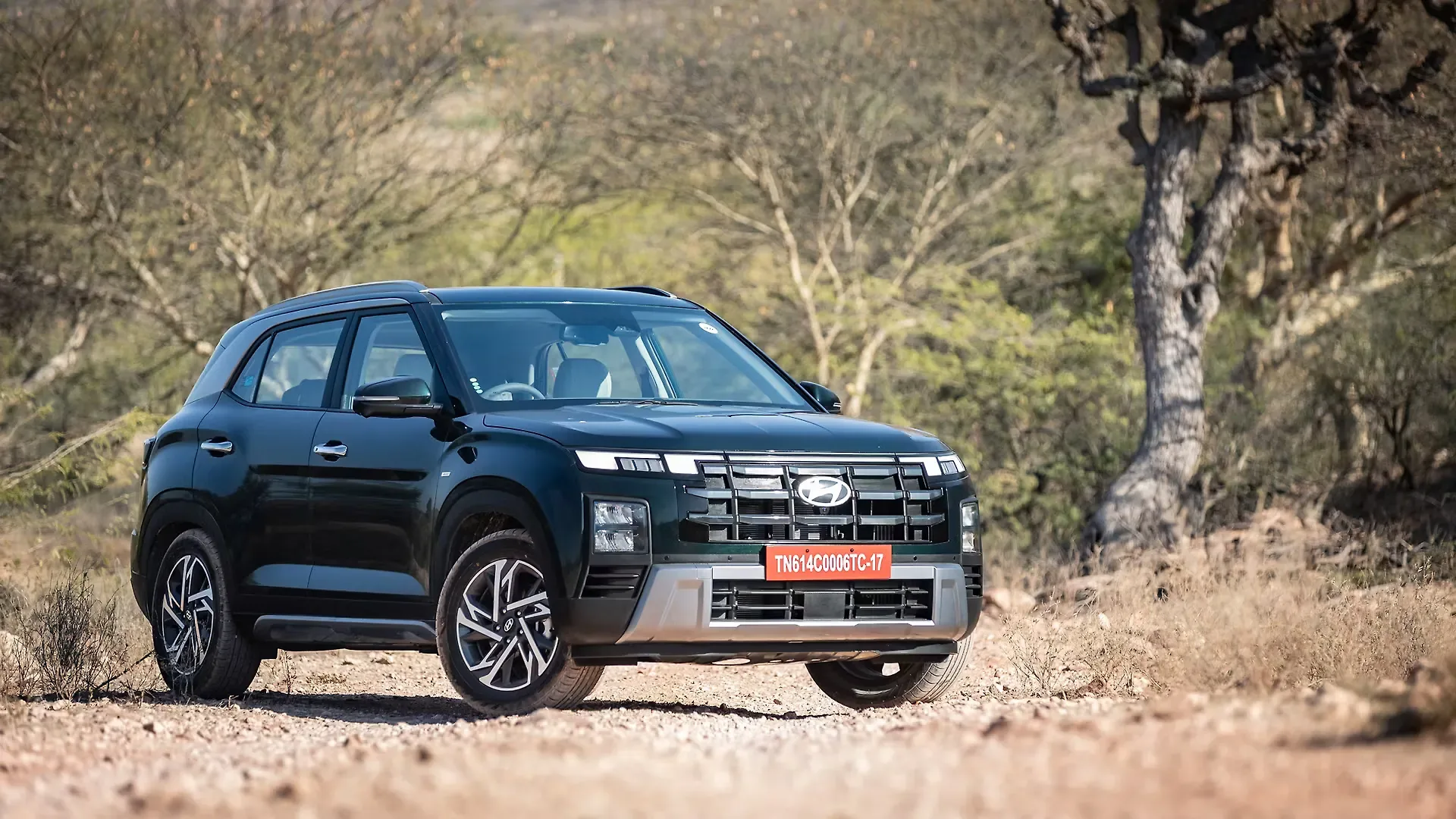
The 2024 Creta facelift adopts a bolder, more Tucson-like front with a split-lamp setup, a slim LED DRL strip on top and chunky main headlamps below, flanked by a large, connected grille. Reviewers agree it has stronger road presence, though opinion is divided: some love the Palisade-inspired aesthetic while others find it polarising. The side profile is largely unchanged with 17-inch diamond-cut alloys on top variants (16-inch on lower trims), roof rails, a shark-fin antenna, and a big panoramic sunroof. At the rear, the connected LED tail-lamps are the biggest visual update, bringing family resemblance with other Hyundai SUVs. Dimensions stay compact at 4.3 m length, 1.8 m width and 1.6 m height. It gets disc brakes on all four wheels. The overall silhouette is clean and well-proportioned, but the design clearly prioritises presence over sportiness, consistent with the Creta's family-SUV positioning.
Inside, the Creta receives its biggest upgrade. A curved, integrated dual-screen layout houses a 10.25-inch touchscreen and a 10.25-inch fully digital instrument cluster, a first for the Creta. The dashboard now uses a grey and light-grey theme, and the flat-bottom D-cut steering wheel carries forward. Feature count is generous: dual-zone climate with physical buttons (not touch), ventilated front seats, 8-way power driver's seat, wireless charging with anti-slip pad, panoramic sunroof with tint, Bose 8-speaker audio, cooled glovebox, and ambient lighting. Rear passengers get AC vents, two Type-C ports, sunblinds, and now three-point seatbelts for all three occupants. The 360-degree camera is a welcome addition. However, reviewers uniformly criticise the hard, shiny plastics throughout, a cost-cutting concern at this price point. The rear seat offers good knee-room and under-thigh support, though the middle passenger gets no headrest. Overall, it feels modern, tech-forward, and premium in ambience if not in tactile quality.
Build quality is a mixed bag. The exterior panels, shut lines, and overall fit-and-finish feel solid and segment-appropriate. Doors thud shut reassuringly and the chassis strengthening is a welcome move from a safety standpoint. Safety equipment is comprehensive: 6 airbags, ESC, hill-start assist, TPMS, all-four disc brakes, three-point seatbelts for all five occupants, and the new Level 2 ADAS suite with front collision warning, adaptive cruise, lane-keep assist, blind-spot monitoring, and rear cross-traffic alert. Global NCAP awarded 3 stars and ASEAN NCAP gave it 5 stars; a Bharat NCAP result is awaited. Where the Creta loses points is interior materials, the hard, shiny plastics on the dashboard, door pads, and centre console feel below the ₹20 lakh price tag and have been flagged by every reviewer. Backlighting on switches is inconsistent, the ORVM on the driver's side lacks a courtesy mirror, and the spare is a 16-inch steel wheel even on 17-inch variants, small cost-cuts that stand out on a flagship trim.
Hyundai offers three 1.5-litre engines. The 1.5 NA petrol (115 PS / 144 Nm) is the volume seller, silent, refined, low-maintenance and paired with a 6-speed manual or IVT CVT. It's adequate for city and casual highway use but struggles above 120 kmph. The 1.5 turbo petrol (160 PS / 253 Nm) with 7-speed DCT is the enthusiast's pick, strong mid-range, paddle shifters, drive modes, and near-2-litre feel, though it's restricted to top variants. The 1.5 diesel (116 PS / 250 Nm) is the long-distance champion, offering excellent torque from 1500 rpm, a light clutch, and claimed efficiency of around 21 kmpl (manual) and 19 kmpl (AT). Reviewers note the diesel AT is slightly noisy and the car feels heavier than the petrol. The turbo petrol DCT and diesel variants both come with three drive modes and three traction modes (Snow/Mud/Sand). A glaring omission is the lack of any hybrid option, which rivals like the Grand Vitara and Hyryder exploit.
The Creta's suspension is tuned on the softer side, which works beautifully for Indian roads, broken patches, potholes and undulations are absorbed with minimal fuss for front occupants. The chassis has been strengthened for the new generation, reducing the bouncy feel of the previous car and making it feel more planted. However, rear-seat passengers still report some bounciness over sharp bumps. Handling is competent but not sporty: the light, easy steering is perfect for city manoeuvring and tight parking, but it lacks feedback at higher speeds and there's noticeable body roll through corners. Reviewers place it behind the Skoda Kushaq and VW Taigun for handling dynamics, while its ride comfort ranks close to the Grand Vitara/Hyryder. High-speed stability is reassuring and the brakes, with discs on all four wheels, are progressive and sure-footed. The ABS calibration has improved notably. It's an SUV tuned for family comfort, not driving thrills, and it executes that brief well.
Pricing spans roughly ₹11 lakh to over ₹20 lakh (ex-showroom varies by variant), placing the Creta squarely against the Kia Seltos, Skoda Kushaq, VW Taigun, MG Astor, Maruti Grand Vitara, Toyota Hyryder, and soon the Tata Curvv. Reviewers agree the mid-to-upper SX and SX(O) variants offer the best value, you get ADAS, the larger screens, ventilated seats, and the 360 camera without pushing past ₹20 lakh. However, strong resale value, a wide service network, 3-year unlimited-kilometre warranty, and proven reliability across 9+ lakh Cretas sold tilt the value equation in Hyundai's favour. Buyers seeking a hybrid or more premium cabin materials should cross-shop rivals. For feature-per-rupee and peace-of-mind ownership, the Creta remains the default recommendation in the segment.
TeamBHP's community has long considered the Creta the benchmark for no-nonsense ownership, strong dealer network, predictable reliability, and excellent resale. Owners praise the diesel manual's highway manners and fuel economy but consistently flag the hard plastics and cost-cutting touches (smaller spare, single backlit switch, no driver-side ORVM mirror) as disappointments at this price. The chassis strengthening and addition of ADAS are seen as overdue but welcome improvements.
"Calls the Creta feature-loaded and easy to drive, but points out polarising design, hard plastics, and a lifeless steering, not an enthusiast's car but perfect for 90% of buyers."
"Praises the new interior, ADAS integration, and multiple engine choices, recommending the SX and SX(O) variants as the sweet spot; notes rear ride is slightly bouncy."
"Drove all four variants and loved the diesel manual and 1.5 turbo DCT; flags the missing hybrid as a big omission and recommends avoiding diesel for low-mileage city users due to DPF issues."
"Highlights the CVT petrol as a silent, efficient performer suitable for most buyers, and rates the Level 2 ADAS, especially front collision avoidance and blind-spot monitoring, as genuinely useful."
"A comprehensive feature walkthrough confirming the Creta's exhaustive equipment list, 3-star Global NCAP / 5-star ASEAN NCAP rating, and 433-litre boot."