 Image: Maruti press kit
A competent first EV from Maruti, but a cramped boot, baffling infotainment ergonomics, and unannounced pricing make waiting for launch details the smart call.
The Maruti Suzuki e Vitara is the brand's first electric car, built on a new platform with BYD-sourced batteries in 49 kWh and 61 kWh forms. It drives smoothly, looks modern, and carries Maruti's 5-star Bharat NCAP credentials, but a tiny 238-litre boot, tight rear headroom and an over-complicated touchscreen-dependent cabin hold it back. With pricing still unannounced a year after its reveal, the e Vitara's fate hinges entirely on how aggressively Maruti positions it against the Creta Electric and Tata Curvv EV.
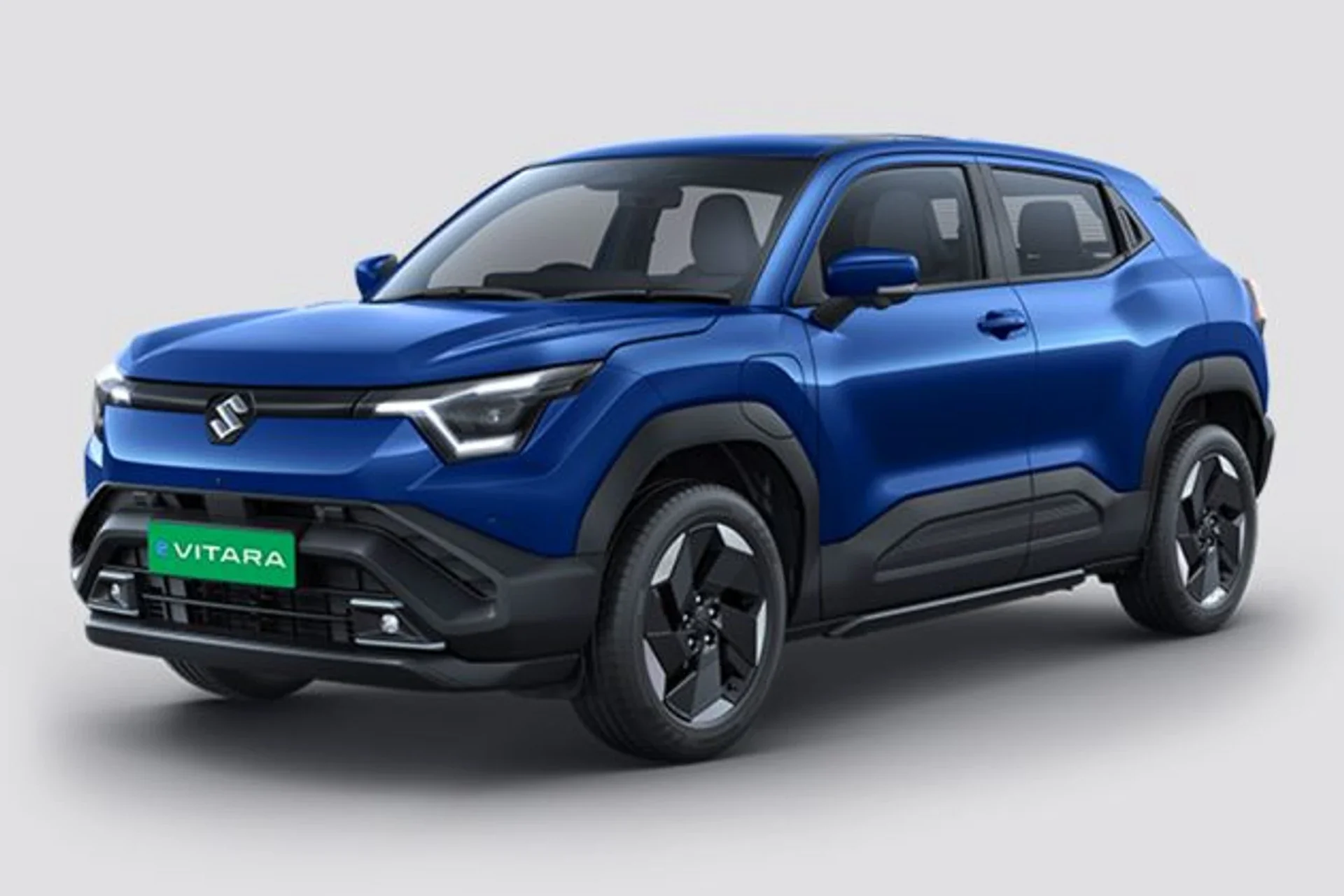
The e Vitara measures 4,275 mm long on a 2,700 mm wheelbase, larger than a Creta on paper, and wears a cleaner, more cohesive design than most recent Marutis. The Y-shaped DRLs, split LED headlamps, active grille shutters and black bumpers create a modern EV face, while hidden rear door handles and body cladding that conceals the battery pack give it a proper SUV stance. Faisal Khan rates it among the best-looking Suzukis in years. India gets 18-inch alloys with aero caps wrapped in 225/55 MRF Wanderer Eco tyres, though global markets get 19-inch wheels. Ground clearance is a modest 185 mm, and the flat underbody is neatly done. Panel gaps and door beading were found to be inconsistent across multiple display cars, a first for Maruti and worth watching at launch. There is a shark-fin antenna, rear spoiler with high-mounted stop lamp, rear wiper, and request sensors on both front doors, but no connected LED tail strip despite the housing suggesting one.
The dashboard is the most premium Maruti has ever built: dual-tone soft-touch materials, a two-spoke steering wheel, twin 10.25-inch and 10.1-inch screens, 12-colour ambient lighting, ventilated front seats, a 10-way powered driver's seat and a fixed panoramic glass roof (not an opening sunroof). Yet the cabin is the car's biggest weakness. Basic functions are buried in menus: turning on seat ventilation needs four taps, changing regen levels means diving into EV settings, and the regen preference resets on every ignition cycle. Three dummy buttons sit on the steering, yet there is no dedicated call-answer button. Rear seat space splits opinion: knee room is good and a 40:20:40 split with proper centre headrest helps, but headroom is tight above 5'8", under-thigh support is poor because of the high floor, and the boot is just 238 litres (306 litres with seats slid forward). A full-size alloy spare, rear AC vents, Type-A and Type-C charging, and ISOFIX are all present.
Fit and finish inside is the best Maruti has managed so far, with soft-touch materials on the upper dashboard, a premium brown treatment, and properly damped door closings. Lower plastics remain hard, the glovebox feels flimsy, and piano black trim scratches and smudges immediately. More worryingly, inconsistent door beading was spotted on multiple display units, and a few sample cars had latches that weren't engaging properly. Feature count is strong: 7 airbags (including a knee airbag), Level 2 ADAS with adaptive cruise, blind-spot monitor, rear cross-traffic alert, 360-degree camera, tyre pressure monitor, wireless Android Auto and Apple CarPlay, wireless charging, Infinity 7-speaker system with subwoofer, PM 2.5 filter, heat pump, and a 5-star Bharat NCAP rating. Glaring omissions include a powered tailgate, a frunk (the bonnet only covers the motor bay), a heads-up display, rear sunshades, ambient lighting for rear passengers, and a dedicated air quality monitor.
India gets two front-wheel-drive configurations: a 49 kWh pack producing 144 PS and a 61 kWh pack producing 174 PS, both making 192.5 Nm of torque. The all-wheel-drive variant with 181 PS and 307 Nm is not offered here. Claimed 0-100 km/h is 8.7 seconds for the larger battery and 9.6 seconds for the smaller one. In practice, the e Vitara drives smoothly and linearly rather than delivering the kick-in-the-pants punch EV buyers expect, with no torque steer and no wheel spin even with ESP off. Amit Khare found it genuinely enjoyable to pedal for a Maruti. Three drive modes (Eco, Normal, Sport) are offered, plus a Snow mode on a separate button. Regen has multiple levels but no true one-pedal driving; the car creeps at 6 km/h even at maximum regen. Top speed is capped at 150 km/h. The BYD blade-cell battery is IP67-rated and supports 70 kW DC fast charging (10-80% in about 45 minutes) and 11 kW AC home charging.
Suspension tuning is clearly biased towards European roads, which shows on Indian surfaces. At low speeds over sharp bumps the ride feels firm and transmits thuds into the cabin, and at higher speeds there is some bounciness over undulations. Over broken patches, rumble strips and expansion joints, cabin noise intrudes more than expected, partly because the glass is on the thinner side and NVH insulation has been cut back. That said, handling is a pleasant surprise: the low centre of gravity, direct steering and tidy body control make it feel lighter than its 1,800 kg kerb weight, and Gagan Choudhary rates it better-handling than most Marutis. Body roll is present but controlled. Ride quality sits below the Tata Curvv EV, roughly on par with or slightly better than the Creta Electric, and comfortably ahead of the MG Windsor. Visibility is good all round except for a slightly thick A-pillar, and the 360-degree camera, while functional, has poor resolution.
Maruti has not announced Indian pricing even a year after the car's reveal. In the UK the e Vitara retails between GBP-equivalent Rs 30 lakh and Rs 36 lakh, but Indian pricing will be significantly lower thanks to local assembly. The direct rival is the Hyundai Creta Electric at Rs 19-26 lakh, with the Tata Curvv EV and MG Windsor EV also in the frame. Ask Car Guru speculates an opening price around Rs 14.5 lakh rising to Rs 18.5 lakh would make it a genuinely compelling package, though that feels optimistic given the BYD battery cost. Maruti may also offer a battery-as-a-service scheme to sharpen the sticker price. The real value proposition is Maruti's service footprint: 2,000 charging points across 1,100 cities at Nexa outlets, a target of one lakh chargers by 2030, and reassurance of parts availability in tier-2 and tier-3 towns where rivals simply aren't present. For many buyers, that network alone will justify the premium.
Enthusiast forums echo the professional reviewers: the e Vitara feels like a genuinely global product with solid underpinnings, but the small boot, fiddly touchscreen interface and delayed launch have dented early confidence. Owners of other Maruti EVs in testing note the brand has clearly prioritised charging-network rollout over pushing the product itself, and most expect pricing to make or break this car against the Creta Electric.
"Calls out Maruti's under-confident launch strategy and flags that efficiency isn't matching expectations, projecting only 330-360 km of real-world highway range from the 61 kWh pack."
"Loves the exterior design and finds it fun to drive thanks to instant torque, but is scathing about the infotainment complexity and the small boot in what is supposed to be a born-electric platform."
"Most positive of the three, praising build quality, safety kit and driving feel, but firmly warns tall buyers about poor headroom and thinks a sub-Rs 19 lakh price is essential."
Compare this car
Tata Nexon EV vs Maruti e Vitara →