 Image: Honda press kit
The 2024 Honda City facelift remains the most well-rounded sedan in its segment, combining a refined petrol powertrain, segment-first ADAS, strong ride and handling, and a 5-star Global NCAP rating.
The 2024 Honda City facelift gets a sportier nose, a new dual-tone alloy design, wireless Apple CarPlay and Android Auto, and crucially Honda Sensing ADAS made available from lower variants. Mechanicals carry over: a 121 PS 1.5-litre i-VTEC petrol with manual or CVT, plus the 126 PS e:HEV strong hybrid. It is the most complete sedan in the segment if you can live without a diesel or turbo-petrol.
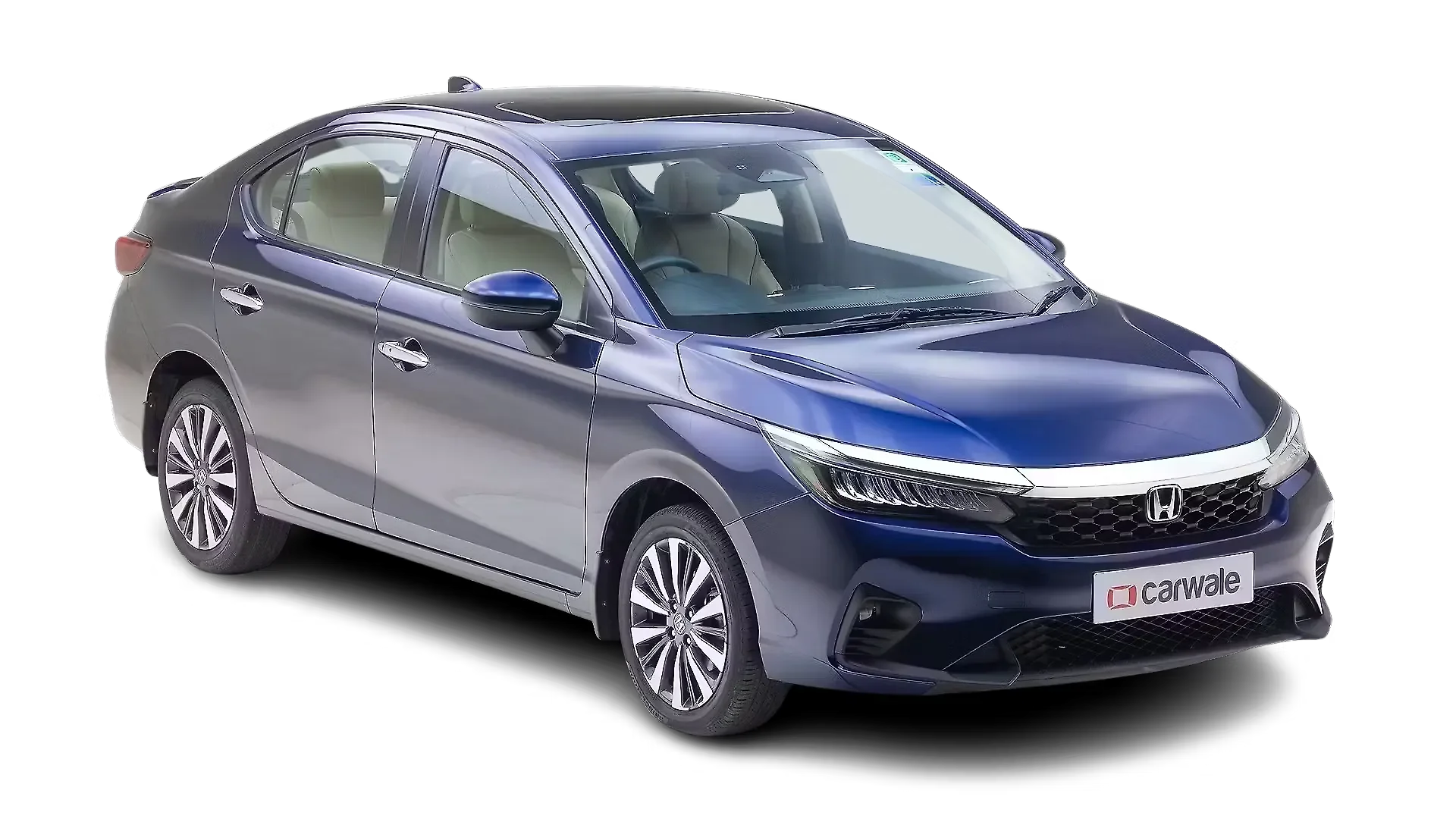
The facelift brings a sharper, more confident face with a new mesh grille, a thick chrome slab up top, redesigned bumpers and a subtle lip spoiler at the rear. Two trim treatments are now offered: Elegant for lower variants and Sporty for the top trims, the latter getting a diffuser-style rear bumper and dual-tone 16-inch alloys wrapped in 185/55 R16 Bridgestone Ecopia rubber. The new Obsidian Blue shade suits the sportier styling, while LED headlamps, LED fog lamps and slim LED tail-lamps carry over. The e:HEV gets a discreet hybrid blue Honda badge and an 'e' boot badge to distinguish it. As Namaste Car notes, the silhouette remains clean and proportionate; this is a sedan that looks like a sedan, with no SUV-aping pretensions. Lower variants make do with 15-inch wheels and steel spares. It is evolutionary rather than revolutionary, but the City now looks more contemporary alongside the Verna, Slavia and Virtus.
The cabin layout carries over largely unchanged, which means a clean, horizontal dashboard, a part-digital part-analogue 7-inch TFT instrument cluster on top variants, and one of the more ergonomic driving positions in the segment. Updates are subtle but useful: the 8-inch infotainment now supports wireless Apple CarPlay and Android Auto, screen resolution has improved for better sunlight visibility, and a removable wireless charging tray slots into the cup holder area. Ambient lighting and a rain-sensing wiper are new additions. Seats remain a highlight: well-bolstered, generously cushioned, with a leatherette-fabric mix on top trims. Rear knee room and headroom are adequate even for six-footers, three proper three-point belts and three headrests are standard, and ISOFIX is included. Niggles persist: there is no USB-C, no ventilated seats, no electric driver seat, the camera feed quality is merely average, and the e:HEV's boot is shallower because the battery sits under the rear seat. Overall fit and finish edges ahead of the Verna in feel, if not in flamboyance.
The City retains its 5-star Global NCAP rating, with six airbags, ABS with EBD, ESC, hill hold assist, ISOFIX mounts, three rear three-point seatbelts and three rear headrests as standard. The facelift's headline addition is Honda Sensing ADAS, now available from mid variants and making this among the most affordable ADAS-equipped cars in India. The system is camera-based rather than radar-based, which keeps costs down but means performance can degrade in heavy fog, rain or low light. Adaptive cruise control, lane keep assist, lane departure warning, auto high beam and forward collision warning are all included, and Faisal Khan rates the calibration as non-intrusive and genuinely useful. On the manual, adaptive cruise control disengages below roughly 30-40 kmph since the gear must be downshifted manually. Notable omissions persist: no electric parking brake on the petrol (only on e:HEV), no 360-degree camera, no ventilated seats, no fully digital cluster, and the spare is a steel wheel.
Two powertrains continue. The 1.5-litre i-VTEC naturally aspirated petrol produces 121 PS and 145 Nm, paired with a 6-speed manual or a CVT. The engine is a Honda hallmark: smooth, refined, and willing to rev cleanly to its 7,000 rpm redline, with a genuinely enjoyable note up top. The manual is the enthusiast's pick and is meaningfully quicker than the CVT, which suffers from the typical rubber-band response under hard acceleration but settles into a relaxed, efficient cruiser otherwise. The e:HEV strong hybrid pairs a 1.5-litre Atkinson-cycle engine with an electric motor for a combined 126 PS and 253 Nm, driven primarily by the motor in the city and by the engine on the highway, with seamless transitions and regenerative braking via paddles. Top speed for the petrol is around 160 kmph and the fuel tank is a modest 40 litres. The glaring absence remains: no diesel and no turbo-petrol, both of which rivals like the Slavia, Virtus and Verna offer.
This is where the City genuinely outshines its rivals. The suspension tuning strikes an exceptional balance: pliant enough to absorb broken Indian tarmac, speed breakers and expansion joints with composure, yet tied down enough to feel planted and confident at triple-digit speeds. The steering is light and easy at parking pace but weights up progressively and offers genuine feedback through fast corners, something the segment often gets wrong. Body roll is well controlled for a sedan of this size, and as MotorOctane observes, even badly executed speed breakers do not unsettle the cabin. The 185/55 R16 Bridgestone Ecopia tyres prioritise comfort and efficiency over outright grip, but they suit the car's character. The e:HEV does feel slightly firmer when fully loaded due to the added battery weight, and the soft-compound rubber demands restraint over sharp-edged potholes. Highway stability is excellent and NVH is largely well controlled, though the manual variant transmits marginally more engine noise into the cabin than the CVT.
Honda has priced the facelift sharply. The petrol range starts around Rs 11.71 lakh ex-showroom and the e:HEV sits at a roughly Rs 1.5 lakh premium over the equivalent petrol CVT, landing at approximately Rs 18-23 lakh on-road for the top trim depending on city. Aggressive pricing is, in fact, the sedan's calling card: Faisal Khan calculates the City ZX MT can be had for very close to the equivalent Elevate, making it one of the better value propositions in its bracket. The petrol CVT delivered a tested 18.7 kmpl over a 200 km mixed run in MotorBeam's test, while the e:HEV touches 21-22 kmpl in city conditions, the kind of figures that justify its premium for urban-heavy buyers. Against the Slavia and Virtus 1.5 TSI, the City loses on outright performance but wins on refinement, hybrid availability and ADAS pricing. The 8-year/1.6 lakh km hybrid battery warranty further sweetens the e:HEV case.
TeamBHP's owner community continues to rate the City highly for long-term reliability, low running costs and Honda's well-known mechanical robustness, with the 1.5 i-VTEC widely regarded as one of the most stress-free petrol engines in the segment. Forum members do flag the soft-compound Bridgestone Ecopias as wear-prone over Indian road conditions and recommend a higher-profile replacement at first change. The e:HEV has drawn praise for real-world fuel economy but caution on the reduced boot and battery longevity beyond the warranty period.
"Calls the City a no-nonsense sedan let down by missing features and a single engine option, but rescued by aggressive pricing and the brilliant manual gearbox; recommends the ZX MT as the value pick."
"Declares it the best sedan money can buy in this price bracket, citing comfort, ride-handling balance, the now segment-affordable ADAS and Honda's dependable refinement."
"Recommends the e:HEV for buyers who want maximum efficiency and the latest features, calling it a bang-on product despite a roughly Rs 22-23 lakh on-road sticker."
"Highlights the e:HEV's 124 hp combined output, 172.8V lithium battery and Thailand-built power control unit, presenting it as a tech-forward, well-equipped hybrid sedan."
"Verified 18.7 kmpl real-world economy on the petrol CVT over 200 km, judging the facelift's changes minor but meaningful, with seats and rear-seat comfort ranking best in segment."