 Image: Skoda press kit
A genuinely fun, practical and safe sedan with class-leading dynamics, though feature gaps and pricing keep it from being a slam-dunk over the Honda City and Volkswagen Virtus.
The Skoda Slavia is a driver's sedan in a market that has all but forgotten the body style. With a class-leading 179 mm of ground clearance, a 5-star crash rating, and a brilliant 1.5 TSI engine making 150 PS and 250 Nm, it punches well above its segment. The trade-off: a cabin and feature list that don't quite justify the near 20 lakh price tag of the top variants.
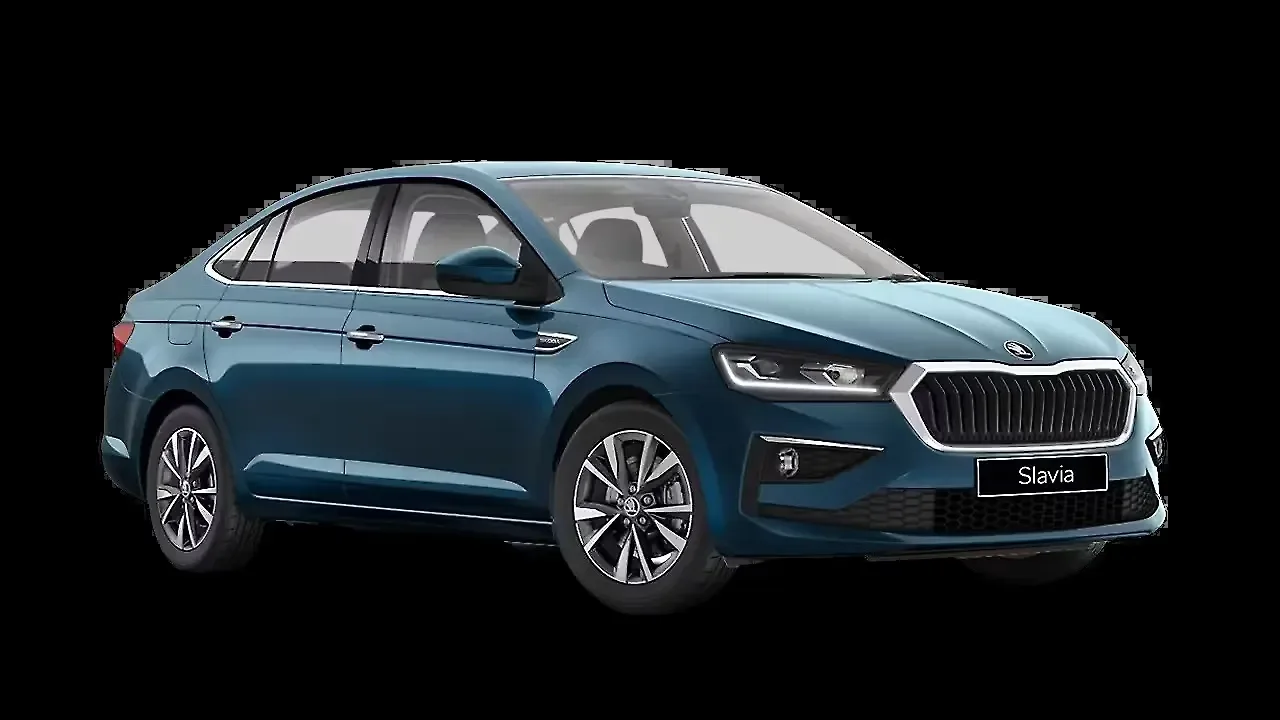
The Slavia plays the elegant sedan card better than most, with crisp Skoda surfacing, a slim grille and that distinctive crystalline lighting signature. Faisal Khan's long-term Elegance variant in black, with subtle badging on the B-pillar and aluminium scuff plates, shows how well the design ages. There are issues, though. The crystalline elements are partly halogen at a near 20 lakh price point, and Skoda has not bothered to visually differentiate the more powerful 1.5 TSI from the 1.0, the only giveaway being the dual-tip exhaust at the rear and the badging. The high-set stance, a consequence of that 179 mm ground clearance, slightly disrupts the low-slung sedan flow but pays dividends on Indian roads. Compared to the Volkswagen Virtus, which uses the shared MQB-A0 IN platform with sharper detailing, the Slavia looks like a slightly under-cooked execution of the same idea. It is handsome on its own terms; it just isn't as showy as a Skoda this expensive should be.
Step inside and the Slavia feels typically Skoda: simple, well laid-out, function over flash. The two-spoke steering, ventilated front seats, and well-bolstered chairs front and rear are the highlights, and the seating position is spot-on. Rear-seat space is good for two adults with adequate legroom, an adjustable middle headrest and a three-point belt, though under-thigh support is average and there is no sunroof at the back. The dark-only theme does not feel claustrophobic thanks to a large glass area. However, the cabin is where the Slavia's premium pretensions wobble. Hard plastics dominate, panel gaps are visible, some bits creak, and the material around the seats looks industrial. The 10.1-inch infotainment is functional but not the slickest, the reversing camera quality is poor and ventilated seats are loud in operation. Storage, on the other hand, is brilliant: the door bins swallow 2-litre bottles, the glove box is huge and cooled, and there is a smartphone pocket on the seat backs. It's a cabin that prioritises usability over wow factor.
The Slavia's structural integrity is beyond doubt: a 5-star Global NCAP rating for both adult and child occupant protection is a strong reassurance for Indian families. Paint quality, even in bright reds, has held up well over thousands of kilometres, with MotorOctane's long-term car showing no fading or scratch issues after a year. The metallic thud when you close the door feels reassuring. But there is genuine room for improvement. Hard plastics are everywhere, the boot lid lacks a multi-position spring and slams shut faster than expected, and the elastic strings on door pockets have been quietly removed. The driver's sun visor doesn't get a vanity mirror, the TPMS only alerts on air loss rather than showing live pressures, and the rear brakes use drums on a 150 PS car. On the feature front, the simply clever touches are charming: ticket holder, smart grip mat, card pockets and request sensors on both front doors. But missing kit like ADAS, electric parking brake, front parking sensors and 64-colour ambient lighting hurt against the Hyundai Verna.
This is where the Slavia earns its keep. The 1.5 TSI Evo makes 150 PS and 250 Nm, paired with either a slick 6-speed manual or a 7-speed DSG. Gagan Choudhary's drive of the manual underlines just how flexible this engine is, pulling cleanly from 1500 rpm right up to 6000 rpm with a sweet exhaust note past 3000 rpm. The DSG runs 0-100 km/h in 8.4 seconds, the manual is 0.3 seconds quicker, and the Active Cylinder Technology shuts down two cylinders during steady cruising to deliver 16-20 km/l on the highway. City efficiency drops to 7-11 km/l depending on traffic. The 1.0 TSI is no slouch either, but the bigger engine simply feels more effortless. Niggles? The DSG can hesitate between 10-30 km/h, the start-stop kicks in too eagerly in bumper-to-bumper crawl, and there is no launch control. Turbo lag is better contained on the automatic. For enthusiasts, the manual is the one to have, even if the Slavia isn't quite as sharp as the old Skoda Rapid.
If there is one thing every reviewer agrees on, it is that the Slavia rides and handles brilliantly for the segment. The suspension is set up softer than the Kushaq's, which means it soaks up sharp potholes and broken patches with composure that genuinely feels a class above. The 179 mm ground clearance, class-leading in this segment, means owners have taken Slavias to Ladakh and through patches where Innovas have grounded out. There is some body roll thanks to the height and softer setup, but body control on twisty roads remains impressive and the steering weights up nicely as speeds rise. Arun Panwar's quick brake test confirms the stopping power is strong even at triple-digit speeds, despite rear drums. NVH is well managed, though the engine note is louder than equivalent Japanese and Korean rivals like the Honda City, something some buyers love and others find intrusive. The forward visibility is slightly hampered by the dashboard vents in bright sunlight. Overall, this is the most rewarding sedan to drive in its class.
Pricing is where the Slavia gets uncomfortable. The top 1.5 DSG Style sits at around 22 lakh on-road, putting it in direct competition with the Hyundai Verna Turbo (which now packs a 160 PS 1.5 turbo plus ADAS, electric parking brake and bigger screens) and the Honda City (smoother NA hybrid, better after-sales). The Volkswagen Virtus, its mechanical twin, often arrives at sharper detailing for similar money. MotorBeam recommends the Ambition variant as the value-for-money pick, around 2-2.5 lakh cheaper than the top trim while keeping the essentials, while the 1.0 TSI offers most of the driving fun at a roughly 2 lakh saving. Skoda's after-sales reputation, while improved, still trails Hyundai and Honda, and upkeep on a turbo-petrol with DSG will not be cheap long-term. The lack of a diesel option, in line with the segment, means highway-heavy buyers must accept that 16-20 km/l on cruise. As a driver's sedan, the Slavia justifies the spend; as a feature-loaded family car, it leaves money on the table.
TeamBHP's owner community echoes the long-term findings here: paint and structural quality are highlights, and the 1.5 TSI with cylinder deactivation genuinely delivers on highway efficiency. Recurring niggles flagged by owners include AC performance in peak summer (now reportedly addressed by Skoda), wireless Apple CarPlay disconnects, the auto-up driver window not closing fully on a single tap, and weak ventilated seat fans. Long-term running costs have settled at roughly Rs 9-9.5 per km on petrol.
"Frames the Slavia in the context of Skoda's Indian sedan legacy, noting that the brand's value proposition has eroded as prices have crept towards entry-luxury territory."
"After 9000 km of long-term use, calls out the Slavia's paint quality and ride as standout but flags an over-eager start-stop, a single-stage boot spring and a noisy ventilated seat fan."
"Recommends the Ambition variant as the value pick and confirms 16-20 km/l on the highway thanks to cylinder deactivation, though the city figure drops to 8-9 km/l."
"A short, real-world brake and speed test that praises the Slavia's stopping power at high speeds despite the controversial rear drum setup."
"Argues the Slavia is European enough but not Skoda enough, noting that the cabin should feel plusher and more special at this price point."