 Image: Volkswagen press kit
A genuinely fun-to-drive sedan with class-leading safety and build, let down only by a feature-light cabin and patchy after-sales perception.
The Volkswagen Virtus is a driver-focused mid-size sedan that punches well above its weight on the highway, backed by a 5-star Global NCAP rating and the trademark German solidity. Two turbo-petrol engines, sharp handling, and a cavernous 521-litre boot make it one of the most complete sedans on sale, even if the cabin tech and feature list trail Japanese and Korean rivals.
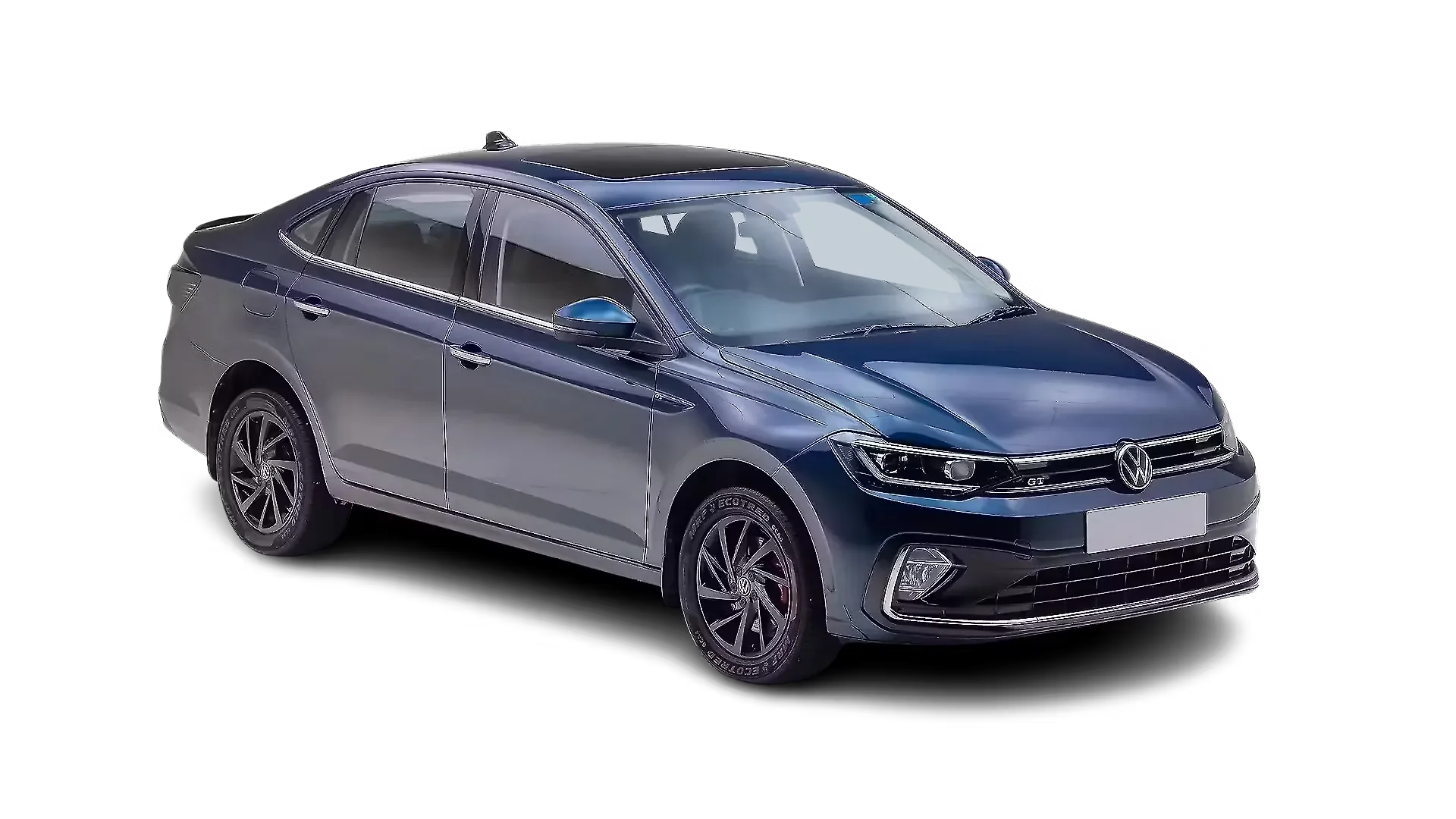
The Virtus is the rare sub-4.5-metre sedan that actually looks like a proper three-box car rather than a stretched hatchback. The long bonnet, sharp LED DRLs and the chrome-laced grille give it a planted, mature stance, while the GT trim's blacked-out alloys, red brake calipers and bootlid lip add the racier flavour Volkswagen reserves for enthusiasts. Namaste Car notes the 4.5-metre length, 1500mm height and a generous 179mm ground clearance, the last of which genuinely matters on Indian speed-breakers and rural roads. The 16-inch alloys look slightly small in the wheel arches on the GT, but proportions are otherwise spot on. The split LED tail-lamps, shark-fin antenna and rain-sensing wipers complete a design that feels classy rather than flashy. There is criticism, though: the side profile is near-identical to the Skoda Slavia, and the rear styling is polarising. Overall it is a sedan that has aged better than most of its 2022-era contemporaries, and still looks fresh in 2025.
Step inside and the Virtus delivers a mixed bag. The dashboard is dominated by a 10-inch touchscreen with wireless Apple CarPlay and Android Auto that, refreshingly, does not lag, paired with a customisable digital instrument cluster, ventilated front seats, wireless charging and a clutch of Type-C ports across both rows. The driving position is excellent, the seats offer genuine bolstering for spirited driving, and the 8-speaker system is competent. However, the cabin's biggest weakness is also obvious: too many hard plastics, dull colour tones, and a feature list that trails the Honda City and Hyundai Verna. As Namaste Car points out, basic functions like cutting a phone call require multiple toggles, the steering misses a mute button, and several settings reset on each ignition cycle. Rear-seat space is generous in knee-room, but the higher cushion and absent sunshades mean taller passengers and chauffeur-driven buyers may find it less accommodating than the City. The 521-litre boot, however, is genuinely cavernous.
Build quality is the Virtus's headline strength. It scored a full 5 stars for both adult and child occupants in the Global NCAP crash test, with examiners specifically praising the standard side airbags, ISOFIX mounts and ESP. Even base variants get an electronic differential lock, multi-collision braking and disc-brake wiping, features rivals reserve for top trims or skip entirely. The doors close with a reassuring thud, panel gaps are tight, and the four-year/100,000km warranty offers peace of mind. Ownership feedback aggregated from long-term tests confirms the car can sustain triple-digit speeds for hours without complaint. Where the package falters is feature depth: there is no 360-degree camera, no electric seats, no rear sunshades, and the AC compressor disengages above roughly 3800rpm to protect the engine, a quirk that becomes noticeable in 40-plus-degree summers. The Virtus also gets My Volkswagen Connect with geo-fencing, SOS alerts and live tracking as a three-year complimentary subscription.
Performance is where the Virtus truly justifies its badge. The 1.0-litre three-cylinder TSI makes 115hp and 178Nm, and despite the cylinder count it feels astonishingly quick: Faisal Khan recorded a verified 204 km/h on the Natrax high-speed bowl, and the engine remained refined and composed even after 24 hours of continuous flat-out running, setting national distance records. The six-speed manual is light and slick; the six-speed torque-converter automatic is smooth in town but feels lazy under hard throttle and is the weakest powertrain combination in the line-up. Step up to the 1.5 TSI EVO with cylinder deactivation, 150hp, 250Nm and the seven-speed DSG, and the Virtus transforms into a genuine warm sedan with a strong mid-range, fast paddle-shifts and an addictive engine note. Below 2000rpm there is mild turbo lag on both engines, but once on boost the response is immediate. For most buyers the 1.0 TSI manual is the sweet spot; enthusiasts should not look beyond the 1.5 DSG.
The Virtus rides on a McPherson strut front and twist-beam rear setup that has been retuned for Indian roads, and the result is one of the best-balanced chassis in the segment. High-speed stability is exceptional, the steering is light at parking speeds yet weights up nicely on the highway, and broken patches are absorbed without sending jolts into the cabin. The MotorOctane long-term test, which clocked over 10,500km in four months across city commutes and trips to Rajasthan and Maharashtra, confirms the suspension never feels crashy despite Volkswagen's reputation for stiffness. Rear passengers do notice firmer damping over sharp bumps, and the Virtus is more composed over potholes than its Taigun SUV sibling. Body control through corners is genuinely entertaining, and NVH levels are strong, with road and engine noise well-isolated. The only quibble is the lack of a sport steering mode for the 1.5 GT, which feels like a missed opportunity given the engine's capability.
Pricing for the Virtus runs from approximately Rs. 13.59 lakh to Rs. 21.90 lakh on-road in Mumbai, putting it in direct contention with the Honda City, Hyundai Verna and its own platform-twin Skoda Slavia. The 1.0 TSI manual is the volume seller and offers the best value; the 1.5 TSI DSG GT, while expensive due to its imported powertrain, is the enthusiast's choice. Real-world fuel efficiency varies widely: 11-12 kmpl in city and 16-18 kmpl on highway for the 1.0 TSI in moderate driving, dropping to 9-10 kmpl in dense city traffic with the automatic. The 1.5 with cylinder deactivation can stretch to 18 kmpl on a gentle highway run. Long-term running costs are reasonable at around Rs. 8 per km. The case against the Virtus is simply that the Honda City offers a more feature-rich cabin, while the Verna offers ADAS at this price. Buyers seeking driving pleasure, safety and German solidity, however, will find few rivals.
TeamBHP's owner community has consistently praised the Virtus for its high-speed stability, build quality and the willingness of both TSI engines, while flagging the 1.0 TSI automatic's hesitation, occasional DSG service costs and Volkswagen India's variable after-sales experience as the chief ownership concerns. Long-term reports echo the YouTube findings: real-world city efficiency in the 9-12 kmpl range, highway figures of 16-18 kmpl, and a chassis that genuinely improves the more you drive it. Most owners recommend buying an extended warranty and a service pack upfront.
"After 10,500km in four months, calls the 1.0 TSI manual the team's favourite long-term car, citing build, safety and fun-to-drive nature."
"Verified 204 km/h on the Natrax bowl in the 1.0 TSI manual and helped set a national 24-hour distance record, calling the engine's refinement astonishing for a three-cylinder."
"Prefers the 1.5 DSG for its broader powerband but flags the AC compressor cut-off above 3800rpm and the lack of a sport steering mode as missed opportunities."
"Highlights the engine response and exterior design as standout traits in a brief walkaround."
"Argues the Virtus 1.5 GT is not for everyone but is the right pick for buyers who want German handling and an emotional connection over feature-count."
"Detailed walkaround highlights the 521-litre boot, 179mm ground clearance, 5-star Global NCAP rating and the comprehensive standard safety kit."
"Notes the 1.0 TSI delivered just 7-8 kmpl in heavy bumper-to-bumper traffic, a reality check on the claimed figures."
"After a month and 1000km with the 1.0 TSI automatic top-line, reports 9.5 kmpl city and 16 kmpl highway, with a running cost of around Rs. 8 per km."