 Image: Volkswagen press kit
A driver-focused, solidly built compact SUV with class-leading safety and engines, held back only by feature gaps and a firm low-speed ride.
The 2025 Volkswagen Taigun facelift sharpens an already competent compact SUV with a refreshed face, an 8-speed torque converter for the 1.0 TSI, an improved variable-displacement AC, and minor cabin updates. Priced from around Rs 13 lakh to Rs 22.83 lakh, it remains the segment's driver's car with bulletproof build quality, a five-star Global NCAP rating and two stellar TSI engines. It loses ground only on outright features and big-city low-speed comfort.
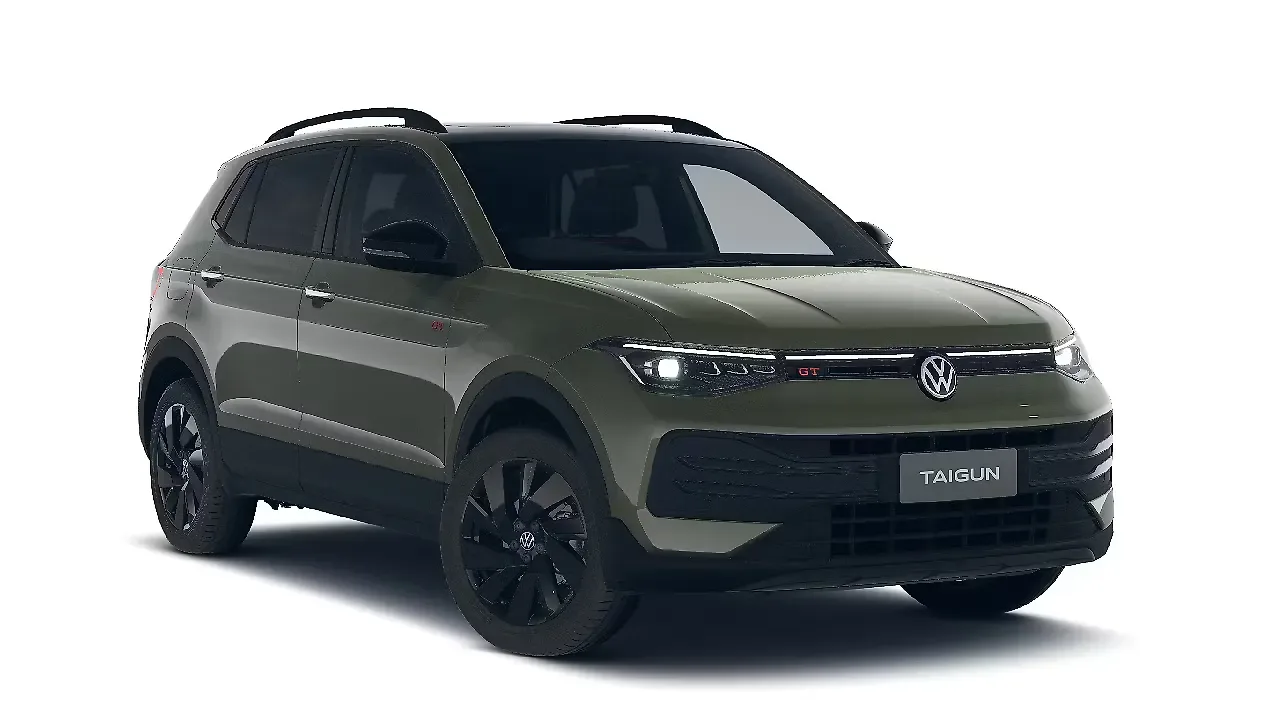
The facelift brings the Taigun in line with global Volkswagen design through a connected LED light bar, an illuminated VW logo, new LED headlamps with auto-levelling and integrated all-weather lights replacing the front fog lamps. Four front parking sensors, sequential rear indicators and a tweaked bumper round off the visual changes. The silhouette is unchanged: 4.22 metres long, 1.6 metres tall, with a European, slightly upright stance rather than the wide crossover look of the Creta or Seltos. Faisal Khan notes the GT Line variants get red brake calipers, blacked-out alloys, GT badging and dual exhausts, while the regular variants stick with chrome accents. Wheel sizes go up to 17 inches on the GT and 16 inches on lower trims. The new green and a few fresh shades suit the car better than the older red. Alloy designs remain the weak link, looking conservative next to the Kushak and Seltos.
Inside, the Taigun is more handsome than lavish. The dashboard layout, ventilated front seats, wireless charging, panoramic sunroof on the top variant, six-way powered driver seat and updated 10-inch touchscreen with wireless Apple CarPlay and Android Auto cover the basics, and a new 10.25-inch digital instrument cluster with reworked menus is genuinely useful. However, hard plastics dominate the dashboard, door pads and lower cabin, and the rubber wireless charging pad and grey upholstery feel low-rent for a car that tops out near Rs 22.83 lakh on-road. The front seats are among the best in the segment for long drives; the rear is best treated as a four-seater, with adequate knee room but tight shoulder space for three. Boot space is 385 litres with a 60:40 split rear bench. Notable misses include ADAS, a 360-degree camera, rear sunshades, ventilated rear seats and a branded audio system, all of which are now standard on key rivals.
Build quality is where the Taigun pulls clear of every rival. Doors shut with a heavy thud, panel gaps are tight, and the structure feels reassuringly dense, validated by a five-star Global NCAP rating for both adult and child occupant protection. Six airbags, ESC, hill hold, multi-collision braking, three-point seatbelts for all and ISOFIX are standard. The facelift adds front parking sensors, an illuminated VW logo, sequential rear indicators, an updated MID, tinted windows from the factory, and a variable-displacement AC compressor that finally cools the cabin properly in 42 to 48 degrees Celsius Rajasthan heat. Volkswagen now offers a four-year warranty, four years roadside assistance, three free labour services and a 70 percent buyback after three years under 30,000 km. MotorBeam's long-term ownership flagged occasional infotainment glitches, an inconsistent driver auto-up window, and a DQ200 dry-clutch DSG that can hesitate between 20 and 40 kmph; an extended warranty is strongly advised.
Powertrains remain the Taigun's headline act. The 1.0 TSI three-cylinder turbo petrol makes 115 PS and 178 Nm and is now offered with a six-speed manual or a new 8-speed Aisin torque converter replacing the older six-speed. The 1.5 TSI EVO four-cylinder produces 150 PS and 250 Nm, paired exclusively with a seven-speed DSG, and features Active Cylinder Technology that shuts down two cylinders under light loads. MotorBeam clocked 0 to 100 kmph in 9.17 seconds with the 1.5 DSG; the 1.0 with the new 8-speed AT manages around 11.4 seconds. The 1.5 is the segment's most rewarding engine: linear, refined past 1,500 rpm, eager to rev, and matched by quick DSG shifts. The 1.0 with the new 8-speed AT is now significantly smoother in stop-go traffic, with the AC no longer cutting out at extreme RPMs. Real-world fuel efficiency runs 10 to 14 kmpl in mixed use, touching 17 to 19 kmpl on a steady highway cruise.
The Taigun rides and handles like a proper European hatchback on stilts. Body control is excellent, the steering is alert and weights up nicely with speed, and high-speed stability inspires confidence well past triple-digit speeds, helped by ground clearance of 188 mm unladen and 158 mm laden. Through corners and twisties, it feels tied down in a way the Creta and Seltos cannot match. The trade-off is a firm low-speed ride: sharp-edged potholes and broken patches register clearly inside the cabin with a noticeable thunk, and Gagan Choudhary points out that some squeaks creep in over flexed surfaces despite the rigid shell. The 1.5 GT, with its slightly stiffer tune, is firmer still. On smoother highways and flowing roads, however, the suspension settles beautifully and the Taigun becomes genuinely entertaining. Buyers in cities with consistently bad roads should test-drive over their daily route before committing.
Pricing runs from roughly Rs 13 lakh ex-showroom for the 1.0 TSI Comfortline to Rs 22.83 lakh for the 1.5 GT Line Sport, with on-road prices on the top variant nudging Rs 25 lakh. The Highline manual at around Rs 16 to 17 lakh is the value sweet spot. Within the Volkswagen group, the Skoda Kushak undercuts the Taigun by around Rs 20,000 across most variants and offers a similar mechanical package. Against the Hyundai Creta and Kia Seltos, the Taigun trades features such as ADAS, 360-degree cameras, ventilated rear seats and panoramic displays for superior build, safety and driving dynamics. The Volkswagen Virtus sedan offers the same engines with a more pliant ride for similar money. Service network coverage remains a genuine concern compared to Hyundai and Kia. Buyers chasing tech and equipment will feel short-changed; buyers who value how a car drives, how safe it is and how it ages will find the Taigun worth every rupee.
TeamBHP owners consistently praise the Taigun's structural integrity, engine refinement and high-speed composure, while flagging the DQ200 DSG's low-speed hesitation and infotainment niggles as known weak spots. The community's standard advice is to opt for the longest extended warranty available and to choose the 1.5 TSI DSG if budget allows, since the powertrain's long-term experience has been overwhelmingly positive on highway-heavy duty cycles.
"The Taigun is the pick for buyers prioritising build quality and driving dynamics, but the lack of an automatic under Rs 15 lakh is a missed opportunity in this segment."
"A focused walk-around of features, dimensions and variants, highlighting the Active Cylinder Technology and the comprehensive connected-car suite."
"After 3,000 km in the long-term 1.5 GT DSG, the engine and handling are addictive but the running cost of around Rs 9 to 10 per km and occasional software glitches need flagging."
"The Taigun is best understood as a compact urban SUV and a brilliant four-seater rather than a five-seater, with the 1.5 TSI being the more sensible choice in city traffic too."
"The 8-speed AT and the new variable-displacement AC are genuine quality-of-life upgrades, but the suspension still thuds over sharp bumps and the steering on the 1.5 could use more weight."
"The 1.5 TSI is segment-defining and the facelift fixes real pain points, but the persistent absence of ADAS, a 360-degree camera and a branded audio system at this price is hard to ignore."