 Image: Kia press kit
A comprehensively updated, feature-loaded urban SUV with proven powertrains and significantly improved ride quality, though it commands a premium price.
The 2025 Kia Seltos arrives on an all-new K3 platform with sharper styling, a triple-screen cockpit, and meaningfully improved ride comfort. Powertrains carry over unchanged: 1.5L NA petrol, 1.5L turbo petrol, and 1.5L diesel. It is the longest car in its segment at 4,545 mm, but the Sierra still beats it on wheelbase and interior space.
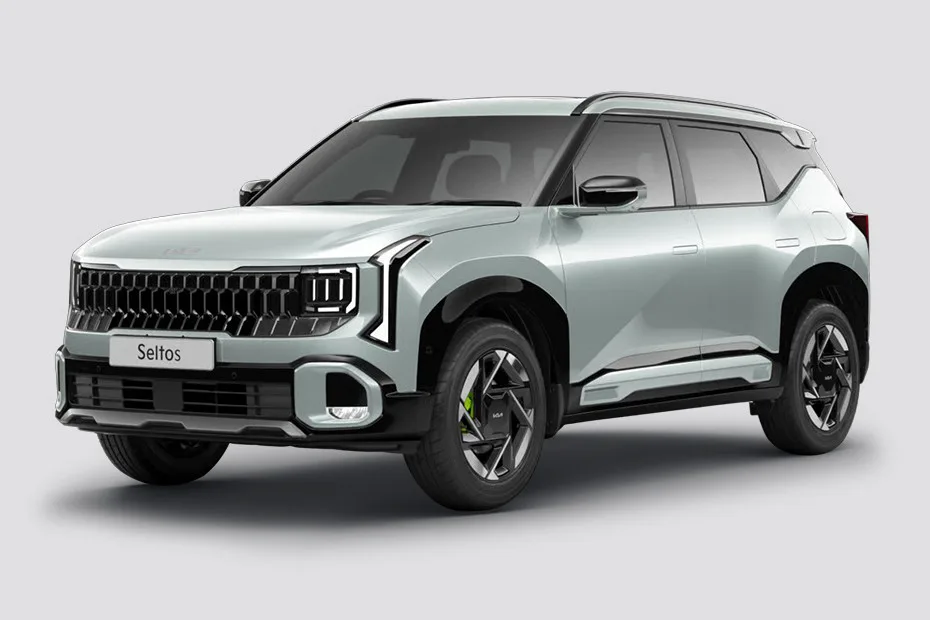
The second-generation Seltos adopts a digital tiger-nose grille with vertical elements, square LED headlight clusters, and a connected LED tail-lamp bar that gives a slight retro-modern vibe up front. At 4,545 mm long, 1,800 mm wide, and on a 2,690 mm wheelbase, it is now the longest car in its segment, though it sits 10 mm lower than before. Auto-flush door handles, a hidden rear wiper-washer like a Range Rover, and gas struts for the bonnet are genuine segment-firsts. The neon-green brake calipers divide opinion: some see them as a sporty signature, others as too loud. Available in 10 solid and two dual-tone colours with four interior themes, the Seltos looks more cohesive in person than in launch images, though boxier rivals like the Sierra appear visually larger despite smaller dimensions on paper.
The cabin is the Seltos's strongest suit. A 30-inch panoramic trinity display, comprising twin 12.3-inch screens flanking a 5-inch climate panel, dominates the dashboard and is supported by genuine tactile buttons for AC, drive modes, and shortcuts: a refreshing contrast to the touch-heavy interiors from Tata and Mahindra. Soft-touch materials cover the upper dashboard and door tops, while plastic quality throughout is consistently high with no rough edges. Pranay Kapoor's owner inputs confirm long-term fit and finish hold up well. The 10-way power driver seat with memory, ventilated front seats, dual-zone climate, head-up display on higher trims, and an 8-speaker Bose system are highlights. Rear seats get sunshades, twin Type-C ports, and AC vents, but no slide, no ventilation, and only a two-step recline. Headroom is adequate, though the dark theme and lower roofline make the cabin feel less voluminous than the Sierra's. Boot space is rated at 447 litres.
Quality is where Kia firmly outpaces the segment. Every touchpoint, from the chunky gear selector to the steering wheel borrowed from the EV6, feels properly engineered, with no loose panels, beading issues, or aftermarket-feeling fitments. Standard safety includes six airbags across all variants, ESC, hill-hold, and 24 standard safety features. The top-spec X-Line gets Level 2 ADAS with 28 features, while the GTX variants tested here run a 21-feature ADAS suite. A 360-degree camera, blind-view monitor on the cluster, six front and six rear parking sensors, and auto-dipping ORVMs that return to the saved position (unlike Tata's implementation) reflect attention to detail. The Hyundai-Kia group has not yet sent the new Seltos for Bharat NCAP or Global NCAP testing, which remains the one open question on safety credentials. Connected car features, OTA updates, valet mode, and a wireless charging pad are standard on higher trims. Notable feature deletions from the older Seltos include the air purifier, sound mood lamp, and ORVM logo projection.
Three carryover engines power the Seltos: a 1.5L NA petrol producing 115 PS and 144 Nm, a 1.5L turbo petrol with 160 PS and 253 Nm, and a 1.5L diesel making 116 PS and 250 Nm. Faisal Khan clocks the turbo petrol from 0-100 km/h in 10.6 seconds via the 7-speed DCT, with the diesel taking 14 seconds and the NA petrol around 13.7 seconds. The turbo petrol is the enthusiast pick: smooth, refined, with a strong mid-range, though the DCT's launch protection eats roughly a second on hard starts and it can feel jerky at crawl speeds. The diesel automatic, paired with a six-speed torque converter, feels slightly strained and adds steering wheel vibration that the manual avoids. Notable absences include a manual gearbox option for the turbo petrol (still IMT only) and any hybrid variant. Real-world fuel economy: 9-12 km/l city and 15-17 km/l highway on turbo petrol; diesel manual hits 17-18 km/l on highways.
The new K3 platform is the biggest mechanical upgrade. Suspension tuning is now distinctly softer, transforming the Seltos from a stiff-riding SUV into a comfortable family cruiser. Bad roads and large potholes are absorbed without the loud clunks the previous Seltos was known for, and NVH levels have improved noticeably. AutoYogi notes that high-speed stability remains good, but Gagan Choudhary observes a slight floaty sensation on undulating roads, a side-effect of the sedan-derived platform underpinning a tall body. Body roll is more pronounced than before, and enthusiastic cornering reveals understeer, particularly on the lighter-steering petrol variants. The diesel's heavier nose gives it marginally better steering weight and composure. Brakes are progressive but the ABS can feel oversensitive. Drive modes (Eco, Normal, Sport) alter throttle response and steering weight but do not change suspension behaviour. Overall, the trade-off favours comfort over sportiness: a deliberate shift that aligns with what most family buyers in this segment actually want.
Pricing has not been officially announced at the time of these reviews, but expectations point to a starting price near 13 lakh ex-showroom and a top-end of around 25 lakh on-road in Mumbai. The HTK(O) variant, as covered by DriveSpark, is positioned at 12.5 lakh ex-showroom and offers the 360-camera, panoramic sunroof, two screens, six airbags, and 16-inch alloys: arguably the value sweet spot. Pranay Kapoor's owner experience on the previous-gen GTX+ shows real-world negotiation can yield 2 lakh discounts at year-end, with insurance and accessory kits worth skipping in favour of third-party options. Service costs run 11,000 to 17,000 rupees annually, on the higher side for the segment. At 25 lakh on-road, the XUV700 and Scorpio-N enter the picture, offering more space and capability. The Seltos justifies its price through quality, refinement, and proven reliability rather than sheer value.
Long-term owner feedback echoes the editorial verdict: the Seltos delivers a refined, reliable ownership experience with strong resale, but service costs trend higher than rivals like Maruti and the wired-only Android Auto on top variants remains a baffling omission at this price. Owners consistently flag the value of skipping dealer-bundled insurance and accessory kits, which can save 60,000 to 1 lakh rupees.
"Calls it a masterstroke from Kia with phenomenal turbo petrol performance, but laments the missing hybrid, no proper manual for the turbo, and removal of features like the air purifier and sound mood lamp."
"Uses a SWOT framework: rates looks, reliability, quality, and feature integration as core strengths; flags unproven crash-test ratings and pricing that pushes into bigger-SUV territory as key weaknesses."
"Declares the cockpit design the best in segment thanks to tactile buttons and intuitive AC controls, but finds rear space underwhelming relative to the Sierra given the dimensions on paper."
"Praises the comprehensive feature update and improved materials but notes three adults cannot sit comfortably at the rear, and questions why Kia retained IMT instead of offering a proper manual with the turbo."
"An 18-month owner of the previous-gen GTX+ confirms zero reliability issues, recommends financing over outright payment for opportunity-cost reasons, and singles out wired-only Android Auto and 12-13 km/l real-world mileage as key gripes."
"Highlights the HTK(O) at 12.5 lakh ex-showroom as the value sweet spot, with surprisingly generous kit including the 360-camera, panoramic sunroof, six airbags, and dual screens."
"Pegs the base petrol manual on-road price near 12.6 lakh post-GST cut, and recommends only an alloy-wheel upgrade to address the base variant's main visual shortcoming."
See also: Creta vs Seltos →