 Image: Mahindra press kit
A feature-loaded, mechanically sorted three-row SUV with proven long-term reliability and strong resale, let down only by thirsty petrol economy and a few glaring feature omissions.
The 2025 Mahindra XUV700 remains one of India's most complete three-row SUVs, offering five powertrain combinations including a rare all-wheel-drive diesel automatic. Updated suspension, a richer feature list, and proven long-term reliability make it a confident buy in the 16 to 33 lakh on-road bracket. Petrol fuel economy and a handful of missing features are the only real chinks in its armour.
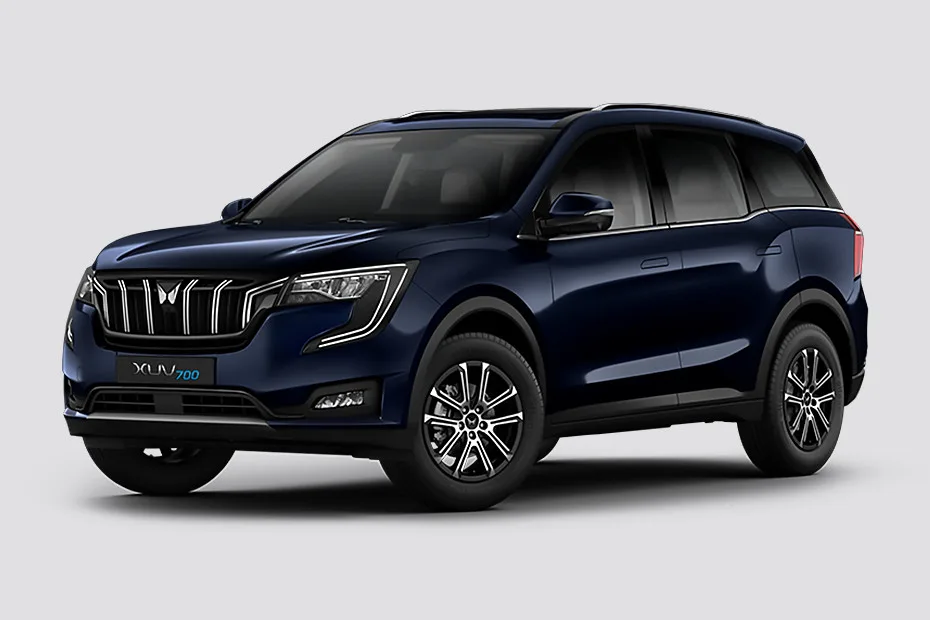
The XUV700 enters 2025 with a Napoli Black edition, dual-tone roof options across all five colours, and blacked-out grille and trim, but dimensions are unchanged: 4.7 m long, 1.9 m wide, 1.7 m tall, with 200 mm of ground clearance and 18-inch alloys on the AX7L. The styling tweaks are evolutionary rather than dramatic. Faisal Khan notes that the Tata Safari's update has leapfrogged the XUV700 on visual drama and feature count, though the Mahindra still looks contemporary with its massive LED DRLs, sequential turn indicators, flush pop-out door handles and shark-fin antenna. Smaller niggles persist: only two rear parking sensors instead of four, the spare wheel is a steel rim rather than an alloy, and the rear gets just bulb-type reverse lights. The overall stance remains imposing and the panoramic sunroof, which spans nearly the entire roof, continues to be a genuine showstopper for Indian buyers shopping in this segment.
The cabin centres on a Mercedes-inspired twin-screen layout (10.25-inch infotainment plus 10.25-inch instrument cluster), now joined by a passenger-side display on top variants. Material quality is generally good, though Gagan Choudhary points out that the bronze, tan, black and dark grey combinations on the dashboard look slightly busy. Seven airbags, ventilated front seats, memory for the driver's seat and ORVMs, wireless Android Auto and CarPlay, a 12-speaker Sony 3D system, and a vast panoramic sunroof headline the equipment list. The omissions sting more in 2025: no auto-dimming IRVM (a feature even the smaller XUV 3XO now gets), no electric tailgate, no rear sunblind, no ventilated second-row seats, only one-touch up/down for the driver's window, and a USB-C port only in the third row. Second-row seats recline but do not slide. Third-row access is easy via a one-touch tumble lever, but knee room and headroom there are best reserved for children or short journeys.
Long-term ownership is where the XUV700 makes its strongest case. A 40,000 km test of an AWD diesel automatic returned no mechanical failures across engine, clutch, brakes or suspension, with cumulative service costs staying under Rs 35,000 thanks to a 20,000 km engine-oil interval. The MotorOctane long-termer reports that interiors have held up well even after rough use, with only minor scratches on piano-black trim and no panel-fit deterioration. Software stability has improved markedly: early infotainment blackouts were resolved through dealer software flashes, and OTA updates continue to add functionality. One parking sensor failed and was replaced free under warranty. Apollo Apterra tyres have proven durable enough to consider replacement only at 50,000 km. The shared engine family with the XUV 3XO, Scorpio-N, BE 6 and XEV 9e means parts availability and service network familiarity are excellent, and resale values remain among the strongest in the segment.
Five powertrain combinations cover almost every buyer profile. The 2.0L mStallion turbo-petrol produces 200 hp and 380 Nm, paired to a 6-speed manual or automatic. The 2.2L mHawk diesel comes in 155 hp and 185 hp tunes, with AWD available on the diesel automatic. The petrol pulls hard and feels exciting; the diesel's wide torque band makes it the better long-distance tool. Refinement is good, though the diesel note filters in at higher revs and the automatic holds gears longer than ideal in Zip mode. The AWD system engages reactively on slip detection: capable on loose surfaces but not a substitute for a true 4x4.
Mahindra switched suspension suppliers for 2025 while retaining frequency-selective damping, and the result is the most meaningful upgrade on this car. The XUV700 now glides over broken tarmac with noticeably less noise and harshness. The cabin stays calm at 100-120 kmph, with only mild wind noise from the A-pillar. Sharp expansion joints can still send a thud, but for 99 percent of Indian road conditions the ride is genuinely impressive. Handling is composed for a 4.7m SUV: body roll is well-controlled, the steering weights up properly past 80 kmph, and the car is stable to its 205 kmph top speed.
Pricing runs from roughly Rs 16.4 lakh for the base MX to about Rs 32.85 lakh on-road Mumbai for the AWD diesel automatic AX7L, with the petrol AX7L tested here at around Rs 30.5 lakh on-road. The 2025 update brings price increases of just Rs 35,000 on the AX7 and Rs 50,000 on the AX7L, with some lower variants actually dropping by Rs 15,000. Waiting periods have eased to under three months for top variants and roughly a month for lower trims. The AX7 trim is widely regarded as the sweet spot, offering most of the meaningful features without the AX7L premium. Namaste Car flags the AWD diesel automatic as the connoisseur's pick. Rivals like the Tata Safari now match or exceed the feature count, and the Jeep Compass top-end undercuts the XUV700 with better engineering but weaker service support. Factor in resale and reliability, and the Mahindra remains the rational choice in this segment.
TeamBHP's long-term ownership threads broadly mirror the findings here: the XUV700 has matured into a reliable, low-fuss product, with most early infotainment glitches resolved through software updates and warranty fixes. Owners particularly praise the AWD diesel automatic for highway touring and report 14 to 17 kmpl on long runs, while flagging the petrol's thirst and the absence of ventilated rear seats as ongoing irritations.
"Recommends the AWD diesel automatic as the variant to buy, but flags the absence of an auto-dimming IRVM and electric tailgate as inexcusable in 2025."
"After 40,000 km of ownership, vouches for the XUV700's reliability, sub-Rs 35,000 cumulative service cost, and 16 to 17 kmpl highway efficiency on the diesel AWD."
"Highlights the improved refinement of the updated monocoque and the second-row space and seat comfort as standout upgrades."
"Calls the new suspension tuning a genuine breakthrough, but feels the dashboard colour combinations look odd and the AX trim is the real value pick."
"Walks through the AX7L feature list in forensic detail and rates the AWD diesel automatic as the most complete variant in the lineup."