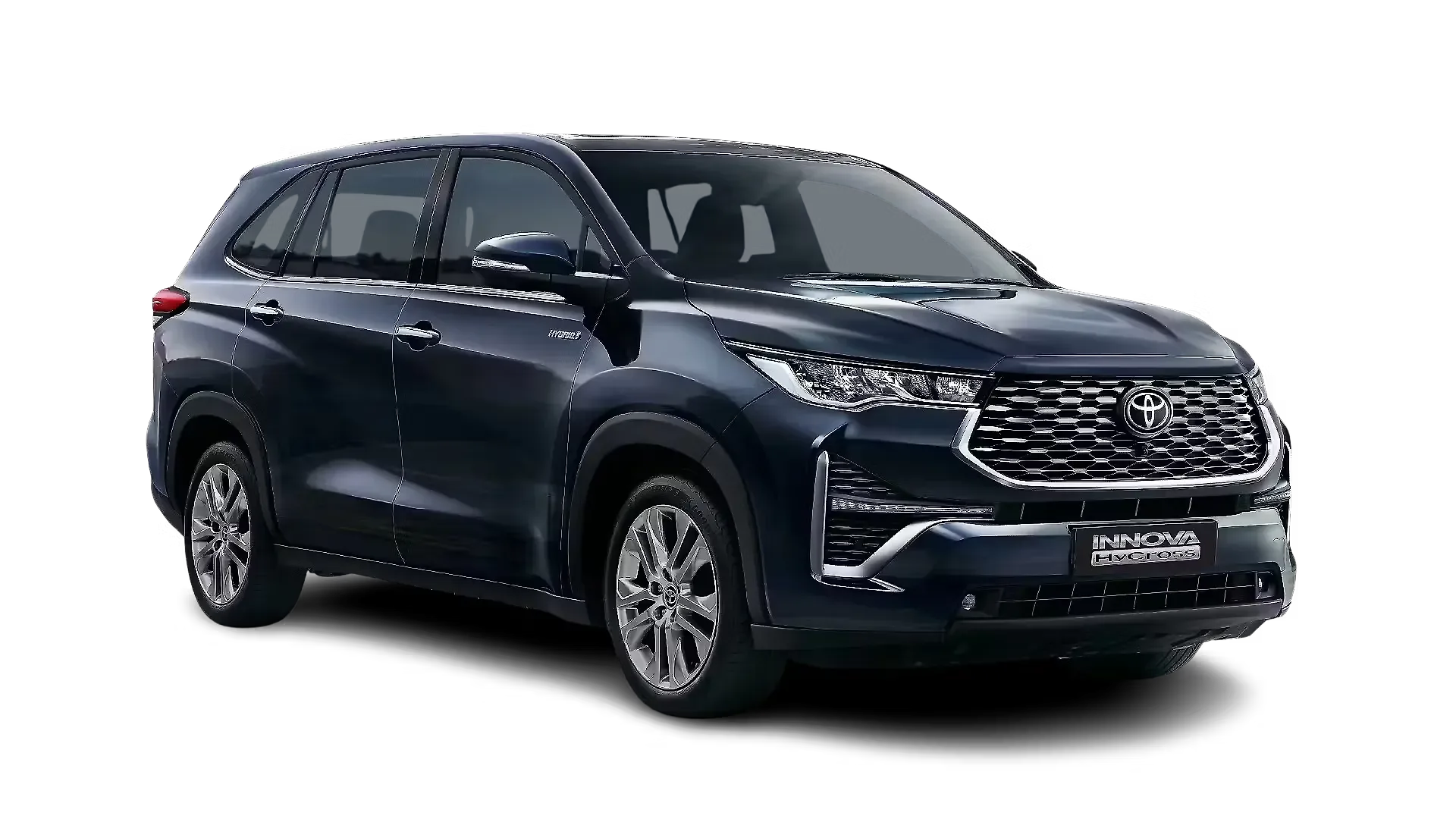
The Toyota Innova HyCross reinvents India's most trusted MPV as a car-like, monocoque, strong-hybrid people mover. With a 2.0-litre Atkinson-cycle petrol engine paired to an electric motor, business-class second-row recliners and 13-16 kmpl real-world efficiency, it sits closer to a luxury limousine than a tool-of-trade. The trade-offs: no diesel, no ladder-frame ruggedness, and a top-trim sticker that brushes Rs 30 lakh.
Jury Score Breakdown
What Works
- Refined, responsive strong-hybrid drivetrain with instant electric torque
- Outstanding fuel economy for a 180 hp, seven-seat MPV
- Plush second-row captain seats with sunshades and dedicated AC
- Composed, settled ride that absorbs broken patches without drama
- Toyota reliability, low maintenance and strong resale value
Watch Out For
- No diesel or manual option for traditional Innova buyers
- Hybrid battery under front seats compromises rear legroom when tall passengers sit up front
- Some plastics, switchgear and the infotainment screen feel below the price point
- Boot space shrinks dramatically with all three rows up; not a true seven-seater for adults
Design
The HyCross looks taller, squarer and more SUV-like than the Crysta it replaces, with a bold trapezoidal grille, slim LED DRLs that double as indicators, integrated radar and 360-degree camera housings, and 18-inch alloys. Most reviewers agree the front and side profiles carry genuine road presence, easily holding their own against luxury cars in a parking lot. Opinion divides at the rear: the flat, slightly stubby tailgate is the weakest angle and feels oddly proportioned for a vehicle this large. The 18-inch wheels are technically sized correctly, but the lower-profile tyres make them appear smaller in the arches than expected. Touches like the Lexus-style chrome strip on the door handles and the request-sensor tailgate add a premium feel. As Gagan Choudhary notes, it is not a head-turner so much as a confident, mature design that grows on you, neither offensive nor exciting, but unmistakably Innova in stance and silhouette.
Interior & Features
Step inside and the HyCross feels like a different vehicle from the Crysta entirely. The dashboard is layered with brushed aluminium-look trim, soft-touch surfaces and a clean, organised layout. The headline act is the second row: powered captain chairs with electrically deployed ottomans that fully recline, sunshades on the rear windows, dedicated rear climate controls and roof-mounted vents. With three rows up, boot space is tight, enough for two cabin bags only. The third row seats two adults in reasonable comfort but is not a genuine three-abreast space. Niggles exist: the 10.1-inch infotainment is functional but not sharp, Android Auto occasionally refuses to connect, the 360-degree camera resolution could be better, ventilated seats are absent at this price, and the steering-wheel switches feel light. The hybrid battery pack sitting under the front seats also eats into rear footwell space when the front seat is pushed back. Overall, however, the cabin ambience punches above the segment norm.
Build Quality & Technology
Build quality is solid and clearly Toyota-grade, with tight panel gaps, thick doors and a sense of long-term durability that the brand is famous for. Soft-touch materials cover key contact points and the brushed-aluminium accents lift the ambience. Yet several touch points fall short of the price tag: certain plastics on the lower dash feel utilitarian, the rear AC vent housings look industrial, and the steering-wheel switchgear feels lighter than expected. Equipment is generous on the ZX trim: ventilated front seats, powered tailgate, panoramic sunroof, JBL audio, wireless charging, ambient lighting, memory seats and a comprehensive Toyota Safety Sense ADAS suite with adaptive cruise, lane-keep assist, pre-collision warning and rear cross-traffic alert. Notable omissions include halogen reverse and number-plate lights at this price, no auto-off for headlamps left on, an electronic parking brake that disengages without seat-belt confirmation, and ADAS settings that reset on every ignition cycle. The connected-car app, however, adds genuine convenience.
Performance & Powertrain
The 2.0-litre Atkinson-cycle petrol engine paired with an electric motor and a 6.5 Ah nickel-metal-hydride battery is the HyCross's defining feature. The system makes around 180 hp combined and channels it through an e-CVT to the front wheels, a complete departure from the rear-wheel-drive Crysta. In daily use, the electric motor handles low-speed crawling silently and instantly, with the petrol engine cutting in seamlessly when load demands it. Refinement is a clear step up over Toyota's smaller 1.5-litre hybrid: there is no stalling sensation, throttle response is linear, and Eco mode is more than adequate for most driving. Push hard and the engine does get vocal, especially with a full load, and outright urgency is modest rather than thrilling. Real-world efficiency lands at 16 kmpl in the city with a light foot and 13-14 kmpl on highways, comfortably better than the old diesel. EV mode exists but switches to petrol the moment battery charge dips, so it is more party trick than practical.
Ride Quality & Handling
Built on Toyota's TNGA-C monocoque platform with independent rear suspension, the HyCross drives unlike any Innova before it. The steering is light at parking speeds, weights up naturally on the highway, and the car turns into corners with composure that genuinely surprises. Over broken patches, expansion joints and small undulations, the suspension stays settled and quiet, with none of the side-to-side rocking the Crysta was known for. The unknown reviewer at kEVXA5t4foM captures it well: you can work on your phone in the back seat without feeling tossed about. The trade-off comes on really bad roads: deep craters and large speed-breakers expose the loss of ladder-frame robustness, and the car feels less indestructible than its predecessor. Ground clearance remains adequate for Indian conditions, and the suspension can take a hammering, but rough-road duty is no longer the natural habitat. Braking is strong, ADAS works unobtrusively, and adaptive cruise control is genuinely usable on expressways.
Price & Value
Pricing runs from roughly Rs 19 lakh for the entry hybrid trims to about Rs 30 lakh for the top ZX(O) variant, ex-showroom. That is a clear premium over the Crysta and pushes into territory occupied by the Toyota Fortuner and seven-seat SUVs like the Mahindra XUV700. The MotorBeam owner comparison with the XUV700 highlights the trade-off neatly: the Mahindra offers diesel torque and a tougher chassis for less money, while the HyCross counters with hybrid efficiency, smoother refinement and Toyota's well-known reliability. Running costs are the HyCross's trump card: 16 kmpl city efficiency, petrol engine that runs on Atkinson cycle with low stress, and projected service costs lower than the diesel Crysta. Resale value, historically Innova's strongest suit, is expected to remain class-leading. For buyers who keep cars 8-10 years and clock 15,000-plus kilometres annually, the math works. For weekend warriors heading to the hills, the Fortuner remains the smarter Toyota.
What India's Reviewers Agree On
Consensus
- Strong-hybrid powertrain delivers 13-16 kmpl real-world, better than the older Innova diesel
- Ride quality and handling feel car-like, a dramatic shift from the Crysta's bouncy MPV character
- Second-row captain seats with powered ottoman recliners offer genuine business-class comfort
- Cabin space, visibility and 360-degree camera make it easy to drive despite the size
- Reliability and resale are expected to remain Toyota-strong, with low running costs
Points of Disagreement
- Whether the loss of ladder-frame chassis and rear-wheel drive matters: some see it as a maturity upgrade, others miss the Crysta's tank-like ruggedness for rough roads
- Cabin perception splits opinion: some find the dashboard premium and well-organised, others call materials industrial and switchgear flimsy for the price
TeamBHP's Take
TeamBHP owners and long-term testers consistently rate the HyCross as the most refined Innova ever, praising the hybrid system's smoothness and real-world 15-17 kmpl efficiency in mixed driving. The community flags genuine concerns around the loss of ladder-frame durability for rural use, occasional Android Auto connectivity glitches, and waiting periods that have stretched well beyond a year for the ZX hybrid trims.
Individual Reviewer Verdicts
"After 1,800 km of mixed driving, calls it a fantastic product that no longer feels like an Innova at all, with car-like handling and surprisingly composed ride being the standout improvements."
"Walks through the top ZX trim at around Rs 30 lakh, highlighting the strong-hybrid drivetrain, JBL audio, 360-degree camera and connected-car features as genuine value adds."
"Calls it possibly the best car in the country today, a limousine in an SUV wrapped in an MPV, while flagging that it is genuinely a four to six-seater rather than a true seven-seater."
"An owner comparison with the Mahindra XUV700 concludes the HyCross wins on refinement and hybrid efficiency, but a confirmed diesel buyer would still pick the XUV for torque and value."
"Tracks the used market closely, noting that pre-owned Crystas and HyCrosses hold value exceptionally well, reinforcing the car's investment-grade resale reputation."