 Image: Toyota press kit
An overpriced and feature-light ladder-frame SUV that nonetheless wins on bulletproof reliability, off-road ability, and class-leading resale, making it the default choice when alternatives have all but vanished.
The 2024 Toyota Fortuner remains India's default body-on-frame SUV, selling over 2,000 units a month, more than double its rivals combined. It trades modern features and ride polish for rugged durability, genuine off-road hardware, and unmatched resale value. You pay a heavy premium for the badge, but for buyers who want indestructible peace of mind, there is currently no real alternative.
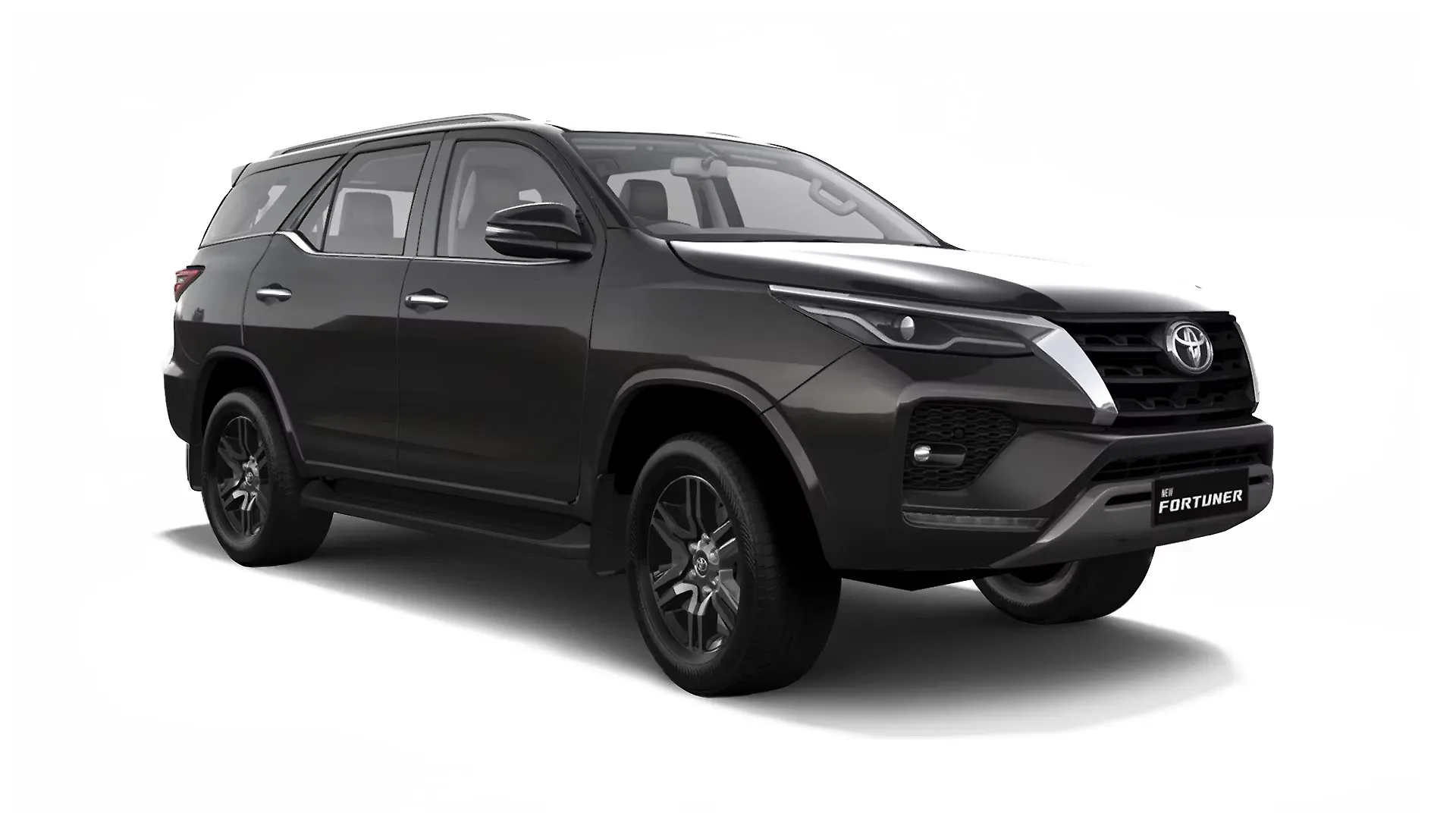
The Fortuner sticks to its tried-and-tested formula of a tall, mafia-style ladder-frame SUV, and the 2024 model continues to look imposing rather than cute or modern. Bi-LED projector headlamps with sharp DRLs anchor a chunky front bumper, while the rear gets LED tail lamps and the now-familiar Fortuner lettering across the tailgate. Faisal Khan notes that the silhouette is unmistakably old-school, with a high bonnet, prominent wheel arches and 265/60 R18 rubber filling out the stance. The G Sport-style trim adds blacked-out cladding and badging without altering the fundamental shape. Approach and departure angles are excellent thanks to the high ground clearance and short overhangs, which is why the SUV looks at home both at a five-star hotel porch and on a broken village road. Running boards are essentially mandatory because shorter occupants struggle to step in. There is no sunroof, no panoramic glass and no flashy lighting signature, yet the Fortuner has the sort of road presence that no monocoque rival can replicate.
Step inside and the Fortuner immediately reveals where Toyota has cut corners. The dashboard layout is functional but visibly dated, the 8-inch infotainment screen looks like it belongs to the previous decade, and Gagan Choudhary points out that several plastic panels feel basic, with the centre console trim physically lifting at the edges. Hard plastics dominate, the steering buttons feel low-rent, and there is no wireless charging, no ventilated seats, no head-up display and no panoramic sunroof, features that are now standard on Toyota's own cheaper SUVs. What does work is space: front seats are large, the second row is genuinely comfortable for three adults, and even the third row, accessed via tumble-folding second-row seats, is usable for shorter trips. The third-row seats fold upwards rather than flat, eating into boot space. Storage is reasonable with a cooled glovebox, decent door bins and a deep central armrest. Build feels tank-like in a structural sense, but the touchpoints simply do not match the Rs 40 to 62 lakh asking price.
Build quality is where the Fortuner earns its reputation and a chunk of its price. The ladder-frame chassis, thick metal panels and over-engineered mechanicals are designed to survive years of abuse, and Toyota's quality control on this Thailand-sourced platform is consistently rated among the best in the segment. Owners regularly clock over 2 lakh kilometres without major mechanical issues, which directly underwrites the SUV's resale strength. That said, the feature list is genuinely embarrassing for the price. There is no sunroof of any kind, no ADAS, no 360-degree camera, no head-up display, no ventilated or heated seats, no electric parking brake, no TPMS, no rain-sensing wipers, no wireless Apple CarPlay or Android Auto, and no USB-C ports. Even the reverse camera lacks adaptive guidelines, and the third-row seats fold upwards, not flat. The Thailand-spec G Sport gets a larger 9-inch screen, wireless connectivity and Toyota Safety Sense, none of which Toyota offers in India. You are paying for the badge, the chassis and the longevity, not the kit list.
The 2.8-litre diesel produces 201 bhp and 500 Nm and is mated to a 6-speed torque converter automatic, with a 2.7-litre petrol available only with rear-wheel drive. The diesel automatic is the unit that matters, and it delivers strong low and mid-range shove that makes overtakes effortless even with a full cabin. MotorBeam highlights that the engine feels relaxed and unstressed at highway speeds, and the gearbox, while not the quickest with downshifts, is well-tuned for the SUV's character. Paddle shifters are offered. The flip side is refinement: the diesel is audibly clattery at idle, sends noticeable vibrations into the cabin, and gets vocal as revs climb. Top-end performance tapers off, so this is a torque-led rather than rev-happy engine. Real-world fuel efficiency hovers around 6.8 km/l, which is poor for a diesel, and the 2.7-litre petrol is significantly thirstier. There is no diesel hybrid on sale despite chatter online; the current Fortuner remains a conventional diesel or petrol.
Ride quality is the Fortuner's most polarising trait. On smooth highways the SUV settles into a stable, planted gait, but on typical Indian city roads the body-on-frame chassis transmits a constant low-amplitude bounce, and sharper bumps thud through audibly. The hydraulic steering is heavy at parking speeds, requiring genuine effort during three-point turns, though it weights up nicely and offers honest feedback once you are moving. Body roll is significant, as expected from a tall, heavy ladder-frame SUV, but grip levels are reasonable and the high seating position gives confidence. Brakes work but exhibit clear nose-dive under hard stops. Where the Fortuner truly shines is off-road: with 4-High and 4-Low, an electronic locking rear differential, active traction control and excellent approach and departure angles, it tackles slush, ruts and steep climbs with little drama. For owners who actually venture beyond tarmac, this remains its single biggest justification over a monocoque rival like the Toyota Innova HyCross or any urban-focused crossover.
Value is the Fortuner's weakest score on paper and its strongest in practice. The range starts at around Rs 40 lakh on-road for the base petrol 4x2 manual and climbs to Rs 62.16 lakh on-road for the top G Sport 4x4 diesel automatic in Mumbai. For that money, rivals like the MG Gloster offer more features, and even Toyota's own Innova HyCross undercuts it significantly while delivering better refinement, mileage and equipment. Yet the Fortuner outsells its entire competitive set combined, moving over 2,000 units a month, because the Ford Endeavour is gone, the Mahindra Scorpio-N plays in a lower price bracket, and no one else offers this combination of body-on-frame ruggedness, Toyota reliability and resale strength. Owners typically recover a far larger percentage of their purchase price after five years than rival SUV buyers, which materially changes the ownership math. Toyota's standard 3-year/1 lakh km warranty extendable to 5 years/2.2 lakh km adds further peace of mind. Overpriced, yes; but in this segment, almost unavoidable.
TeamBHP's long-running ownership threads echo what professional reviewers conclude: the Fortuner is dated and overpriced, but its mechanical bulletproofness and resale strength make it the default recommendation for buyers seeking a true SUV. Owners consistently report trouble-free ownership well past 2 lakh kilometres, with service experience rated among the best in the industry, though many flag the missing features and stiff city ride as genuine annoyances.
"Frames the Fortuner as a long-term investment thanks to its exceptional resale value and Toyota reliability, arguing it remains a sensible buy despite a steep on-road price upwards of Rs 50 lakh."
"Calls it a genuine off-road beast that offers unmatched peace of mind, but warns away buyers seeking a compact, premium-feeling or comfortable urban SUV."
"Places the Fortuner in context against imported D-segment SUVs, noting that despite its premium price the Fortuner's local assembly, scale and service network make it a far more rational ladder-frame purchase."
"Most critical of the lot: lists pricing, feature deletions, ride quality and refinement as serious cons, calling the Fortuner overpriced, under-equipped and selling largely on herd mentality."
"Acknowledges weak interior quality and a tiring city ride, but concedes that the trust factor and brand pull mean most buyers will still walk into a Toyota showroom regardless."