 Image: Mahindra press kit
The Thar Roxx delivers genuine 4x4 capability, SUV presence, and a premium feature set at a price no rival can match, making the trade-offs in ride bounce and wind noise easy to live with.
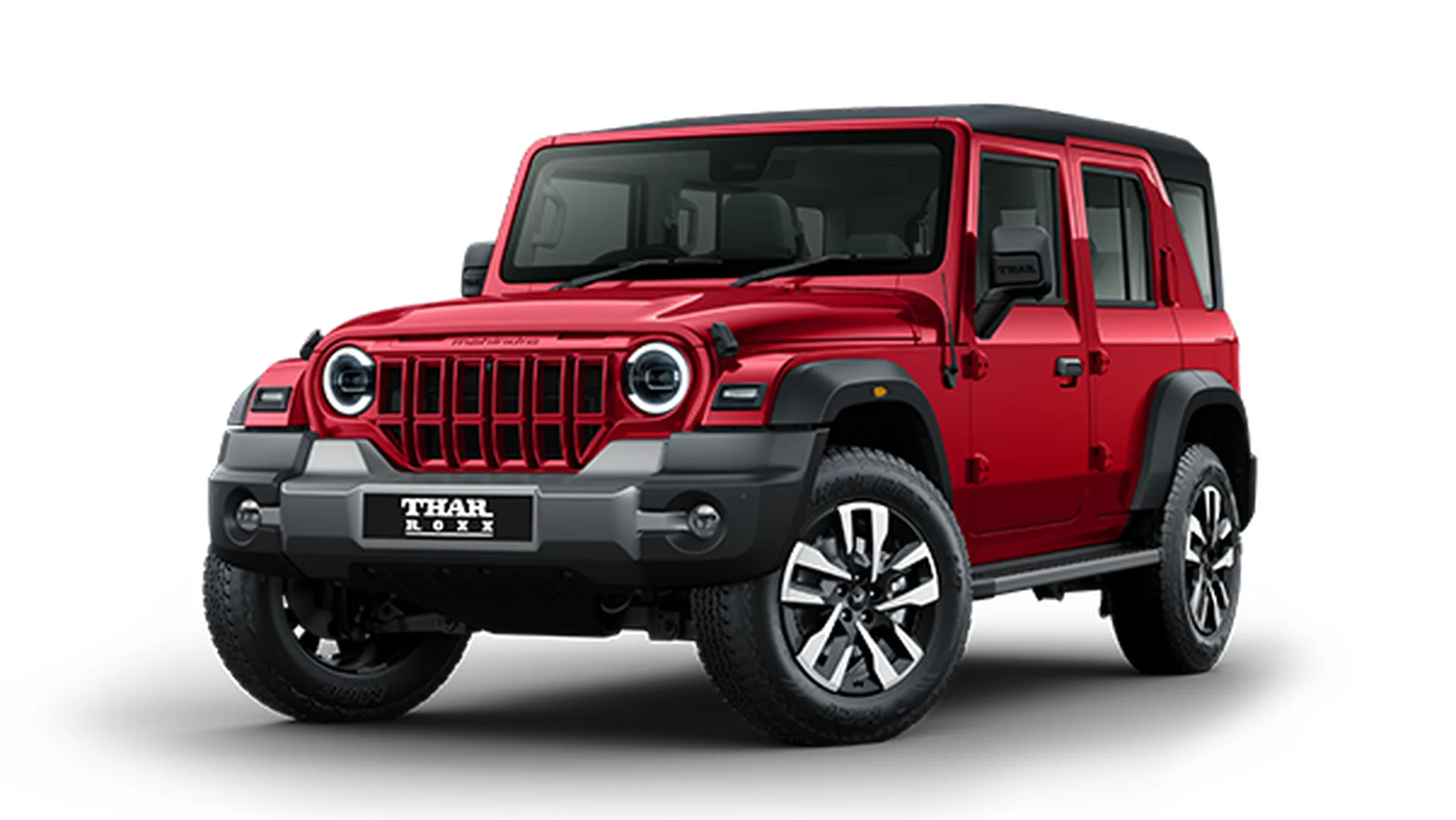
The Mahindra Thar Roxx is the five-door, family-friendly evolution of India's most iconic modern SUV, built on a new fourth-generation ladder frame with sharper road manners, a properly loaded cabin, and genuine 4x4 hardware. Priced from roughly Rs 15 lakh on-road for the petrol base to around Rs 27-29 lakh for the top diesel 4x4 automatic, it undercuts every direct rival while adding panoramic sunroof, ADAS Level 2, ventilated seats, and a 9-speaker Harman Kardon system. It is not a perfect highway cruiser, but for the money it is the most complete lifestyle SUV India currently sells.
The Roxx is unmistakably Thar yet clearly its own car. The six-slat grille, C-shaped LED DRLs, projector headlamps, exposed bonnet hinges, fender-mounted antenna and side step preserve the rugged identity, while the longer 2850 mm wheelbase, angled C-pillar cut and bigger 19-inch diamond-cut alloys give it proper SUV proportions. At 4428 mm long and 1.9 m wide, it has visibly more road presence than the three-door, and small Easter eggs (camels, a cactus, '4x4' etchings) add personality. Not every detail lands cleanly: the recessed door handles break the shoulder line a touch awkwardly, the parking-sensor count has been trimmed to two at each end, and Faisal Khan finds the alloy design less attractive than the three-door's. The full-size tailgate-mounted spare, rear wiper-washer and split tail-lamp signature still nail the brief. It looks like a Wrangler made for Indian streets, and that, more than anything, is what buyers in this segment want.
Inside, the Roxx is the biggest leap Mahindra has made in cabin quality. The dashboard uses soft-touch material with double-stitched leatherette, the dual 10.25-inch screens look sharp, and details like the frameless auto-dimming IRVM, illuminated power-window switches and aluminium pedals lift perceived quality well above the three-door. Front seats are wide and supportive with six-way power adjust and ventilation for both occupants, and the panoramic 'Sky Roof' is genuinely huge. Rear knee room is generous, the bench reclines and splits 60:40, and rear AC vents plus a 65 W Type-C port are welcome. There are misses: door pockets are too narrow for a standard one-litre bottle, the steering adjusts only for tilt, the dual-tone beige interior dirties quickly, and the touchscreen response can feel a step behind on some menus. The white-and-black scheme that Gagan Choudhary lives with daily holds up better than expected, but anyone planning serious off-road use should opt for the darker cabin.
Build quality is a clear step up for Mahindra. Panel gaps are tight, the doors shut with a damped thud, and the use of leatherette, double stitching and soft-touch plastics across the dash and door tops feels segment-appropriate. Six airbags, ESP, hill descent control, ABS with EBD, TPMS, ISOFIX, a 360-degree camera and ADAS Level 2 are standard, and Mahindra is targeting a five-star Bharat NCAP rating on the same architecture that earned the Scorpio N its score. ADAS includes adaptive cruise, AEB, forward collision warning, lane keep assist, blind view monitor and traffic sign recognition, but as MotorOctane notes, the count is 10 features against 20-plus on some Hyundais, and there is no blind-spot collision alert. Long-term feedback flags small irritants: the wireless charger triggering iPhone NFC, indicator-sound dropouts, an imperfect adaptive high beam and wipers that needed redesigning (Mahindra has updated them in newer batches). For a car at this price, the fit and finish punch above its weight.
Two engines are offered: a 2.0-litre mStallion turbo-petrol with 162 hp/330 Nm (rear-wheel-drive only, manual or automatic) rising to 175 hp/380 Nm in higher trims, and a 2.2-litre mHawk diesel with 152 hp/330 Nm or 172 hp/370 Nm in the 4x4 automatic tested here. The diesel is the powertrain of choice: smooth, quiet enough that you frequently forget it is an oil-burner, and well-matched to the six-speed Aisin torque converter. Throttle response has a slight initial lag and outright acceleration is leisurely because the car has gained weight over the three-door, but in-gear tractability is excellent. The petrol is livelier and revvier but drinks heavily and is locked to rear-wheel drive. There are no paddle shifters, no drive modes on the 4x4 automatic (only terrain modes: Snow, Mud, Sand), and the manual mode on the lever is the only way to override the gearbox. For Indian conditions, the diesel automatic is the easy pick.
Ride and handling are where the new mLIDE frame, FDD dampers, hydraulic rebound stops and watt's-link rear suspension show their worth. The Roxx feels notably more composed than the three-door, body roll is reduced, and the steering, now electric, is light enough for two-finger city driving while still tracking straight on the highway. On smooth tarmac it is genuinely impressive for a body-on-frame SUV. The caveat, as the long-term ownership view from Gagan Choudhary makes clear, is that sharp patchwork and broken urban surfaces still send a jolt through the cabin, and the CEAT-shod cars feel harsher than the MRF-shod ones. Wind noise is the bigger annoyance: below 80 km/h the cabin is hushed, but above that the upright windscreen generates enough roar to interfere with phone calls. Off-road, with 41.7-degree approach, 36.1-degree departure, 23.9-degree ramp-over angles, 650 mm wading and an electronic locking diff, it goes pretty much anywhere a private buyer will ever ask of it.
Pricing is the Roxx's knockout punch. The range opens around Rs 14.5-15 lakh on-road for the base petrol and stretches to roughly Rs 27-29 lakh on-road for the fully loaded diesel 4x4 automatic, depending on city. For that money you get genuine four-wheel-drive hardware, a panoramic sunroof, ADAS Level 2, ventilated seats, a nine-speaker Harman Kardon system, dual 10.25-inch screens, wireless charging, six airbags as standard and Mahindra's growing connected-car suite. No direct rival, neither the Force Gurkha 5-door nor the more expensive Scorpio N at similar trim, matches that combination, and the Jeep Wrangler costs nearly three times as much. Running costs favour the diesel, which should return double-digit fuel economy from the 57-litre tank, while the petrol will struggle to do so. Resale is the one watch-out: GST changes have softened prices slightly. As an overall value proposition in the lifestyle-SUV space, nothing else currently on sale in India comes close.
TeamBHP's community consensus aligns with the launch reviews on the Roxx being a transformative product for Mahindra, with owners highlighting the solid build, premium cabin and genuine 4x4 ability. Long-term threads flag the same real-world niggles surfaced here: wind noise above 80 km/h, harshness over patchwork, small door bottle holders and the missing request sensor on early cars (since added on 2025 bookings). Owners overwhelmingly recommend the diesel automatic 4x4 and PPF for paint protection.
"Calls it the best Indian car on sale right now and a Wrangler on a budget, picking the diesel 4x4 automatic as the variant to buy despite some lost feel versus the three-door."
"Rates the Roxx as the most complete SUV at its price, praising the new platform's ride and handling, but reserves judgement on long-distance comfort until a Cochin-to-Mumbai drive."
"After 20,000 km of ownership, says every rupee of his Rs 25 lakh is justified, while flagging wind noise, harsh patchwork ride on CEAT tyres and several small ergonomic misses."
"Frames it as a properly new car rather than a stretched three-door, highlighting the fourth-gen frame, electric steering and reduced body roll as the real story."
"Echoes the broader view that the Roxx finally makes the Thar nameplate viable as a sole family car without sacrificing its rugged character."