 Image: Honda press kit
A sensible, reliable, well-engineered family SUV that wins on driving manners, ground clearance and boot space, but feels under-equipped for the segment.
The Honda Elevate is the brand's belated entry into India's hottest SUV segment, built on the City platform and powered by Honda's familiar 1.5-litre i-VTEC petrol. It plays to traditional Honda strengths: refinement, reliability, space and an honest driving experience, with class-leading 220 mm ground clearance and a 458-litre boot. The catch is a thin feature list and the absence of any turbo, hybrid or diesel option in a segment where rivals offer all three.
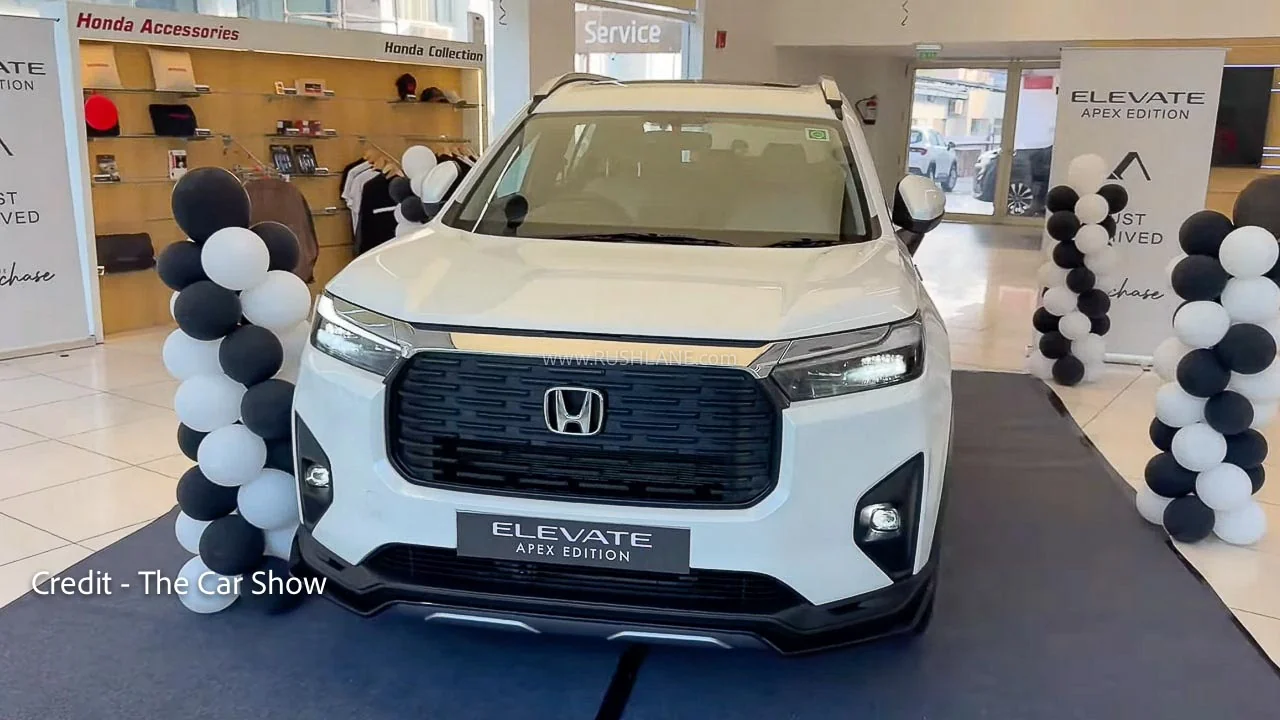
The Elevate breaks from Honda India's traditionally sleek design language with a tall, boxy, deliberately SUV-like silhouette. The big bold grille, full-LED headlamps and fog lamps, 17-inch alloys and 220 mm of ground clearance give it genuine road presence; Faisal Khan notes the front borrows visual cues from the larger Honda Pilot. Dimensions are competitive with the Creta, Seltos, Kushaq, Taigun and Grand Vitara, though the wheelbase and width translate to a car that looks bigger than it actually is. Seven exterior colours are offered with three available in dual-tone with a black roof. There are sensible touches like a Lane Watch camera on the left ORVM, integrated roof rails, a shark-fin antenna and a small sunroof, though panel gaps and metal feel are not best-in-class. Whether the styling works is genuinely subjective: some find it imposing and butch, others find it functional and forgettable. The 16-inch steel spare and rear drum brakes are reminders that cost has been managed.
Inside, the Elevate borrows heavily from the Honda City and that is largely a compliment. The black-and-tan dashboard is clean, mature and well laid out, with leatherette seats that feel sofa-soft and comfortable for city use, though thigh support is modest and taller occupants may sink in on longer drives. A 10.25-inch touchscreen with wireless Apple CarPlay and Android Auto, a part-digital instrument cluster, single-zone auto climate, a wireless charger with a dedicated on-off button and a small electric sunroof headline the equipment. The misses are glaring for a 2025 SUV near twenty lakh: no ventilated or powered seats, no 360-degree camera, no head-up display, no rear USB-C, only one-touch up-down for the driver's window, and a cooled glove box is absent. The rear bench offers good knee room, AC vents and a stable armrest, but seats only two adults in real comfort; the centre passenger gets a lap belt and no headrest. Practical and pleasant, rather than plush.
Mechanically, the Elevate feels typically Honda: doors shut with a solid thunk, switchgear has the familiar precision and the engine bay is finished with thoughtful touches like gas-strut-free self-supporting hood and a battery splash partition. Plastics are a mix of soft-touch on the upper dashboard and harder grades lower down, and Car Blog India notes the piano-black inserts and stitched leatherette lift the cabin's perceived quality. Where the Elevate trails Korean rivals is in last-mile finish: panel gaps are inconsistent in places, some metal panels feel thinner than ideal and there is a subtle colour mismatch between metal and plastic on certain shades. Safety hardware includes six airbags, ESP, hill-hold, traction control and Honda Sensing ADAS with adaptive cruise, lane keep assist, collision mitigation and road departure warning on the top variant; lower variants get only two airbags and TPMS is missing across the range. The car has not yet been crash-tested by Global NCAP, though the City platform has historically performed well in ASEAN NCAP.
There is exactly one engine: Honda's 1.5-litre naturally aspirated i-VTEC making 121 PS and 145 Nm, paired with a 6-speed manual or a CVT with paddle shifters. The motor is the Elevate's character: smooth at idle, eager to rev cleanly to 7,000 rpm and rewarding when worked hard, especially in the manual where the short-throw gearbox and light clutch make it a genuinely enjoyable drive. The CVT uses simulated step-shifts to mask the rubber-band effect and works well in stop-go traffic, but ask for a quick highway overtake and the revs flare before the speed builds; paddle shifters help. There is no turbo-petrol, no diesel and, most disappointingly given Honda's strengths elsewhere, no strong hybrid, while the Hyryder, Grand Vitara, Creta and Seltos all offer at least one of these. Claimed efficiency is 15.31 kmpl manual and 16.92 kmpl CVT; expect roughly 10-11 kmpl in city use. Top speed is electronically limited to 160 kmph.
The Elevate rides with the kind of pliant, absorbent calm Honda has long been known for. Around town it glides over broken patches, expansion joints and small potholes with very little fuss, and the 220 mm ground clearance means speed-breakers and rough rural roads are dispatched without drama. On the highway the suspension stays composed at cruising speeds, though loaded up with four passengers and luggage it can feel a touch bouncy over sharper inputs. Handling is safe and predictable rather than sporty: the steering is light, accurate and easy in the city but short on feedback for enthusiasts, and there is some body roll as you would expect from a tall, soft-sprung SUV. Grip from the factory Bridgestones is reassuring. The Unknown Reviewer's clearest criticism is sound insulation: tyre roar and engine noise above 2,500 rpm intrude more than they should, undermining what would otherwise be a genuinely refined experience. Compared with the Skoda Kushaq it trades sharpness for comfort.
Pricing is the Elevate's most important lever and Honda appears to have understood that. The strategy mirrors the City: aggressive on lower and mid variants, with automatic and ADAS available at price points where rivals like the Hyundai Creta, Kia Seltos and Skoda Kushaq still ask for top-trim money. Expect roughly 50,000 to 60,000 rupees premium over the equivalent City variant. For buyers cross-shopping a top Nexon, Sonet or Venue, stretching to a mid-variant Elevate buys a genuinely larger SUV with more space, more ground clearance and ADAS. The trade-off is real: cross-shop a top Creta or Seltos and the Elevate looks under-equipped, with no turbo, no hybrid, no 360-degree camera, no ventilated seats and no panoramic sunroof. Honda counters with reliability, low running costs, a refined engine and a 3-year warranty extendable to 10 years. For the rational buyer who values long-term ownership over showroom feature counts, the value case is genuinely strong.
TeamBHP's community echoes what most reviewers concluded: the Elevate is a sorted, low-maintenance family SUV whose biggest weakness is its missing equipment list rather than anything mechanical. Owners and forum experts repeatedly highlight the City-derived reliability, the well-judged ride and the genuine usability of the 220 mm ground clearance on Indian roads, but flag the lack of a hybrid or turbo as a serious commercial misstep against the Hyryder, Grand Vitara and Seltos.
"Sees the Elevate as a smart pricing play: ADAS and automatic at variants where rivals don't offer them, ideal for buyers stepping up from compact SUVs."
"Predicts realistic sales of 3,500-4,000 units a month and argues Honda should have offered the strong hybrid even at the cost of dropping ADAS on a lower variant."
"Loves the i-VTEC magic and the driving position but warns Honda has brought a knife to a feature gunfight against the Koreans and Toyota."
"Calls the Elevate a car that 'settles' for good when it could have been brilliant; recommends the manual for all-round use and the CVT strictly for city duty."
"A detailed walkaround highlighting the 458-litre boot, the Honda Sensing suite and the 90% local content, with the optional CNG retrofit as a notable ownership angle."
"Praises the elegant interior finish, comfortable rear-seat space for two adults plus a child and the mature exterior design."