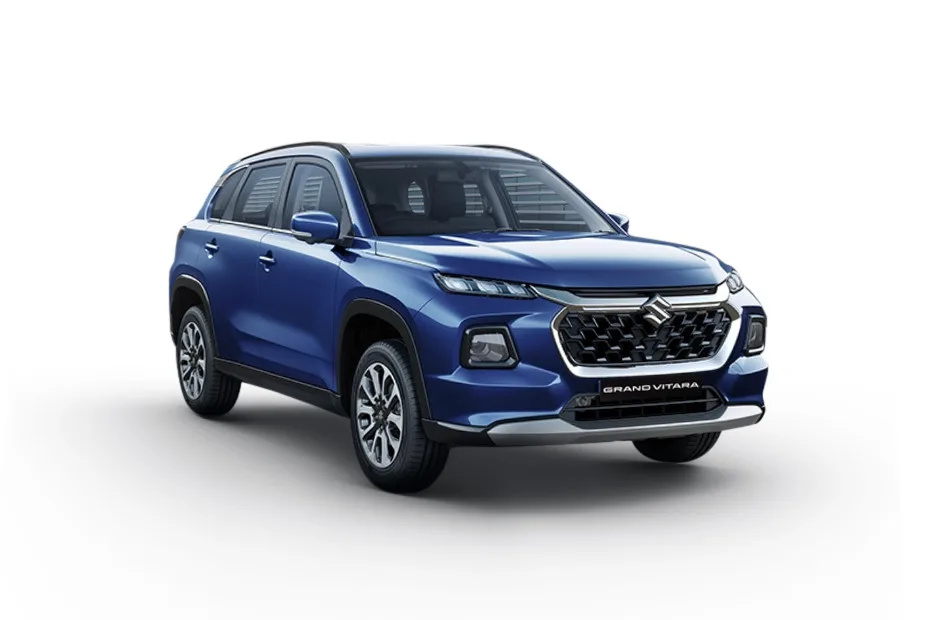
 Image: CarDekho / Maruti Suzuki press kit
A sensible, well-rounded mid-SUV that excels in ride comfort, fuel efficiency and reliability, even if the strong-hybrid powertrain lacks outright punch.
The 2025 Maruti Grand Vitara is a Maruti-Toyota joint venture mid-SUV that pairs sensible packaging with class-leading hybrid efficiency. It impresses with its ride quality, cabin comfort and Maruti's service reach, but the strong-hybrid powertrain prioritises frugality over excitement.
The Grand Vitara's exterior strikes a confident balance between SUV proportions and modern detailing, with LED projector headlamps, integrated DRL-indicator units and 215/60 R17 alloys that look understated rather than flashy. The front fascia is the strongest angle; the rear can look slightly busy in photos but settles down in person. Gagan Choudhary actually rates the Grand Vitara's stance as marginally better than the closely related Toyota Hyryder, which is telling given how similar the two cars are underneath. A shark-fin antenna, hybrid badging on the tailgate and chrome accents lift the visual appeal without overdoing it. Compared to the sharper Hyundai Creta or the more European-looking Skoda Kushaq, the Grand Vitara plays it safe but cohesive. The 17-inch wheels could have been more distinctive at this price, and the rear three-quarter design polarises opinion, but overall the SUV looks substantial and well-finished on the road.
The cabin is where the Grand Vitara shows both its strengths and its compromises. The dual-tone dashboard, large touchscreen infotainment, fully digital instrument cluster, head-up display and panoramic sunroof all elevate the perceived quality, and the seats are wide, well-cushioned and offer decent thigh support. Ventilated front seats are a smart addition for Indian conditions, though the fan is audibly loud even on the lowest setting. Ergonomics are typically Maruti: switches fall to hand, the climate controls are physical, and storage is well thought out with dual USB-A and USB-C ports up front and a 1-litre bottle holder in the door. Less impressive is the heavy use of hard plastics across the dashboard and door tops, and the panoramic sunroof's semi-transparent shade lets heat through, which pushes AC consumption up in summer. Rear seat comfort is genuinely good with a reclining backrest, three proper headrests, three-point seatbelts and ISOFIX mounts.
Build quality reflects the Maruti-Toyota partnership: panel gaps are consistent, doors shut with a reassuring thud, and the underlying platform has already earned a solid Global NCAP rating. Feature count is competitive for the segment with a 360-degree camera, head-up display, wireless charging, auto headlamps, rain-sensing wipers, electrochromic IRVM, ventilated front seats, large panoramic sunroof, six airbags and full electronic safety suite. Some niggles remain: the steering-mounted volume buttons can feel slow to respond, only the driver's door unlocks by default (configurable), front parking sensors are missing, and the speakers carry no audio brand tie-up despite sounding decent. The infotainment software is shared with the Baleno and XL6, so it is familiar and functional rather than cutting-edge. Long-term reliability and Maruti's nationwide service network remain the trump cards, and these alone tilt the scales for buyers who keep cars for 7-10 years.
Powering the strong-hybrid is a 1.5-litre three-cylinder petrol paired with an electric motor and a small battery, driving the front wheels via an e-CVT. The system starts silently in EV mode, with the petrol engine cutting in seamlessly above a certain speed or throttle input. Real-world frugality is the headline: 20-22 kmpl on the highway and even higher in pure city use, numbers no rival petrol can match in this segment. However, refinement is the weak link. MotoWagon and the wider reviewer pool note that the three-cylinder's vibrations occasionally surface when the engine reconnects to the wheels at low speeds, producing a brief stall-like sensation that more polished hybrids avoid. Power delivery is adequate rather than energetic, even in Power mode, and outright performance trails the turbo-petrol Hyundai Creta and Kia Seltos. Buyers prioritising mileage and smoothness in traffic will love it; those wanting overtaking punch on highways may find it lacking.
Ride quality is arguably the Grand Vitara's standout dynamic trait. The suspension absorbs broken roads, expansion joints and rural patches with a maturity that feels a class above Maruti's older efforts, and 210 mm of ground clearance means speed breakers and rutted lanes pose no concern. High-speed stability is genuinely confident; the SUV stays planted through lane changes at 80-100 kmph despite its tall stance. Handling, however, is tuned for comfort rather than engagement. The steering is light and feels somewhat disconnected, lacking the weight and feedback of a Skoda Kushaq, and there is noticeable body roll if you push hard through corners. Braking performance is adequate, though the M+S-rated tyres feel like an odd choice for the front-wheel-drive variant; highway-terrain rubber would have suited it better. Cabin insulation is reasonable, though some wind and minor rattle noises do filter in around the A-pillar area on certain test units.
On paper the Grand Vitara strong-hybrid sits at the pricier end of the mid-SUV segment, retailing above an equivalent Toyota Hyryder mild-hybrid and even above some diesel rivals, which is the single biggest hurdle for value-conscious buyers. The strong-hybrid premium is recovered only over high-mileage ownership, so buyers doing under 1,000 km a month may find a Hyundai Creta diesel or even the Maruti Brezza a more rational choice. That said, what you do get is genuine 20+ kmpl efficiency, a comprehensive feature list, Maruti's service reach and Toyota's hybrid engineering, a combination no rival offers under one roof. Compared to the Hyundai Creta and Kia Seltos, the Grand Vitara trades outright performance and feature glitz for frugality and long-term peace of mind. For city-heavy users with long ownership horizons, it makes solid financial sense; for highway warriors and enthusiasts, the calculation gets harder.
TeamBHP's community consistently rates the Grand Vitara strong-hybrid as a sensible long-term buy, citing real-world efficiency of 20-22 kmpl and minimal niggles in long-term ownership reports. Owners flag the limited boot space and three-cylinder vibrations as the biggest day-to-day compromises, but praise the ride quality, cabin comfort and the reassurance of Maruti-Toyota's combined service backbone. Long-term owners also highlight the strong-hybrid's ability to run on electricity at low speeds in bumper-to-bumper traffic, which meaningfully reduces running costs in Indian cities. Service costs are reported as low across both Maruti Arena and Toyota Hyryder-equivalent service centres, making this one of the more economical mid-SUVs to own over a five-year horizon.
"After 1,000 km of testing, calls it a strong, sensible package with excellent ride and efficiency, but flags the engine's lack of low-speed refinement and wishes for slightly more power."
"Highlights the 22.9 kmpl real-world efficiency advantage and considers the strong-hybrid's price premium over the Hyryder worth it only for high-mileage buyers."