 Image: Maruti press kit
A polished, fuel-efficient and spacious premium hatchback that nails the basics for Indian families, even if enthusiasts will find it short on driving thrills.
The 2025 Maruti Baleno arrives with a refreshed face, more features and a new 5-speed AMT replacing the older CVT. It remains one of India's most sensible premium hatchbacks: light on the wallet, spacious, and easy to live with. The trade-off is a cabin that still feels ordinary in places and a driving character tuned for comfort over excitement.
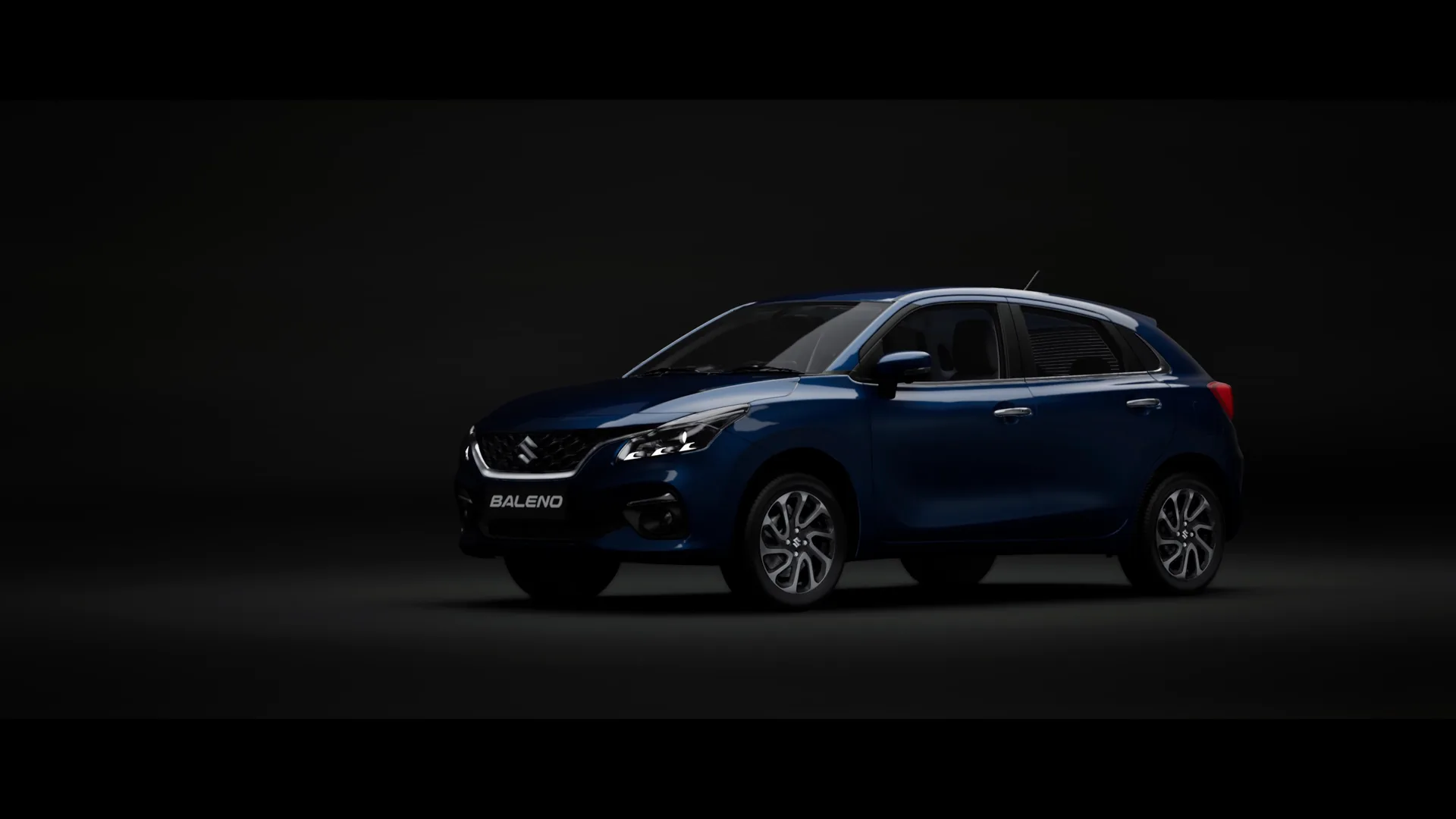
The facelifted Baleno carries forward Maruti's 'liquid flow' design but adds genuinely modern touches. The new ice-cube DRL signature, LED projector headlamps with cornering function, LED fog lamps and dual-tone 16-inch alloys with 195/55 R16 rubber give the front end a sharper, wider stance. Profile and rear remain familiar, with L-shaped LED tail lamps and a subtle spoiler. Maruti claims structural rigidity has improved through greater use of high-tensile steel, and kerb weight has gone up by around 55 kg as a result. There is no Global NCAP rating to validate the safety story, but six airbags and ESP on top variants are now standard. The car looks clean and inoffensive rather than aggressive: in an era of polarising designs, MotorBeam notes the Baleno's understated approach still ages well. Compared to the boxier Maruti Swift, the Baleno reads more grown-up and aerodynamic.
Inside, the Baleno gets a new dashboard with a blue insert running across the middle, leatherette touches on the doors and a colour-themed cabin that lifts the mood. The 9-inch SmartPlay Pro+ touchscreen is fluid and supports wireless Apple CarPlay and Android Auto, paired with a six-speaker Arkamys-tuned audio system that is a clear step up from before, even if rivals like the Hyundai i20 still sound better. The head-up display is a genuine segment-first highlight, with adjustable height and brightness. The 7-inch driver's MID adds power, torque and acceleration readouts. Rear-seat space is excellent for two adults, with generous knee room, dedicated AC vents, a Type-C and a USB port. Front seats are firmer than before and supportive. The misses are real: no wireless charging, no sunroof, no TPMS display, a fiddly UI for basic functions and noticeable rattles from the dashboard near the AC vents. Boot space stands at 318 litres with a 60:40 split rear bench, though the high loading lip remains.
Maruti's structural upgrade is most visible in the doors, which thunk shut with more authority, and in the heavier overall feel. UV-cut glass on top variants is a thoughtful, segment-rare addition. Yet build quality stays divisive: hard plastics on the upper dash, AC vent rattles at full blower and a sense that quality is acceptable rather than premium. There is no published Global NCAP rating, which matters for buyers cross-shopping the 5-star Tata Altroz. Top trims now get six airbags standard, ESP, hill-hold, traction control, ISOFIX and a 360-degree camera; resolution is functional but trails Hyundai's setup. Suzuki Connect adds geo-fencing, remote lock, vehicle tracking and Alexa integration. Wireless charging, ventilated seats and a sunroof are notable omissions for a top variant in 2025.
The 1.2-litre K12N DualJet four-cylinder petrol is now made in India, drops the smart-hybrid system and retains only idle start-stop. It produces 90 PS at 6000 rpm and 113 Nm, making it the most powerful naturally aspirated motor in the segment ahead of the i20, Altroz and Jazz. Refinement is the headline: NVH is excellent at idle and through the mid-range, and four-cylinder smoothness is a clear advantage over the three-cylinder units in the Swift and Dzire. Performance is adequate; 0-100 kmph takes about 13-14 seconds, and you need to rev past 3000 rpm for genuine overtakes. Fuel efficiency is the trump card: 13-15 kmpl in the city, 20+ kmpl on the highway. The 5-speed manual has a light clutch and slick shifts; the new 5-speed AMT replaces the older CVT, is well-calibrated for gentle driving but reveals its head-nod character when pushed.
Ride and handling are where the Baleno quietly outshines rivals. The retuned suspension soaks up broken surfaces, expansion joints and speed breakers with a maturity rare at this price; Arun Panwar notes how planted it feels versus the predecessor. High-speed stability is strong for a sub-tonne hatchback, helped by 195-section tyres and a stiffer shell. Larger front disc brakes are confident, though rear drums remain and pedal feel could be sharper under panic stops. Steering is light at parking speeds and gains weight at pace, but feedback is the weak link: it does not communicate the front end well and self-centering is not always crisp. Enthusiasts wanting Polo-style tactility or Altroz-style planted high-speed manners will be left wanting. For everyday Indian driving, the balance of plush ride and predictable behaviour is hard to beat.
Pricing runs from approximately Rs. 6.66 lakh to Rs. 9.88 lakh ex-showroom, with the AMT commanding around Rs. 50,000 over the equivalent manual. Maruti has held prices broadly steady despite adding equipment, which strengthens the value case. The Zeta and Alpha trims emerge as the sweet spots: Zeta brings the bulk of the meaningful features at a sensible price, while Alpha adds the HUD, 360-camera, LED fog lamps, six airbags and dual-tone alloys for buyers who want everything. Sigma and Delta start to feel sparse against rivals. Running costs are predictably low thanks to Maruti's vast service network, proven engine reliability and segment-leading fuel efficiency. Resale value continues to be a strong suit. Cross-shoppers should note that the Maruti Fronx, built on the same platform, sits roughly a lakh higher and steals attention from the Baleno despite offering the same mechanicals; for many buyers, the Baleno is the smarter rupee-for-rupee choice in the Nexa showroom.
TeamBHP's review highlights that the facelift is a meaningful update rather than a cosmetic one, with a new dashboard, head-up display, 360-camera, Arkamys audio and six airbags as standard on top trims. The forum notes the kerb weight has gone up by 55 kg thanks to greater use of high-tensile steel, the older CVT has been dropped in favour of an AMT (making automatics cheaper), and that Maruti claims improved NVH and a new suspension setup, all of which are validated by the driving impressions.
Read full forum review →"AMT well-tuned, engine refined; flags missing wireless charging, TPMS, sunroof and AC-vent rattles."
"Frames the Baleno as a well-equipped, sensible family hatchback at the price."
"Segment-leading efficiency, 100 kg lighter platform, excellent ride; average plastics, high boot lip."
"Most spacious, smooth, reliable in its segment; numb steering and weak high-speed braking warned."
"Tata Altroz feels more premium in design and dynamics; Baleno's case rests on efficiency and dealer reach."
"K-series engine is the standout; AMT disappoints versus the old CVT, cabin feels like a compromise."