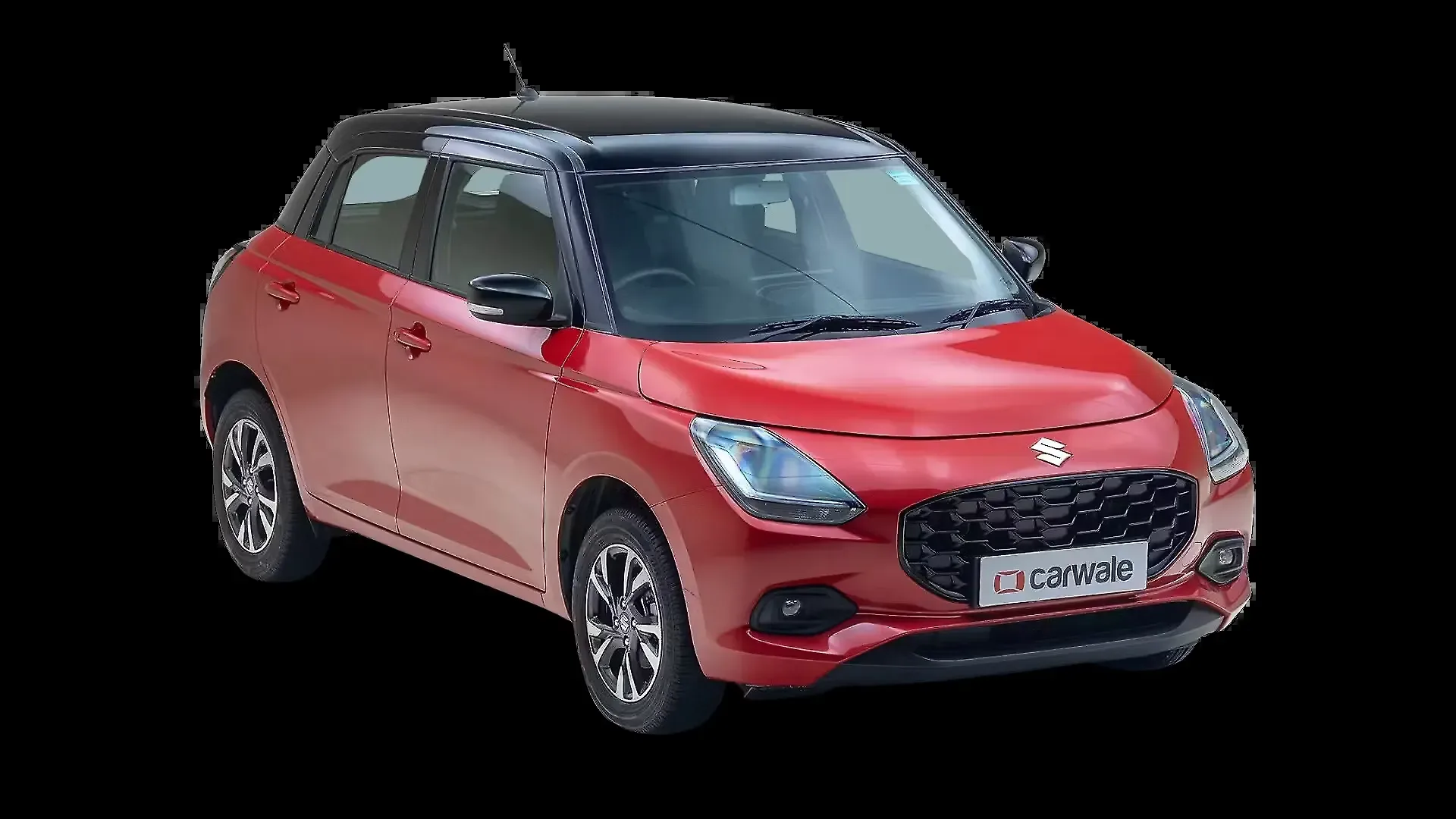
 Image: Maruti Suzuki press kit
The fourth-generation Swift remains a fun, efficient and well-priced hatchback, though it has softened up and lost some top-end punch.
The 2024 Maruti Swift enters its fourth generation with a new 1.2-litre three-cylinder Z12E petrol engine, a fresher cabin and improved efficiency, priced between Rs 6.49 lakh and Rs 9.64 lakh ex-showroom. It trades some of the older car's top-end fizz for better low-end tractability, a plusher ride and class-leading fuel economy. Six airbags as standard and a rich features list keep it competitive, though the in-house Baleno casts a long shadow.
The fourth-gen Swift sticks to evolution rather than revolution. The signature bonnet line still wraps around the body, but the headlamps are now smoked LED projectors with boomerang DRLs, the grille gets a piano-black treatment and the rear door handles return to a conventional position, ditching the old hidden-pillar trick. Faisal Khan flags that the fog lamps and indicators are still halogen reflector units despite the LED appearance up front, which feels like cost-cutting at this price. The 15-inch dual-tone precision-cut alloys with 185/65 R15 Bridgestone Ecopia tyres look smart, and the dual-tone black roof, micro-pole antenna and turn-indicator-equipped mirrors lift the kerb appeal. At 3.86 m long with a 4.8 m turning radius and 163 mm ground clearance, dimensions are unchanged, yet the car is 20 kg heavier thanks to more steel for safety. It is a love-it-or-grow-into-it design rather than the dramatic global redesign many had hoped for.
Inside, the dashboard borrows heavily from the Baleno and Brezza, with a multi-layered floating centre console and a driver-tilted 8-degree fascia. The 9-inch SmartPlay Pro+ touchscreen supports wireless Android Auto and Apple CarPlay, OTA updates and Suzuki Connect, and the six-speaker Arkamys system delivers respectable sound. A wireless charger, USB-A and USB-C ports, automatic climate control with physical knobs and a height-adjustable driver's seat are all welcome. The fabric seats are comfortable, but the cabin gives away ground to the Baleno: there is no front centre armrest, no auto-dimming IRVM, no head-up display and the rear bench misses both a centre headrest and an armrest. As MotorBeam notes, rear knee room is genuinely tight for taller occupants and the central tunnel hump compromises the middle passenger. Boot space is rated at 265 litres, fine for a weekend run but not class-leading. Fit and finish are typical Maruti: hard plastics dominate, but everything feels durable.
Build quality follows the modern Maruti template: light overall but reassuringly solid where it matters. The fourth-gen Swift carries 20 kg more steel than its predecessor, contributing to a stronger shell aimed at improved crash performance. Six airbags, ESC, hill-hold assist, ISOFIX mounts, three-point seatbelts with pre-tensioners and force limiters up front, a tyre pressure monitoring display, four rear parking sensors and a reverse camera are standard or available across the lineup. Namaste Car flags useful ownership touches like a security alarm with shock sensor, speed-sensitive auto door locks and an engine immobiliser. Doors shut with a typical light Maruti thunk rather than a Volkswagen-grade thud, and panel gaps are consistent. Some hardware niggles persist: power-window switches feel dated, dummy buttons clutter the dash, the reverse camera lacks adaptive guidelines and several settings, including regen-style preferences, do not persist across ignition cycles. Overall, this still feels like a car built to age well in Indian conditions.
The big change is mechanical. The new 1.2-litre Z12E three-cylinder petrol replaces the long-serving K12 four-cylinder, producing 81 hp and 112 Nm, down 8 hp and roughly 1.3 Nm. On paper it is a downgrade; in the real world it is a sideways move. Low-end and mid-range tractability are excellent, making city driving genuinely effortless, but the top end has lost its old zing and the engine now redlines at just 6,000 rpm. Maruti claims a 0-100 kmph time of around 13.5 seconds and a top speed of about 160 kmph, with the car running out of breath past 130 kmph. Three-cylinder vibrations are visible at the engine bay but barely felt inside the cabin, a credit to Suzuki's NVH work. The 5-speed manual is the enthusiast's pick: light clutch, slick shifts and willing rev habits. The 5-speed AMT, priced about Rs 57,000 more, is convenient and efficient but still suffers the familiar head-nod and slow upshifts.
Ride and handling are where this Swift genuinely shines. The reworked suspension, MacPherson struts up front and a torsion beam at the rear, soaks up broken tarmac, expansion joints and rough patches with a maturity uncommon in this segment. MotorBeam's bad-road run highlighted just how pliant the setup feels at urban speeds, while high-speed composure is far better than the older, stiffer Swifts. Body control through corners remains tidy: the car is light, eager to change direction and forgiving when pushed. The flat-bottom steering wheel weighs up reasonably at speed but lacks real feel, and the Bridgestone Ecopia tyres prioritise efficiency over outright grip, especially in the wet. Braking, with discs at the front and drums at the rear, is strong from 70 kmph though the ABS calibration is on the sensitive side. Overall it feels glued to the road in a way the OG Swift never did, which broadens its appeal even if hardcore enthusiasts will miss the older car's edge.
Pricing runs from Rs 6.49 lakh to Rs 9.64 lakh ex-showroom (Rs 7.67 lakh to Rs 11.32 lakh on-road Mumbai for the top variants), positioning the Swift as a premium hatchback rather than the budget choice it once was. The headline rivals are the Hyundai Grand i10 Nios at Rs 7-10 lakh and, more awkwardly, Maruti's own Baleno, which sits roughly Rs 8,000 higher but adds a 360-degree camera, head-up display, front armrest, larger cabin and Nexa showroom experience. CNG is not yet offered on the new engine but is expected. Where the Swift fights back is fun-to-drive character, lower running costs thanks to claimed mileage of 24.8 kmpl (MT) and 25.75 kmpl (AMT), and Maruti's unmatched service reach. For buyers cross-shopping SUVs, the brand also offers the Brezza and the upcoming e-Vitara if a hatchback no longer fits the bill. Within its segment, the Swift remains a sensible, resale-friendly pick if you can live with its tighter rear and softer top end.
TeamBHP owners and long-term testers echo the consensus that the new Z12E is smoother and more efficient in daily use but lacks the older K12's mid-range punch. Forum threads highlight strong low-speed driveability, a pliant ride and frugal real-world economy of 15-18 kmpl, while flagging the small 37-litre fuel tank, tight rear seat and feature gaps versus the Baleno as the main ownership niggles.
"Praises the supple ride, refined three-cylinder NVH and fun manual gearbox, but feels Maruti has played it too safe and that the Baleno offers more car for almost the same money."
"Walks through the car's specs, safety kit and feature list in detail, highlighting six airbags as standard, the 9-inch SmartPlay Pro+ system and the new Z12E engine's lower CO2 emissions as genuine progress."
"Finds ride quality pliant and braking strong, but warns that rear knee room is seriously limited and that Bridgestone Ecopia tyre grip drops sharply in wet conditions."