 Image: Toyota press kit
A genuinely efficient hybrid SUV with Toyota reliability and a real-world 19-20 kmpl, let down only by a small boot, average cabin quality and stiff low-speed ride.
The Toyota Urban Cruiser Hyryder is a Maruti-Toyota co-developed mid-SUV whose star act is the strong-hybrid powertrain that returns a real-world 19-20 kmpl. It blends Toyota's hybrid expertise with city-friendly EV-mode running, but compromises on boot space, cabin quality and outright punch. Best suited to efficiency-focused urban buyers.
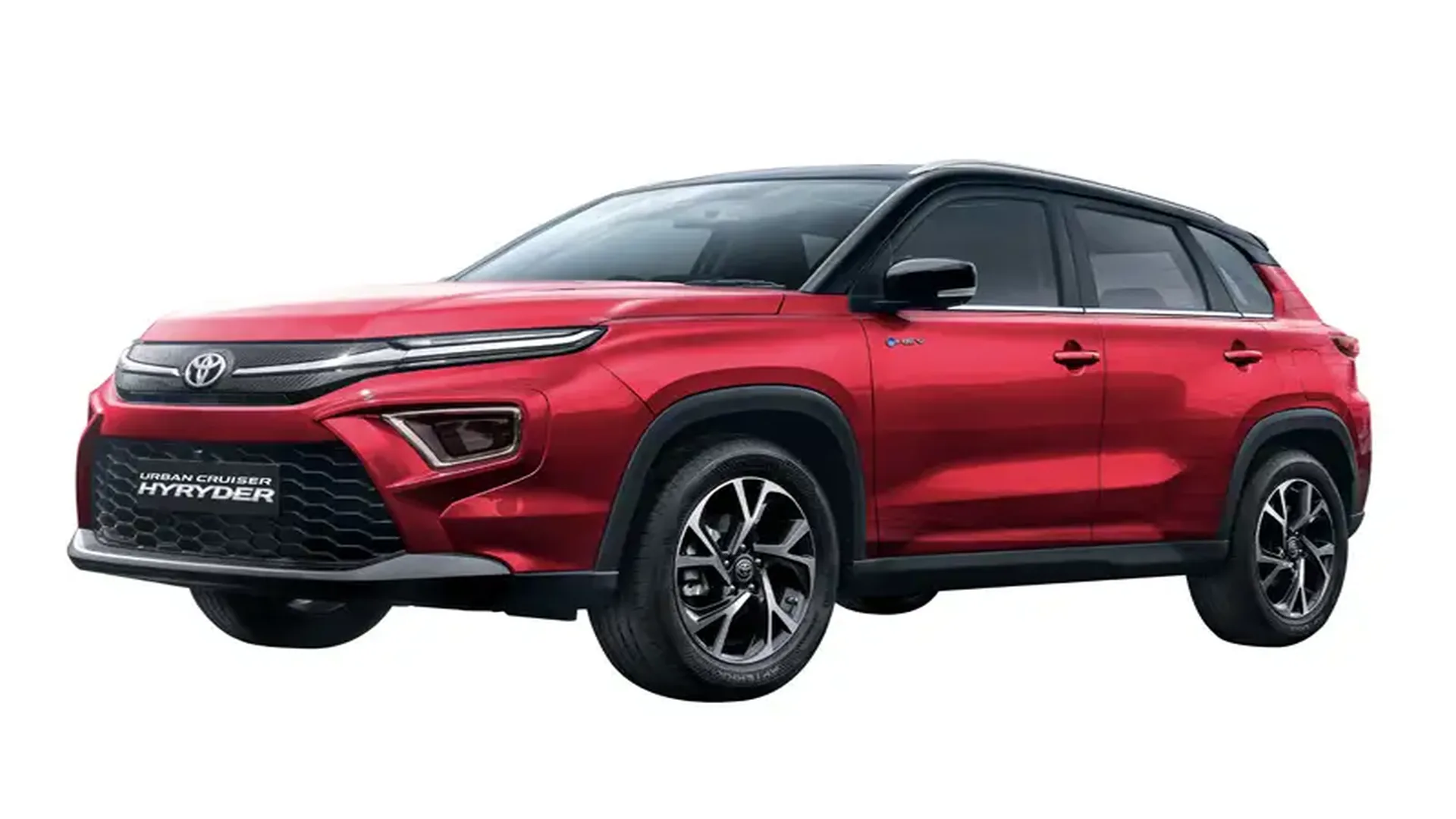
The Hyryder wears a more upright, SUV-flavoured face than its Maruti Grand Vitara twin, with a crystal-acrylic upper grille, LED projector headlamps with sweeping DRLs and a connected light bar at the rear. Dimensions sit at 4.3 metres long with 17-inch machine-cut alloys on top variants, and Namaste Car notes a usefully tight 5.4-metre turning radius. Halogen reflector fog lamps and a basic bulb-type rear indicator feel out of place at this price. The dual-tone roof, shark-fin antenna and chunky cladding give it presence, but it is not as visually fresh as the Hyundai Creta or Kia Seltos. Overall the styling is conservative-handsome rather than striking, and ageing better than it dazzles.
Inside, the Hyryder mixes a brown-and-black theme with soft-touch dashboard inserts, a 9-inch touchscreen, a 7-inch TFT cluster and a head-up display on top trims. Wireless Android Auto and Apple CarPlay, wireless charging, ventilated front seats, panoramic sunroof and a 360-degree camera tick the feature boxes. The catch is execution: switchgear, window switches and the sunroof shade feel borrowed from cheaper Maruti products, and Arun Panwar singles out the curtain as too thin to block heat. Front seats are comfortable with electric adjust on the driver's side, but rear under-thigh support is just adequate and the cabin is narrower than a Creta's, making three adults at the back a squeeze.
Build quality is the Hyryder's most debated trait. Doors shut with a reassuring thud and the structure feels solid, but inside, the gloss-black centre console will scuff quickly, the climate-control panel and indicator stalks feel lifted from a Baleno, and panel gaps around the dashboard are visible. The TeamBHP community flags poor NVH from the three-cylinder unit and an audible vacuum pump as surprising for a Toyota. On safety the car redeems itself: six airbags, ESP, hill-hold, three-point belts for all five occupants, ISOFIX, 360-degree camera and TPMS are standard or available, and the hybrid battery carries an eight-year warranty. The car overall covers the basics competently rather than feeling genuinely premium.
Three powertrains are on offer: a 1.5 mild-hybrid petrol, a CNG option and the headline 1.5 strong-hybrid that pairs an Atkinson-cycle three-cylinder petrol with an electric motor and a 177-volt lithium-ion battery for a combined 114 bhp. In the city it slips into EV mode often, the transition to petrol is seamless and creep behaviour mimics a torque converter. Acceleration is linear rather than punchy; MotorBeam confirmed cruising at 95-100 km/h is effortless but overtakes above 110 km/h expose the rubber-band e-CVT and a vocal engine. Buyers wanting outright shove or all-wheel drive will find the AWD strong-hybrid combination missing in India, leaving this very much a relaxed, efficiency-first powertrain.
Ride and handling sit in the middle of the segment. At low speeds the suspension feels firm over sharp expansion joints and broken patches, with reviewers consistently calling the setup stiff in town. Pick up speed and the Hyryder settles into a composed, planted gait; body control over undulations is good and it stays flat through highway sweepers. The electric power steering is light at parking speeds and weights up acceptably, though feel is muted. Braking is progressive with a well-blended regen-to-hydraulic transition rare for a first-generation hybrid system. The 17-inch wheels with 215/60 tyres find a fair balance, but committed enthusiasts will still prefer the sharper Skoda Kushaq, while the Creta offers a plusher low-speed ride.
Pricing runs from roughly Rs 10.5 lakh ex-showroom for the base petrol to Rs 20 lakh for the top strong-hybrid AWD, putting the headline hybrid against the Hyundai Creta and Kia Seltos diesel automatics. Gagan Choudhary's running-cost math is the clincher: at a tested 19.89 kmpl, real-world fuel cost works out to around Rs 5.35 per kilometre, on par with diesel and well below a regular petrol SUV. Add the eight-year hybrid battery warranty, Toyota's resale reputation and three years/one lakh km vehicle warranty and the case strengthens for high-running urban buyers. Buyers chasing features-per-rupee or a diesel feel will still find a Seltos or Creta diesel automatic harder to ignore.
TeamBHP rates the Hyryder strong-hybrid as a sensible, efficient urban SUV that delivers 20+ kmpl in city traffic with seamless EV-mode running, but flags poor NVH from the 3-cylinder engine, a small boot and Maruti-grade cabin plastics as clear weaknesses.
Read full forum review →"A practical, efficient hybrid SUV but cabin plastics and feature execution betray its near-20-lakh price tag."
"If the 10-year diesel rule does not apply to you, a Seltos diesel automatic still offers more fun for the money."
"Strong-hybrid tech, eight-year battery warranty and Toyota reliability make it a safe long-term ownership pick."
"Running cost matches diesel at Rs 5.35 per km, but interior quality and ergonomics need a serious rethink."
"Returned 19.89 kmpl over 1000 km; comfortable and feature-rich, though the ride is stiff and boot is small."