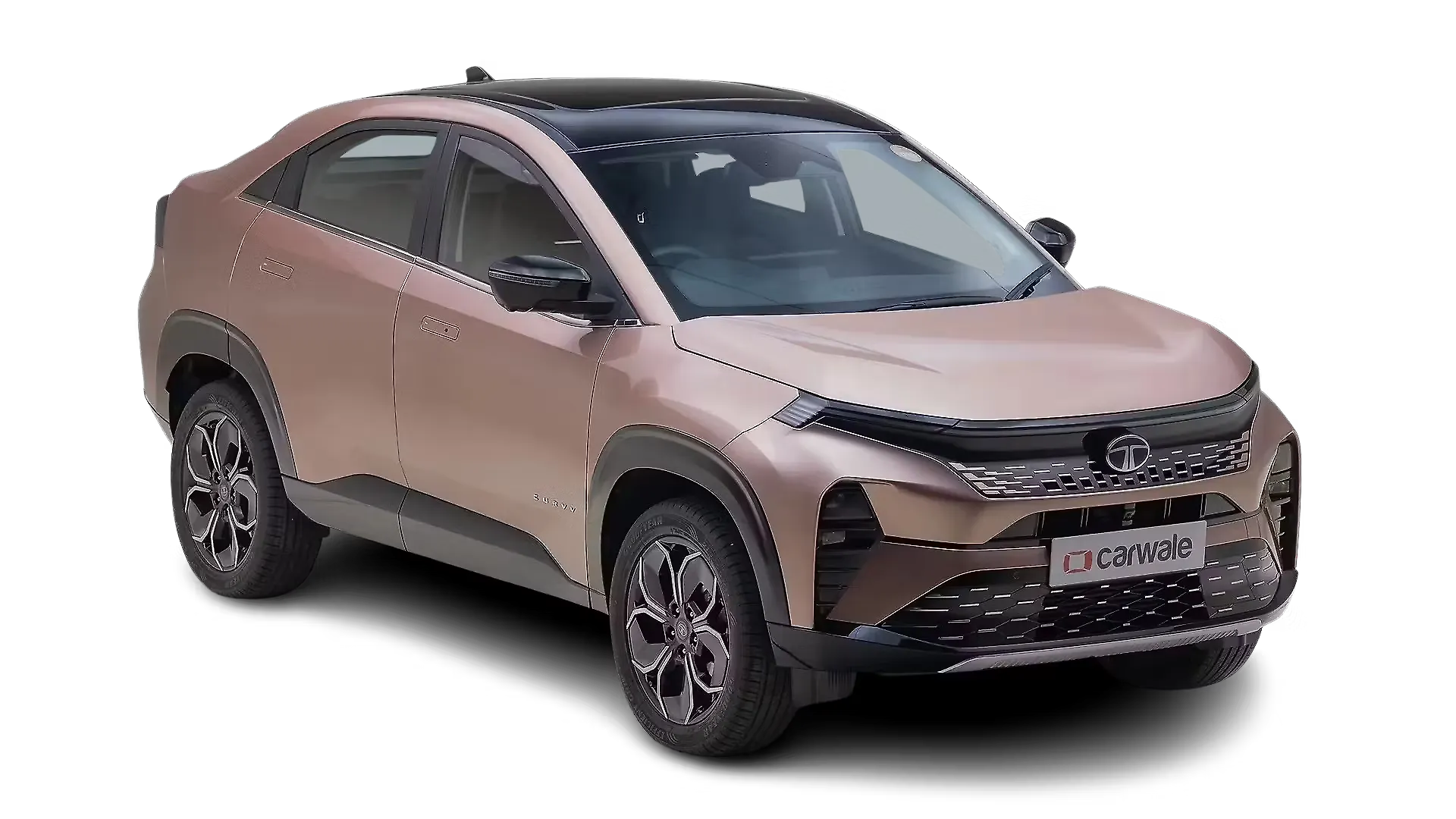
The Tata Curvv is India's first mainstream coupe SUV, offered in petrol, diesel and electric guises on an extended Nexon platform. It delivers a distinctive silhouette, a class-leading 500-litre boot and a genuinely capable 1.5 diesel, but ergonomic quirks, a rough dual-clutch automatic and a cabin lifted largely from the Nexon keep it short of segment-best.
Jury Score Breakdown
What Works
- Distinctive coupe SUV design with connected LED lighting
- Massive 500-litre boot with powered tailgate
- Strong 1.5 diesel with 17+ kmpl real-world mileage
- Feature-loaded top variants with Level 2 ADAS and JBL audio
- Solid ride quality at highway speeds and structurally strong platform
Watch Out For
- Rear headroom compromised by the sloping coupe roofline
- Diesel DCA gearbox is jerky, slow and feels underdeveloped
- Interior is largely a rebadged Nexon with hard plastics and odd ergonomics
- No rear wiper, only two parking sensors each end, quality niggles persist
Design
The Curvv is Tata's most distinctive silhouette in years and, for now, the only mainstream coupe SUV in India. Connecting LED DRLs, sequential indicators, flush door handles, an integrated rear camera in the Tata logo and welcome/goodbye animations give it real showroom presence. The petrol and diesel get a differentiated grille and bumper versus the EV, and 18-inch alloys are standard on top variants. Length is 4.31 m with a 190 mm ground clearance on the EV and 208 mm on ICE. The front-end resemblance to the Punch and Nexon is the weak spot, and the absence of a rear wiper on such a steeply raked tailgate is a genuine oversight. Love it or hate it, few rivals stand out this much in an SUV car park.
Interior & Features
Inside is where the Curvv struggles to justify its premium over the Nexon. The dashboard, AC controls, wireless charger and front seats are near-identical to its smaller sibling, dressed up here with a burgundy or dual-tone theme, ambient lighting and a 12.3-inch Harman touchscreen on top variants. Fit and finish has improved but plastics that look soft to the eye are hard to touch, panel gaps are inconsistent and the sunroof beading is patchy. The steering column sits slightly off-centre and juts out enough that taller drivers can knee it while exiting. Rear headroom is tight for six-footers thanks to the sloping roof, under-thigh support is average, and the middle passenger gets no headrest. The 500-litre boot with powered tailgate remains the cabin's true trump card.
Build Quality & Technology
Structurally the Curvv is built on Tata's Atlas platform, engineered for a 5-star Bharat NCAP rating, with six airbags, ESP, all-disc brakes on higher variants and Level 2 ADAS including blind-spot view monitor, rear cross-traffic alert and adaptive cruise. Feature count on the top trims is genuinely competitive: 12.3-inch touchscreen, 10.25-inch cluster, nine-speaker JBL, ventilated front seats, electric parking brake, panoramic sunroof and gesture-controlled powered tailgate. However, the ownership experience remains a concern flagged repeatedly: laggy screens, a sunroof leak on one press car, flashing DRLs, a stuck rear door, inconsistent panel gaps and Tata's mixed service reputation. Adaptive cruise wasn't functional on media cars despite being a production feature, which is worrying so close to launch.
Performance & Powertrain
Three engines are on offer, all shared broadly with the Nexon: a 1.2 revotron petrol, a new 1.2 TGDi direct-injection petrol with 125 PS and 225 Nm (with a 25 Nm sport-mode torque boost in third and above), and a 1.5 diesel with 118 PS and 260 Nm. The TGDi is a clear step up in refinement and mid-range punch, though V3Cars notes it still needs a better chassis to shine. The diesel is the pick of the line-up for torque and 17-19 kmpl real-world mileage, but the seven-speed dual-clutch automatic paired with it is the weakest link: shifts are slow, jerky and hunt around 1800 rpm. Faisal Khan clocked 0-100 in 11.2 seconds for the diesel DCA and 12.5 seconds for the petrol, both slower than the Creta turbo.
Ride Quality & Handling
Ride quality is a Tata strength and the Curvv largely upholds it. The suspension absorbs broken city roads and expansion joints with composure, and at highway cruising speeds the car feels planted and mature. The catch is a slightly firm low-speed edge and, on the EV, a noticeably firmer setup because of the heavier battery pack. Above 80 kmph over undulating surfaces the tail can feel a touch bouncy for rear passengers. The steering is light in the city but weights up oddly on the move, and the EV's yo-yoing assist gets tiring on longer stints. Body roll is present but controlled, and the tyres, Goodyear Efficient Grip on our test cars, don't offer much lateral bite. Brakes are progressive, though ABS intervention feels early.
Price & Value
The Curvv range starts at around Rs 10 lakh and stretches to Rs 22.5 lakh ex-showroom for the top petrol, with the diesel top-end just Rs 38,000 more. The EV runs from Rs 17.49 lakh to about Rs 23 lakh on-road, undercutting the Nexon EV top-spec while offering a bigger 55 kWh battery, 350-400 km real-world range and more space. The Pure S at Rs 11.69 lakh (with sunroof) and the Creative+ around Rs 12 lakh emerge as the sweet spots. Against the Creta and Seltos it offers more boot, similar features and a unique shape, but concedes a punchier petrol and a more polished cabin. Tata's 3-year/1 lakh km warranty helps, but resale and service reliability remain the honest question marks.
What India's Reviewers Agree On
Consensus
- Coupe SUV styling is genuinely differentiated in the segment
- 500-litre boot is class-leading and highly practical
- 1.5 diesel is torquey and returns 17-19 kmpl in real-world use
- Cabin, dashboard and driving position feel too close to the Nexon
- Level 2 ADAS, panoramic sunroof, ventilated seats and 360 camera are well-loaded
Points of Disagreement
- Whether the diesel DCA gearbox is acceptable: MotorBeam finds it a nice combo, while Faisal Khan and Gagan Choudhary call it jerky and unfinished
- Pick of the range: MotorBeam backs the diesel automatic, Faisal prefers the diesel manual, and MotorOctane leans toward the EV for value
Individual Reviewer Verdicts
"The Curvv EV is a strong value pick over the Nexon EV for city buyers who want a bigger battery and more space."
"Fine if you drive slowly on highways, but the engines lack fun and the DCA gearbox undermines the diesel."
"The diesel manual is the pick; the DCA feels like an AMT and traction control cannot be disabled."
"A feature-loaded, well-equipped coupe SUV with a strong safety story and a genuinely unique silhouette."
"Curvv EV already feels outclassed by newer rivals despite decent range, thanks to ergonomic and quality misses."
"Diesel automatic is the sweet pick of the range with 17.6 kmpl real-world and a refined engine."
"The new TGDi petrol impresses with mid-range punch, but the chassis doesn't yet do the engine justice."