 Image: Tata press kit
The 2025 Nexon EV remains India's most feature-rich, well-rounded mass-market electric car with meaningful improvements in motor efficiency, safety, and tech.
The 2025 Tata Nexon EV facelift brings a lighter Gen-2 motor, a 12.3-inch touchscreen with Arcade.EV apps, a 7.2 kW AC charger bundled as standard, and six airbags with reinforced side structure. With a 40.5 kWh long-range battery claiming 465 km ARAI, V2L/V2V capability, and prices starting around ₹14.49 lakh, it continues to outclass rivals like the Mahindra XUV400. However, panel-gap niggles, stiff low-speed ride, and ergonomic quirks keep it from perfection.
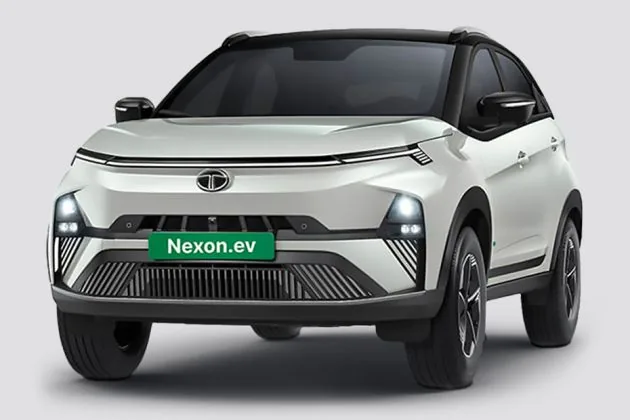
The 2025 Nexon EV carries the facelift's sharper silhouette but differentiates itself with a full-width connected LED light bar front and rear, a signature element that doubles as a charging-status indicator, glowing progressively as the battery fills. The front bumper, EV-specific low-rolling-resistance 215/60 R16 alloys, functional air curtain (claimed to improve range by 2%), and body-coloured cladding distinguish it from the ICE Nexon. Some reviewers note the front-end resembles the BYD Atto 3, though Tata showcased the Curve concept well before. The Empowered Oxide colour option, dual-tone roof, hidden rear wiper under the spoiler (Range Rover-style), and welcome-light animation add premium flair. However, fit and finish disappoints, panel gaps around the bumper, misaligned charging-flap trim, and inconsistent alignment between left and right sides are visible even on showroom cars. Overall, it looks modern and EV-distinct without being polarising, but the execution lacks the finesse expected at this price.
Inside, the Empowered variant introduces a blue-and-black theme with leather-like soft-touch upper dashboard, piano-black accents, and a Range Rover-inspired flat-bottom steering wheel. The star is the new 12.3-inch touchscreen (up from 10.25-inch) running Arcade.EV, a suite of apps including Netflix, YouTube, Prime Video, and games, accessible via a bundled Jio Wi-Fi dongle when parked or charging. A 10.25-inch digital cluster, wireless Android Auto/CarPlay, wireless charging pad, 45 W USB-C fast charging (front and rear), ventilated front seats, electronic parking brake with auto-hold, single-pane sunroof with voice commands, and JBL 9-speaker audio with subwoofer round out the kit. Rear-seat space is adequate but under-thigh support suffers due to the raised floor (battery pack). Piano-black surfaces are fingerprint magnets, the horn pad requires awkward pressing, and steering adjusts for tilt only (no telescopic). The cabin feels genuinely premium in parts but is let down by hard lower plastics and fiddly touch controls.
Tata has made meaningful strides on safety, six airbags are standard, the side structure has been reinforced for better pole-impact protection, ESC is standard, and features like blind-spot monitor, driver rear-view camera, 360° camera, front and rear parking sensors, hill-hold and hill-descent control are included. Doors shut with a satisfying thud and the cabin feels solid. However, exterior fit-and-finish lets the package down: reviewers pointed out visible panel gaps, a misaligned charging-port flap, uneven bumper-to-body alignment, and a request sensor present on only one side. Interior material quality is improved with soft-touch upper dashboard and leather-like surfaces, but lower plastics remain hard and piano-black trims scratch and smudge easily. Touch-sensitive controls on the centre console are fiddly in motion. The 8-year / 1.6 lakh km battery warranty and Tata's widespread service network are strong reassurances for long-term ownership.
The long-range variant uses a 40.5 kWh battery paired with a new Gen-2 permanent-magnet synchronous motor producing 145 PS and 250 Nm, torque is actually 38 Nm lower than before, yet the 20 kg lighter motor helps the car hit 0-100 km/h in 8.9 seconds (quicker than before). Top speed is now 150 km/h (up from 140 km/h). Three drive modes (Eco, City, Sport) and four regen levels (now on paddle shifters) are offered, though reviewers note there's no true one-pedal driving, even max regen won't bring the car to a complete stop. Acceleration is linear and refined but has lost the original Nexon EV's neck-snapping urgency, feeling more like a quick petrol car than an aggressive EV. The medium-range variant gets a 30 kWh pack with 129 PS / 250 Nm and a claimed 325 km range. Performance is more than adequate for city and highway use, with silent, refined cruising being a highlight.
Ride quality is a mixed bag. At low city speeds the suspension feels stiff, and sharp bumps and broken patches do filter into the cabin, a trait amplified by the battery weight (kerb ~1,531 kg). As speeds rise the ride settles down noticeably, ironing out larger undulations with composure and feeling robust over highway expansion joints. Ground clearance is adequate for Indian roads and the sealed battery removes any water-ingress worry during monsoons. The steering is light at parking speeds and weighs up adequately on the highway, though it's not particularly communicative; body roll is present but controlled. Handling is safe rather than sporty, and the low-rolling-resistance MRF tyres prioritise range over outright grip, leading to some tyre squeal under hard cornering or braking. Rear disc brakes (absent on the ICE Nexon) improve stopping power, and brake-pedal feel is consistent even as regen blends in. Overall, the Nexon EV is a comfortable city cruiser that matures on the highway.
Prices start at ₹14.49 lakh ex-showroom for the medium-range Creative and go up to ₹19.49 lakh for the long-range Empowered (one reviewer estimates on-road Mumbai pricing of ₹18-21.5 lakh). The jump from medium to long range is roughly ₹1 lakh at equivalent trims, money well spent given the extra 140 km of claimed range. The Nexon EV remains the most feature-rich mass-market EV in India, undercutting and out-equipping the Mahindra XUV400 on almost every count, reviewers were unanimous that the XUV400 simply cannot match this package. Standard inclusions like the 7.2 kW AC home charger, V2L/V2V capability, six airbags, 360° camera, ventilated seats, and Arcade.EV apps justify the premium over ICE rivals for urban buyers with home charging. However, real-world range of 250-290 km means it's best suited as a city car; long-distance travellers may still prefer a diesel. Overall, it offers strong value within the EV space.
TeamBHP's community has long praised the Nexon EV's sorted ride, strong safety credentials, and Tata's improving service network, while consistently flagging panel-gap issues and software glitches as areas needing attention. Owner feedback on earlier Nexon EVs suggests real-world range of 250-280 km in mixed conditions aligns with what the 2025 model delivers, and the 8-year battery warranty plus growing fast-charger network make it a sensible second-car choice for urban families. Long-term forum threads note that ownership costs are significantly lower than ICE rivals, but buyers are advised to do a thorough PDI given Tata's history of quality inconsistencies.
"Calls it the best mass-market EV in India that blows the XUV400 out of the water, but laments the loss of the original Nexon EV's aggressive acceleration and highlights persistent fit-and-finish issues."
"Appreciates the new 12.3-inch screen, Arcade.EV apps, bundled 7.2 kW charger and Gen-2 motor, but holds back full judgement until embargo lifts, noting the price will be the critical factor."
"Independent range test recorded 7.17 km/kWh in city and 6.06 km/kWh on highway, translating to a real-world full range of 270-290 km in city and 250-260 km on highway, well short of the 465 km ARAI claim."
See also: BE6 vs Nexon EV →