 Image: Tata press kit
A genuinely capable electric SUV with strong road presence, real off-road ability and Tata's lifetime battery warranty, though it isn't a born EV and the cabin tech still has rough edges.
The Tata Harrier EV is India's first mass-market electric SUV with a Quad Wheel Drive system, paired with a 75 kWh battery, 390 hp dual-motor setup and a 0-100 km/h time of 6.3 seconds. Priced from Rs 21.49 lakh to Rs 28.99 lakh ex-showroom, it offers Land Rover-derived underpinnings, a 5-star Bharat NCAP rating and a lifetime battery warranty. The catch: it shares its silhouette with the diesel Harrier, charging tops out at 120 kW DC, and real-world range sits around 380-420 km in mixed driving.
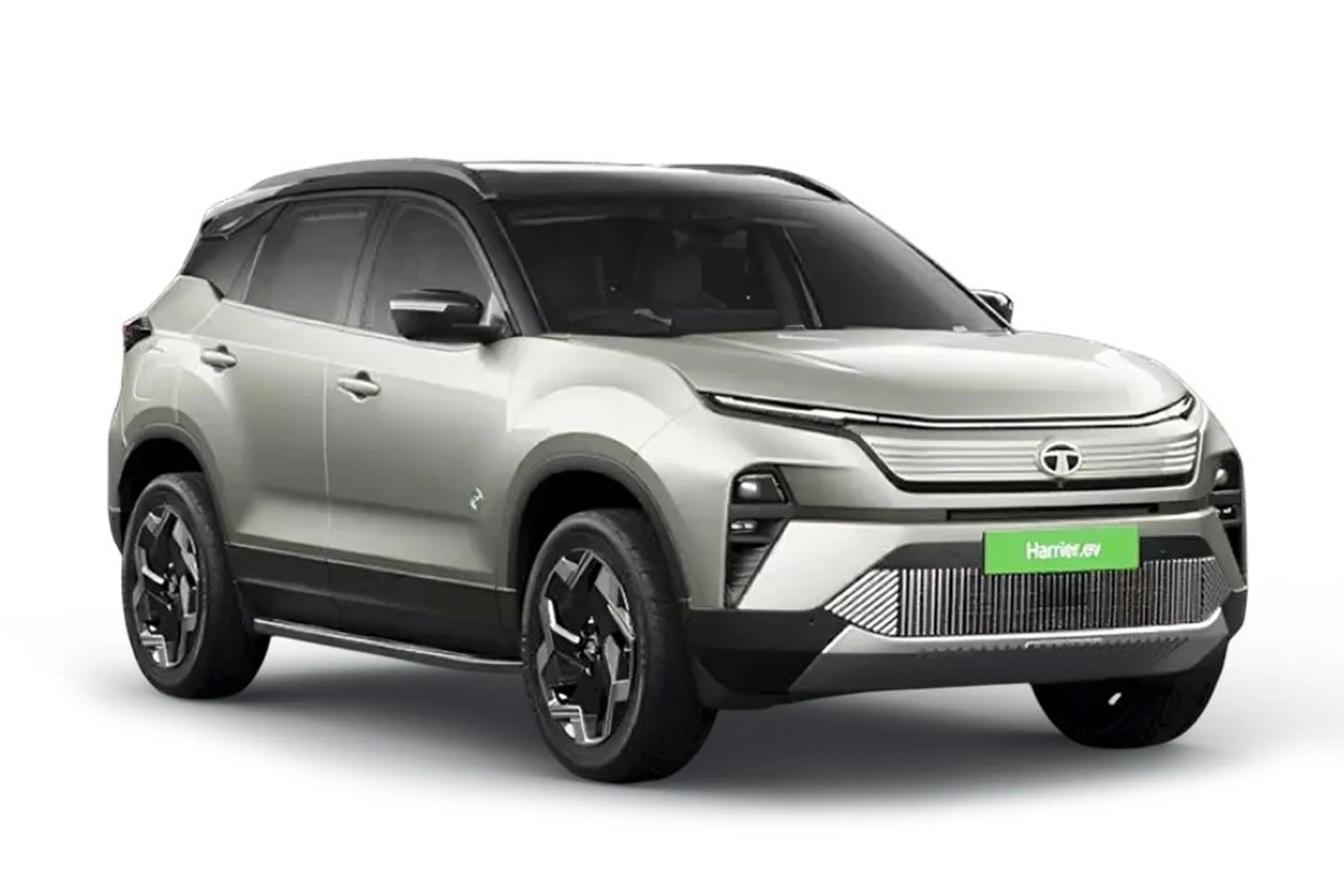
The Harrier EV plays it safe, wearing the same silhouette as the diesel car with EV-specific tweaks: a closed grille, connected LED DRLs with sequential indicators, 19-inch piano black alloys with aero inserts and subtle QWD badging. Dimensions are SUV-substantial at 4.6 metres long, 2.1 metres wide and 1.7 metres tall, with a 25.3-degree approach angle, 600 mm wading depth and roughly 2,300 kg kerb weight. The Stealth Edition's matte black finish and the unique Nainital Nocturne Blue add visual flair, while skid plates, roof rails and a shark-fin antenna housing the rear-view camera complete the look. Biturbo Media notes the new grille design is genuinely an improvement over the ICE car's. The wider editorial concern is that this is still recognisably a Harrier at a time when the Mahindra XEV 9e and BE 6 are using born-EV freedom to look futuristic. For buyers who want quiet confidence rather than statement design, that familiarity is a feature, not a bug.
Inside, the Harrier EV pushes hard on premium feel. The dashboard mixes soft-touch materials with piano black trim and is dominated by a 14.53-inch Samsung NeoQLED Harman infotainment screen, which earns praise for its UI quality and Dolby Atmos tuning through the 10-speaker JBL system. A 10.25-inch digital cluster, ventilated front seats with memory, six-way powered driver and four-way powered passenger seats, panoramic sunroof, dual-zone climate, wireless charging and a digital IRVM with HD camera and dashcam recording round out the kit. Rear space is decent for the segment with a flat floor, boss mode, sunshades and rear AC vents, though anyone over six feet sitting behind a similarly tall driver will find knee room tight. Boot space is 502 litres but with an awkward shape due to the spare wheel housing. Niggles add up: too many functions buried in touch menus, no centre rear headrest, no sun-visor vanity mirror, and the key fob's auto-park summon buttons need an uncomfortably firm press.
Build quality and safety credentials are core to the pitch: a 5-star Bharat NCAP rating, seven airbags on the top variant, IP67-rated motor and battery protection, ESP, hill descent, blind-spot monitor, 360-degree camera with transparent mode and a comprehensive ADAS suite. Tata's lifetime battery warranty for the first owner (15 years, unlimited km), 8-year/1.6 lakh km motor warranty and 3-year/1.25 lakh km vehicle warranty stack up well. Feature integration, however, betrays the shared-platform origin. Namaste Car catalogues a long list of tech, but several reviewers flag that the Harrier EV is not a born EV: AC charging is capped at 7.2 kW (versus 11 kW or higher on rivals), DC fast charging tops out at 120 kW, the dashcam isn't tied into the 360 system, and seat ventilation doesn't talk to the infotainment. Software glitches surfaced during testing, including screens going blank, indicator chimes cutting out and the regen level not persisting between ignition cycles. The hardware is excellent; the software needs more polish.
The QWD variant pairs a front induction motor with a rear permanent-magnet synchronous motor for a combined 390 hp and 504 Nm, delivering a claimed 0-100 km/h in 6.3 seconds and a 180 km/h top speed. In practice, MotorBeam found the instant torque genuinely useful in Mumbai traffic and on the old Mumbai-Pune highway, where the car cruised effortlessly and tackled Rajmachi's off-road trail without drama thanks to dedicated Mud Ruts, Sand, Rock Crawl, Snow/Grass and Custom modes. Three drive modes (Eco, City, Sport) plus Boost adjust throttle response and steering weight, though Boost is disabled below 50% state of charge. The steering gains weight in Boost but feedback is artificial. Paddle shifters are repurposed to toggle four levels of regen, a thoughtful touch. ADAS Level 2 with adaptive cruise, lane keep assist and AEB works well on marked expressways. The car's roughly 2.3-tonne kerb weight is always felt, but the chassis manages it without feeling unwieldy under normal use.
Ride quality is one of the Harrier EV's standout strengths. The independent suspension with active frequency-dependent dampers, derived from the Land Rover-influenced Omega Arc-based Acti.ev Plus platform, glides over patched highways and broken city roads with a composure that few EVs at this price match. Goodyear Electric Drive tyres on 19-inch wheels keep things quiet. Sharp-edged potholes still send a thud through the cabin, but the recovery is quick and the structure feels rock solid. Handling is where opinions split. V3Cars finds the soft setup makes the car feel nervous at highway speeds, with body roll evident during quick lane changes and curves. Other reviewers report it stays stable and confidence-inspiring, particularly in Boost mode where steering weight increases. The reality is that this is a tall, heavy SUV tuned for comfort first, so spirited driving is not its brief. Auto Hold paired with the electric parking brake is exceptionally well calibrated and intuitive in stop-go traffic.
Pricing runs from Rs 21.49 lakh to Rs 28.99 lakh ex-showroom, with the QWD top variant tested here at Rs 28.99 lakh. The 65 kWh RWD opens the range, the 75 kWh RWD adds Rs 1 lakh in the Fearless+ trim, and the QWD Empowered Stealth sits at the top. For the money, you get a 5-star-rated SUV with genuine all-wheel-drive off-road ability, a 75 kWh LFP battery, dual motors, lifetime battery warranty and a feature list that genuinely competes with cars costing more. The trade-off is real-world range that lands at 380-420 km in mixed driving (slightly more for the lighter RWD), the Harrier-derived design that won't turn heads the way an XEV 9e does, and the inherited compromises of a non-bespoke EV platform. For buyers who value substance, safety and capability over novelty, it represents strong value. Those chasing the freshest born-EV experience or maximum DC charging speeds should weigh the alternatives carefully.
TeamBHP's community has long valued the Harrier's road presence and build, and early Harrier EV impressions echo that, while flagging the same software niggles and charging-speed limitations seen across recent Tata EVs. Owner-style observations on the forum align with the consensus that the QWD's off-road hardware is genuine but range anxiety on remote routes like Spiti or Ladakh remains a real concern given India's patchy charging infrastructure.
"Calls out that the Harrier EV is not a born EV and that some features feel bolted on, with city range around 400 km and highway range closer to 340 km in his test."
"Impressed by the off-road capability on a dedicated track and the infotainment UI, but argues Tata missed a chance by not styling it differently from the ICE Harrier."
"Walks through the spec sheet in forensic detail, highlighting the 5-star rating, lifetime battery warranty, 540-degree camera and the unique Nainital Nocturne Blue paint."
"After a structured range test, pegs effective real-world efficiency at 6.21 km/kWh in city and 4.49 km/kWh on highway, translating to 400-470 km city and 330-380 km highway."
"Took the car from Mumbai to Rajmachi via the old Pune highway and came away convinced the QWD makes light work of off-road trails while delivering around 450 km on a full charge."