 Image: Tata press kit
India's first coupe-SUV EV delivers genuine range, a bigger battery and distinctive styling at a sensible price, provided you can live with Tata's familiar quality niggles.
The Tata Curvv EV is India's first mainstream coupe-SUV, built on the acti.ev platform with a 55 kWh long-range battery option claiming 585 km. It's larger, better equipped and quicker than the Nexon EV it shares parts with, but inherits the same dashboard, interior and Tata's familiar quality concerns. Priced from around Rs 17.49 lakh to Rs 22 lakh ex-showroom, it's a value-led EV with a polarising silhouette.
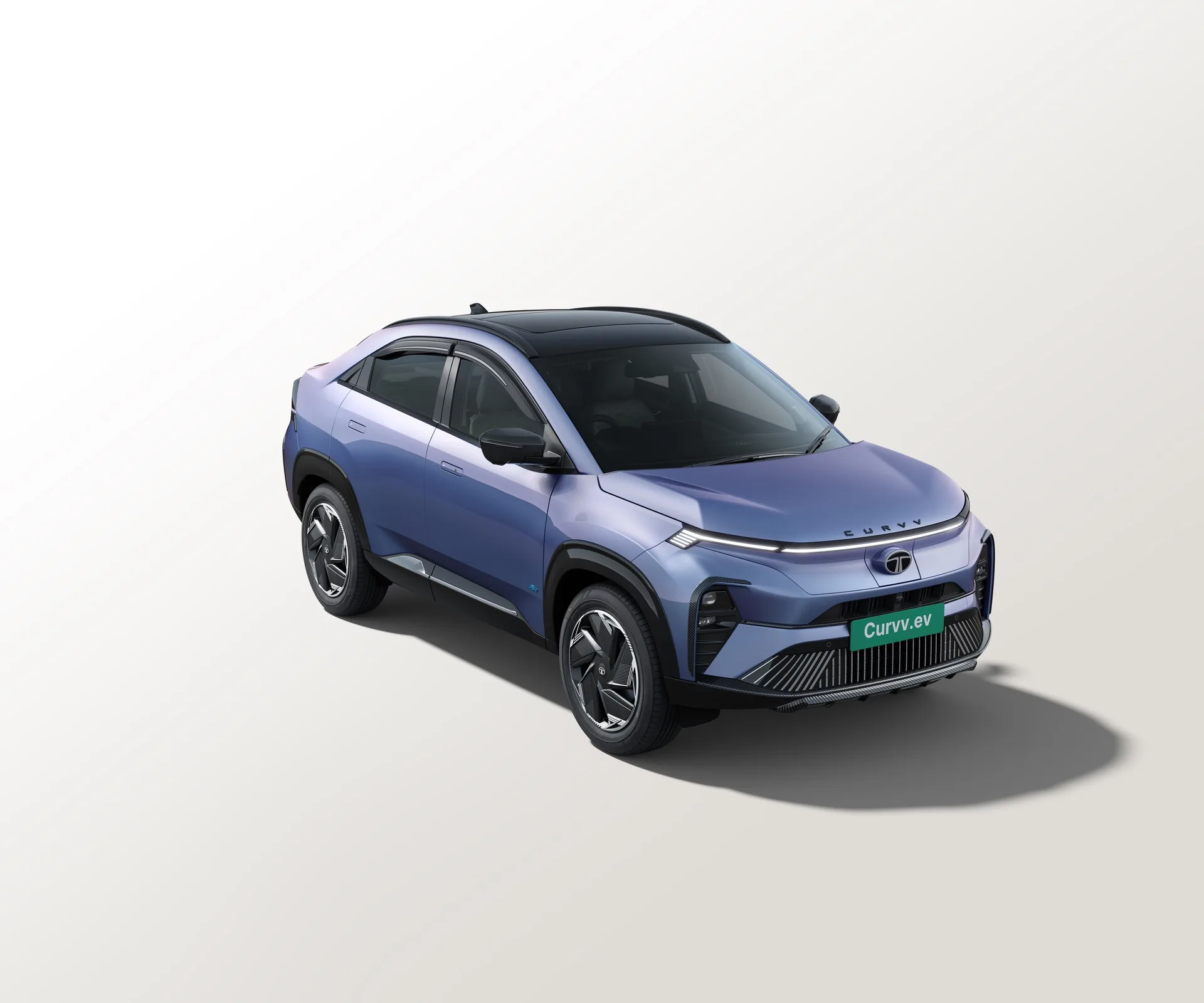
The Curvv EV is the first mainstream coupe-SUV from an Indian carmaker and that single decision defines the car. The front end is largely lifted from the Nexon, with connected LED DRLs, sequential indicators and a closed-off EV fascia, but the rear three-quarter is where the design earns its keep: a sharply raked roofline, connected LED tail lamps, a glossy black spoiler and an integrated camera in the Tata logo. Flush door handles with illumination are a segment-first touch, though the press point sits oddly to one side of the lit area. At 4310 mm long with a 2560 mm wheelbase, it is 62 mm longer in wheelbase than the Nexon, sits on 17 or 18 inch wheels depending on variant, and offers 190 mm of ground clearance on the EV. The piano black lower cladding is a magnet for scratches, as Faisal Khan flags, and the front could have been differentiated more from its smaller sibling.
Step inside and the Curvv EV feels less like a new car and more like a Nexon EV in nicer clothes. The dashboard, centre console, AC controls, wireless charging pad and door pads are shared wholesale, with only the four-spoke Harrier-style steering wheel and a different upholstery shade marking it out. The 12.3 inch Harman touchscreen and 10.25 inch digital cluster are crisp, the latter now showing a blind-view feed when indicators are used. Materials look soft-touch but are hard plastic almost everywhere. Front seats are six-way powered with ventilation; the panoramic sunroof gets ambient lighting around its frame. The biggest interior demerit is packaging: the centre console lacks cup holders (Tata oddly puts them in the glovebox), the rear bench loses headroom to the sloping roof for anyone near six feet, and a third rear passenger gets no headrest. Boot space, however, is genuinely class-leading at 500 litres plus an 11.6 litre frunk.
This is the Curvv EV's weakest area and the one Tata most needs to address. Faisal Khan's punch list is long: inconsistent panel gaps, a horn that requires effort to press, a flimsy sunroof switch, occasionally unresponsive touch panels, fingerprint-prone glossy finishes, only two parking sensors per bumper instead of four and switchgear that feels dated next to Hyundai-Kia rivals. The flush door handles look the part but are a form-over-function exercise. That said, the feature list is genuinely generous: six airbags, ESC, TPMS, hill descent control, ISOFIX, a 360-degree camera with 3D view, a nine-speaker JBL system with subwoofer, an air purifier, auto-dimming IRVM and a comprehensive Level 2 ADAS suite including adaptive cruise, lane keep assist, autonomous emergency braking, blind spot monitor and rear cross-traffic alert. The car is engineered for a five-star Bharat NCAP rating. Warranty stands at three years/1.25 lakh km on the vehicle and eight years/1.6 lakh km on the battery.
The Curvv EV is offered with two battery packs: a 45 kWh unit producing 148 PS with a claimed 502 km range, and the 55 kWh long-range variant making 167 PS and 215 Nm with a claimed 585 km. The latter does 0 to 100 kmph in a claimed 8.6 seconds and feels genuinely brisk in Sport mode, with traction control struggling to contain wheelspin off the line. In the real world, an instrumented range test by Gagan Choudhary showed the 55 kWh car delivering an extrapolated 309 km when driven hard with shoots in between, translating to a comfortable 380 to 420 km in normal use, meaningfully more than the Nexon EV long-range manages. Charging support is up to 70 kW DC for the 55 kWh and 60 kW for the 45 kWh, with V2L and V2V at 3.3 kW. There are three drive modes and four regen levels, enabling near single-pedal driving in city traffic.
Underpinned by the dedicated acti.ev platform with a 50:50 weight distribution, the Curvv EV feels planted and light to drive. Low-speed ride is absorbent, the steering is feather-light around town and weights up acceptably as speeds rise. The platform's strength shines on the ghat roads around Udaipur, where the V3Cars team noted how composed it feels for a 1.8-tonne EV. Where opinions split is at highway speeds: on undulating sections above 80 kmph the rear can feel bouncy, and Namaste Car notes the heavier rear end translates to visible body roll in fast corners. Brakes are progressive thanks to Tata's iVBAC system blending regen and friction braking. Ground clearance of 190 mm is 18 mm less than the petrol-diesel Curvv, so buyers in pothole-heavy areas should note the Nexon EV will tackle bad roads with better approach and departure angles than its larger coupe sibling.
Tata has priced the Curvv EV from roughly Rs 17.49 lakh to Rs 21.99 lakh ex-showroom, with on-road prices for the top Empowered+ A 55 hovering around Rs 23 to 25 lakh. That positioning is sharp: the Nexon EV long-range top variant lands in similar on-road territory, meaning Curvv buyers get a larger car, a bigger battery, more range, faster charging, ADAS and a panoramic sunroof for comparable money, as MotorOctane points out. Against the MG ZS EV and Mahindra XUV400, it reads as strong value. A 7.2 kW AC home wallbox is bundled free. The catch is depreciation risk tied to Tata's quality reputation and the fact that the smaller 45 kWh Curvv EV may itself match the Nexon EV long-range on real-world range while costing less, making it the sweet-spot variant for buyers who don't need the absolute maximum range. For city-centric EV buyers, the Curvv 55 is the rational pick.
TeamBHP's community has flagged the Curvv EV as Tata's most resolved EV yet on the acti.ev platform, with owners praising the real-world range and fast-charging consistency on networks like Statiq. However, recurring threads echo the press fleet's findings on fit-finish, software lag and early teething issues with LED lamps, alongside concerns about Tata's after-sales response times that prospective buyers should factor in.
"Ran a back-to-back range test against the Nexon EV and concluded the Curvv 55 will return 380 to 420 km in favourable conditions, with a more accurate speedometer than the Nexon."
"Calls it strong value-for-money against the Nexon EV long-range, with the bigger battery, more space and a feature edge justifying the small price premium."
"Rates the Curvv EV as the best variant of the lineup and clearly ahead of the petrol GDI and DCT diesel, but maintains a long list of fit-finish and switchgear gripes."
"Praises the bold coupe-SUV silhouette and 500 litre boot but flags rear headroom loss, body roll and high-speed instability over undulations."
"Highlights the platform's lightness and composed dynamics on ghat roads, but feels the cabin lacks novelty given how much it borrows from the Nexon EV."
See also: Hyundai Creta Electric