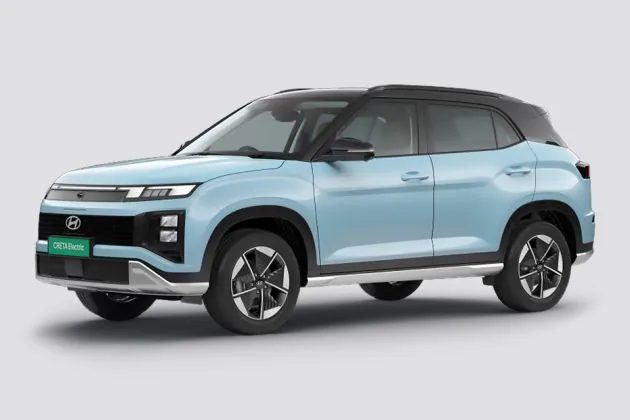
Hyundai Creta Electric — official press image Image: Hyundai press kit
The Car Jury Verdict · 2025

Hyundai Creta Electric — The Jury's Verdict

BUY
7.8
Jury Score / 10

A no-nonsense, feature-loaded electric SUV that leverages Creta's proven reliability with strong range and Hyundai's charging network advantage.

By The Car Jury Editorial Published 2026-04-23 Synthesis of 5 independent sources 2,167 words · 9 min read

The Hyundai Creta Electric is the EV avatar of India's best-selling mid-size SUV, offered with 42 kWh and 51.4 kWh battery packs delivering 390 km and 473 km of claimed range respectively. With 171 PS on tap, it's the fastest Creta ever at a claimed 0-100 km/h of 7.9 seconds, and comes loaded with Level 2 ADAS, V2L, 360-camera, and Hyundai's in-car payment for 10,000+ charging stations. It trades outright drama for Hyundai's trademark reliability and ease of ownership.

Jury Score Breakdown

Design
7.5
Interior
8.0
Performance
8.0
Ride Quality
7.0
Build Quality
8.0
Value for Money
7.5

What Works

  • Fastest Creta ever with instant EV torque and 171 PS on the long range variant
  • Proven Creta reliability, pan-India service network and strong resale assurance
  • Class-leading feature list including Level 2 ADAS, V2L, in-car payment, boss mode and memory seats
  • Real-world range of 350-400 km is very achievable on the long-range variant
  • Frunk storage (22L) plus 433L boot, flat rear floor and improved rear seat recline

Watch Out For

  • Ride quality has become firmer due to stiffer suspension; body roll still present at speed
  • NMC battery chemistry may be less suited to Indian heat than LFP used by some rivals
  • No wireless Apple CarPlay/Android Auto despite premium positioning
  • Steering lacks feel and feedback; not a driver's car
  • LFP vs NMC debate aside, some cost-cuts remain (no request sensor on passenger side, basic key)

Design

The Creta Electric is instantly recognisable as a Creta, but Hyundai has made 32 changes to differentiate it. The front gets a fully closed grille with active air flaps for aerodynamics and battery cooling, a pixel-pattern bumper, and a front-mounted charging port (which reviewers note is vulnerable in front-end collisions). The DRLs and connected tail lamps carry over, but the rear bumper now features six reverse lights in pixel treatment and EV-specific badging. New aero-style 17-inch alloys on 215/60 R17 Goodyear Assurance low rolling resistance tyres mark it out, as does an exclusive matte green shade. Ground clearance is up by 10 mm to 200 mm, overall height by 20 mm, and length by 10 mm. A matte green finish, dual-tone roof option and EV-only colours add freshness, though the silhouette is clearly Creta. Notably, the battery pack is visible from the side and appears to leave unused space at the rear, suggesting room for a larger battery in future.

Interior & Features

The cabin retains the familiar Creta layout but gets meaningful EV-specific upgrades. A new free-floating centre console liberates storage space, with a wireless charging pad, NFC tap-to-start, cooled storage under the armrest, and twin cup holders. A new flat-bottom steering wheel (with Hyundai's Morse-code four-dot motif borrowed from the Ioniq 5) replaces the standard unit, and shift-by-wire moves the drive selector to the steering column. You get dual 10.25-inch screens, dual-zone climate (now touch-sensitive — a point of contention), ventilated and 8-way power-adjustable front seats with memory, an 8-way powered co-driver seat, and boss mode borrowed from the Alcazar. Rear occupants benefit from a flat floor, two-step seat recline, airline-style trays with cup holders, rear AC vents with twin USB-C ports, window sunshades, and a big panoramic sunroof. Seats are upholstered in material made from recycled corn extracts and plastic bottles. Boot space stays at 433 litres with a Bose subwoofer; the 22-litre frunk is a genuine bonus. Fit, finish and consistency remain Creta-strong.

Performance & Powertrain

This is the fastest Creta ever built. The long-range variant pairs a 51.4 kWh NMC liquid-cooled battery with a 171 PS / 255 Nm front-mounted motor, claiming 0-100 km/h in 7.9 seconds — one reviewer clocked 7.5 seconds with downhill assist and 8.7 seconds in wet conditions, with significant wheelspin being the limiting factor due to front-wheel drive. The standard-range 42 kWh pack makes 135 PS but retains the same 255 Nm torque and is claimed to do 0-100 km/h in under 9 seconds. Top speed is around 173 km/h. Four levels of regen (adjustable via paddles) culminate in an i-Pedal one-pedal driving mode, and the ADAS system cleverly links to regen for smoother deceleration when following traffic. Real-world range on the long-range variant is consistently reported at 350-400 km, with one reviewer seeing 9 km/kWh efficiency on the highway. Drive modes include Eco, Normal and Sport, with Eco noticeably blunting performance. The VESS pedestrian alert sound is mandatory at low speeds.

Ride Quality & Handling

To cope with the additional 166 kg of battery weight (kerb weight rises to around 1,577 kg), Hyundai has stiffened the suspension compared to the ICE Creta. Opinions on the result diverge: reviewers agree ride quality remains composed for India's broken roads, but V3 Cars notes road imperfections filter into the cabin more than expected, and body roll is still present — a contradictory trait that hurts high-speed confidence. MotorOctane disagrees, feeling the lower centre of gravity from the floor-mounted battery actually reduces body roll versus the ICE Creta and makes it more planted. The steering weighs up decently at speed but lacks feedback and isn't engaging. Brakes are adequate with well-contained nose-dive. Ground clearance of 200 mm is reassuring, and Hyundai claims 40% gradeability and an IP67-rated, water-submersion-tested battery pack. The Creta Electric is a relaxed, No-Nonsense cruiser rather than a driver's EV — in keeping with the Creta's traditional character.

Build Quality & Technology

Hyundai claims 75% of the body structure uses high and ultra-high strength steel, with a redesigned lower structure to accommodate the battery. The car gets 52 standard safety features and 75 advanced safety features including 6 airbags, ESC, Level 2 ADAS with 19 functions (forward collision warning, AEB, adaptive cruise with stop-and-go, lane keep assist, blind view monitor, rear cross-traffic alert, leading vehicle departure alert), TPMS, all-wheel disc brakes, and ISOFIX. The battery pack is IP67-rated, liquid-cooled, survives 30 minutes in 1 metre of water, and operates down to -35°C. Vehicle warranty is 3 years unlimited km (extendable to 7), battery warranty is 8 years / 1.6 lakh km, and the AC charger gets a 3-year warranty. Blue Link connected car features are complimentary for 3 years with 70+ functions and 260+ voice commands (132 in Hindi). Fit and finish are typical Hyundai — consistent, durable and feel built to last, which is the car's core promise.

Price & Value

Exact pricing wasn't disclosed at the time of the reviews, but estimates place it in the ₹16-24 lakh (on-road) bracket, pitting it directly against the Tata Curvv EV and MG ZS EV, with the more powerful, rear-wheel-drive Mahindra BE 6 and XEV 9e sitting above. Reviewers unanimously call out that the Mahindras offer bigger batteries (59/79 kWh), more power and a born-EV platform, but at higher prices. The Creta Electric's trump card is Hyundai's reliability track record, service network, strong resale value, and the in-car payment system tied to 10,000+ chargers (targeting 600 Hyundai-branded stations in 7 years, with 295 chargers across 119 dealers). Charging: 58 minutes (10-80%) on a 50 kW DC charger, dropping to 39 minutes once the 100 kW OTA update arrives. AC charging on the bundled 11 kW unit takes about 4-4.5 hours. Complimentary 3-year roadside assistance and an optional 5-year maintenance package sweeten the deal. For buyers prioritising peace of mind over outright specs, this is the EV to pick.

What India's Reviewers Agree On

Consensus

  • The long-range 51.4 kWh variant with 473 km claimed range is the one to buy; the 42 kWh version's 390 km claim is inadequate
  • Performance is genuinely quick — 7.9 seconds claimed 0-100 km/h makes it the fastest Creta ever
  • Feature loaded: Level 2 ADAS, dual 10.25-inch screens, panoramic sunroof, Bose audio, ventilated seats, 360 camera, V2L, boss mode
  • Reliability, brand trust, service network and resale value are the biggest reasons to pick this over rivals
  • In-car payment with 10,000+ mapped chargers and Hyundai's expanding charging network is a genuine USP
  • Suspension has been stiffened to cope with 166 kg extra weight, making the ride firmer than the ICE Creta
  • Boot space remains at 433 litres plus a usable 22-litre frunk

Points of Disagreement

  • Handling verdict is split — MotorOctane says body roll is reduced due to low centre of gravity, while V3 Cars feels it lacks confidence at higher speeds with contradictory stiff-yet-rolly behaviour
  • Touch-sensitive climate controls divide opinion — some find them modern and EV-appropriate, others prefer the physical buttons of the ICE Creta

TeamBHP's Take

teambhp-text">The TeamBHP community broadly validates the Creta Electric as a sensible, low-risk EV purchase given Hyundai's proven reliability, nationwide service footprint and strong resale — traits that have made the regular Creta one of India's top-selling SUVs for a decade. Forum members flag the choice of NMC chemistry over LFP as a concern for Indian summers, and note that Mahindra's BE 6 and XEV 9e offer more power, bigger batteries and a dedicated EV platform for similar money. However, for owners prioritising no-drama ownership and strong residuals, the Creta Electric is considered the safest bet in the segment.

Individual Reviewer Verdicts

Faisal Khan
Faisal Khan (vDDuSEwRdkA)

"Calls it the fastest Creta ever at 7.5 seconds on test, loves the feature list and in-car payment, but notes it trades excitement for Hyundai's trademark no-nonsense reliability."

Mudit Bhambri
Mudit Bhambri (w0HX9r_tUII)

"After a 160 km real-world test, endorses the 350 km realistic range and says the Creta Electric is a well-rounded, trustworthy EV that delivers on Hyundai's brand promise."

V3 Cars
V3 Cars (MVhVmvYyLzA)

"Highlights 9 km/kWh efficiency and improved cabin feel, but is critical of the stiffened suspension that compromises ride balance while still allowing body roll."

Nikhil Rana
MotorOctane (M-EvNivlXwE)

"Positions it as the safest EV bet in the segment thanks to Hyundai's reliability and resale, but flags the missing brake-by-wire as a clear engineering miss."

Watch the Reviews

Frequently Asked Questions

Should I buy the Hyundai Creta Electric?
Yes, if you value reliability, a strong service network and peace of mind over outright specs. It's the fastest Creta ever (0-100 km/h in 7.9 seconds claimed), offers 473 km claimed range on the long-range variant, and comes with Level 2 ADAS, V2L, and in-car payment access to 10,000+ chargers. Pick the 51.4 kWh long-range variant — the 42 kWh version's 390 km claim translates to only around 300 km real-world.
What is the Hyundai Creta Electric price in India?
Official pricing was not confirmed at the time of these reviews, but industry estimates place it in the ₹16-24 lakh on-road bracket, competing directly with the Tata Curvv EV and MG ZS EV, and undercutting the Mahindra BE 6 and XEV 9e.
What are the main problems with the Hyundai Creta Electric?
Key complaints include a stiffer ride due to the added 166 kg battery weight, steering that lacks feel, touch-sensitive climate controls (less user-friendly than the ICE Creta's buttons), no wireless Apple CarPlay/Android Auto, NMC battery chemistry (potentially less heat-tolerant than LFP), and the front-mounted charging port which is vulnerable in minor front-end bumps.
How is the Hyundai Creta Electric mileage?
The long-range 51.4 kWh variant claims 473 km; real-world range reported by reviewers is 350-400 km depending on driving style and use of regen. The smaller 42 kWh variant claims 390 km, translating to around 300 km in real-world conditions. Efficiency observed was around 9 km/kWh on the highway.
Is Hyundai Creta Electric good for highway driving?
Yes. With 171 PS, 255 Nm and a claimed 0-100 km/h of 7.9 seconds, it has ample highway performance. Level 2 ADAS with adaptive cruise control, lane keep assist and blind view monitor make long drives easier. However, the steering lacks feedback and some body roll remains at higher speeds.
How does Hyundai Creta Electric compare to rivals?
Against the Tata Curvv EV and MG ZS EV, the Creta Electric offers better cabin space, more features, Hyundai's reliability edge and a stronger charging ecosystem. Against the pricier Mahindra BE 6 and XEV 9e, it loses on battery size (51.4 vs 59/79 kWh), power and the born-EV platform, but wins on proven reliability, resale value and service network.
What is the boot space of Hyundai Creta Electric?
The boot offers 433 litres, identical to the ICE Creta, plus an additional 22-litre frunk (front storage) under the bonnet — usable for small bags or a laptop. Rear seats get a 60:40 split for flexibility.
Is Hyundai Creta Electric safe?
It comes with 6 airbags, ABS with EBD, ESC, traction control, Level 2 ADAS with 19 functions, 360-degree camera, TPMS, ISOFIX mounts, all-wheel disc brakes and a 3-point seatbelt for all five occupants. Hyundai claims 75% of the structure uses high and ultra-high strength steel, and the IP67-rated battery survives 1-metre water submersion for 30 minutes.
What is the waiting period for Hyundai Creta Electric?
Specific waiting periods weren't disclosed in these reviews. Given the regular Creta has already sold 11 lakh units in India and demand for EVs in this price band is high, early bookings are advised to avoid long waits, especially for the top long-range variant.
Which variant of Hyundai Creta Electric should I buy?
The 51.4 kWh long-range top variant is the unanimous pick. It offers 473 km claimed range (versus 390 km for the 42 kWh), 171 PS (versus 135 PS), and comes with the full feature list including Level 2 ADAS, Bose audio, memory seats, boss mode, panoramic sunroof and 360-camera. The real-world range gap (400 km vs 300 km) alone justifies the premium.