 Image: Renault press kit
A handsome, practical, feature-rich sub-4m SUV that delivers value but trails segment benchmarks on refinement, fuel economy and cabin quality.
The 2026 Renault Kiger facelift is a handsome, spacious sub-4m SUV that punches above its weight on price, features and rear-seat room. But single-digit city mileage from the 1.0 turbo, a noisy three-cylinder engine and patchy cabin quality keep it a value pick rather than a premium one.
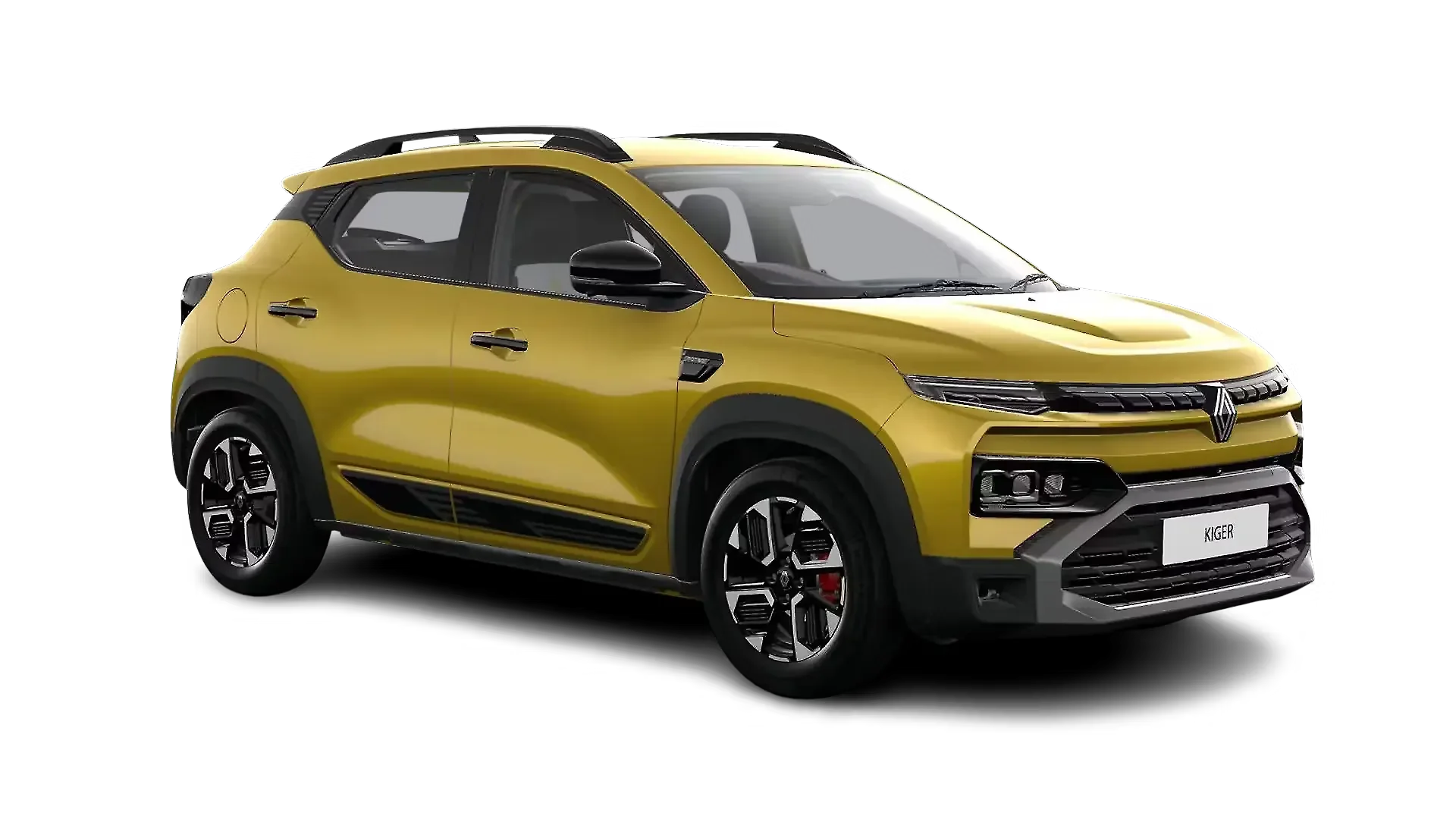
The Kiger facelift is one of the segment's better-looking cars, and reviewers unanimously agree it no longer resembles its cheaper Renault siblings. The tri-octa LED headlamps, revised grille, sculpted bonnet and C-shaped LED tail lamps give it genuine road presence, so much so that buyers cross-shop it against larger SUVs like the Brezza and Nexon despite its shorter stance. The 16-inch diamond-cut alloys, functional roof rails rated for 50 kg, rear spoiler and dual-tone black roof add character. At 4 metres long with a 205 mm ground clearance, it looks bigger than it is. The swoopy roofline is the only compromise, eating slightly into rear headroom, but Namaste Car notes the proportions still work. For the money, few sub-4m SUVs look this deliberate.
This is where the Kiger stumbles. The dual-tone dashboard, yellow contrast stitching and two glove boxes look smart, but plastic quality is inconsistent, with sharp edges near lower panels and exposed fasteners behind the seat belt mount. The 8-inch floating touchscreen supports wireless Android Auto and CarPlay, and the 7-inch TFT cluster with drive-mode-linked graphics is a genuine highlight. Ventilated front seats, PM 2.5 filter, wireless charging, 360-degree camera and Arkamys sound are welcome, but there's still no sunroof, no USB-C, and cupholders have been sacrificed for storage. Rear space is a strong suit: adults over six feet fit comfortably, with generous knee room and a proper centre armrest. The boot swallows 405 litres, expanding to 879 litres with seats folded.
This is the Kiger's Achilles heel. Long-term use surfaces rattles, and the suspension develops audible clunks. Wiper quality is mediocre, the outside mirror lacks auto-dimming, and the AC compressor struggles in peak summer. There's no auto headlamp on lower variants, the front doors don't unlock automatically on ignition-off, and drive-mode settings reset every ignition cycle. Global NCAP awarded four stars and the equipment list includes six airbags, ESP, hill-hold, TPMS and ISOFIX. Namaste Car highlights the extensive accessory catalogue, from 360-camera retrofits to CNG kits with three-year warranty. The Kiger feels light rather than solid, and Gagan Choudhary cautions buyers who want Maruti or Hyundai levels of long-term smoothness to look elsewhere. For the price, it's acceptable; against segment benchmarks, it isn't.
The 1.0-litre turbo petrol makes 100 PS and 160 Nm (152 Nm on the CVT) and remains the Kiger's most convincing element. Gagan Choudhary notes the CVT has been retuned to feel smoother in traffic while retaining strong overtaking punch on the highway. It cruises at 100 km/h at around 2,600 rpm, and the sport mode sharpens throttle response noticeably. The trade-off is refinement: the three-cylinder sends vibrations through the seat, steering and gear lever, and the CVT's rubber-band effect surfaces under hard acceleration. Eco mode dulls the throttle so much the car feels lethargic with four people on board. Skip the 1.0 naturally aspirated engine, which is genuinely underpowered. Three drive modes, cruise control and paddle-free CVT round out the package.
Ride quality is a mixed bag. Over undulations and larger bumps the Kiger feels plush and composed, and the 205 mm ground clearance means broken roads pose no worry. Highway stability is reassuring even at three-digit speeds. The problem is sharp-edged potholes and expansion joints, where the suspension crashes through audibly, with the noise itself making the impact feel worse than it is. The steering is light and city-friendly with a small turning circle, but it's lifeless on the highway, slow to self-centre after full lock, and offers no feedback. Brakes lack initial bite and can feel vague under hard application. Body roll is contained for the segment, but this isn't a car built for enthusiastic driving; it rewards a relaxed 80 km/h cruise.
Pricing starts around Rs 5.76 lakh ex-showroom, with the turbo manual from roughly Rs 10 lakh and the top RXZ CVT around Rs 11.15 lakh. Faisal Khan quotes an on-road Mumbai range of Rs 7.62 lakh to Rs 12.9 lakh. That undercuts the Venue, Sonet, Brezza and Nexon meaningfully, and the equipment sheet (wireless CarPlay, ventilated seats, 360 camera, keyless proximity entry, cooled glove box) reads richer than the price suggests. The Nissan Magnite is mechanically identical and often cheaper still. If you want a refined, premium sub-4m SUV, the Hyundai Venue or Kia Sonet justify their premium. For buyers focused on space, features and presence per rupee, and willing to accept mediocre mileage and average finish, the Kiger delivers strong value.
"After a year of ownership, positives outweigh negatives but insulation, mileage and brakes need serious work."
"A car for calm drivers who value presence over polish; expect small niggles but no major breakdowns."
"Tested CVT returned 9.82 kmpl city and 13.86 kmpl highway, mixed 11.5 kmpl, ranking ninth in their fuel test."
"The facelift meaningfully improves NVH, suspension and drivability, making it a great value pick, not a premium one."
"Normal city driving is effortless; upgraders from an Alto or first-time buyers will find little to complain about."
"Extensive feature list, six airbags, four-star Global NCAP and huge accessory catalogue make it easy to personalise."
"Flags the RXZ variant at Rs 8.80 lakh as the sweet-spot trim in the lineup."