 Image: Nissan press kit
The facelifted Magnite delivers genuine sub-4m SUV value with class-leading safety, a 360 camera and solid space, provided you can live with Nissan's smaller network.
The 2025 Nissan Magnite is now a sensibly premium compact SUV that still undercuts every rival on price. With six airbags standard, a 360-degree camera, a proven 1.0L turbo CVT and a 4-star Global NCAP rating, it makes a strong value case. The trade-offs are a smaller dealer network and a few interior misses.
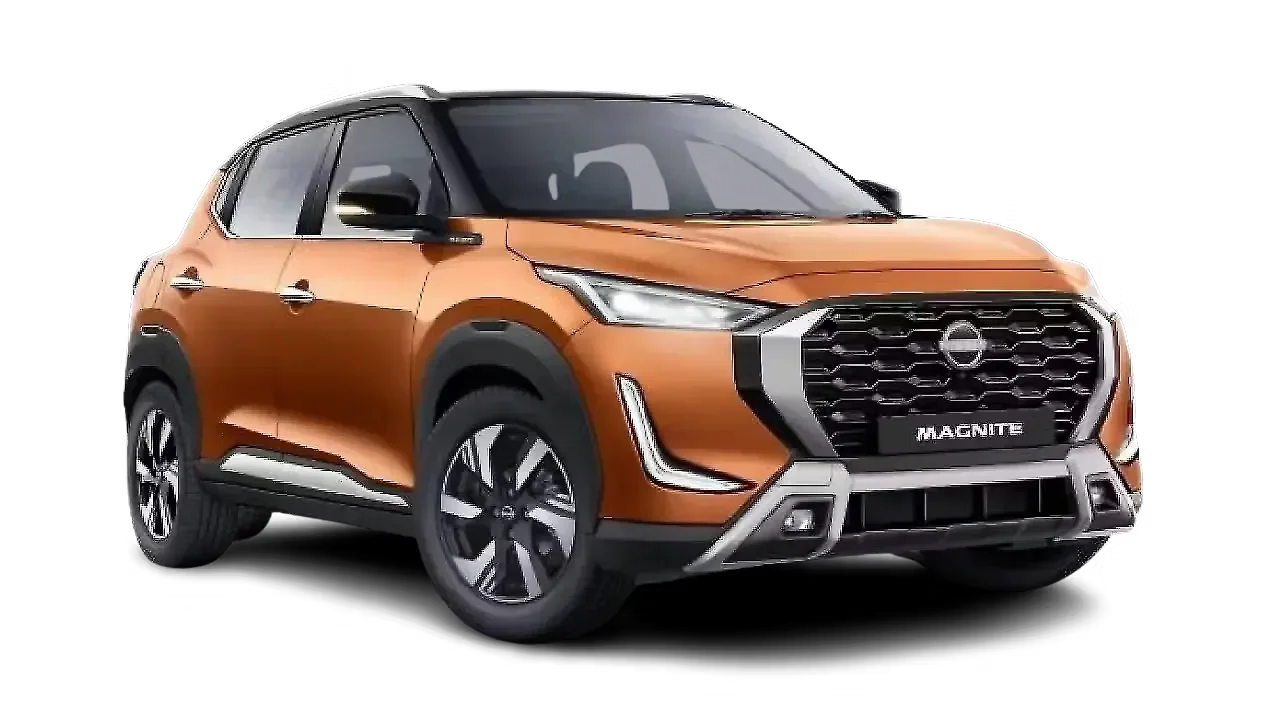
The facelifted Magnite keeps its 1.6m height, 205mm ground clearance and sub-4m footprint, but adds a new honeycomb grille, L-shaped LED DRLs, LED projector headlamps and 16-inch dual-tone diamond-cut alloys. The 3D honeycomb LED tail-lamps and floating skid plates lift kerb appeal. Opinion splits on the changes: the front end now looks busier and heavier, with day-lamp updates that feel fussy compared to the cleaner original. The earthy Sandstone Brown and new Copper Orange shades hide minor dents well, which matters in Indian parking conditions. Panel gaps are wider than ideal but consistent across the body. Overall, the SUV stance, raised bonnet and roof rails still justify the SUV badge despite the compact footprint.
Inside, the Magnite has taken a clear step up. Leatherette dashboard and door inserts, orange stitching, a 9-inch floating touchscreen with wireless Android Auto and CarPlay, a 7-inch driver display, ambient lighting and an auto-dimming IRVM are now part of the package. The 360-degree camera is the standout, genuinely useful in tight Indian parking. The Arkamys six-speaker system sounds clean for the segment. Where it slips: the touchscreen UI looks dated next to rivals, daylight visibility is average, and there is no wireless charger or ventilated seat as standard. Ergonomics are mostly sound, though the IRVM placement limits rear visibility for shorter drivers. As MotorOctane notes, three adults fit comfortably across the rear bench, which most rivals in this price band still cannot manage.
Build quality is where the facelift makes the biggest leap. The Namaste Car walkaround confirms 67 percent high-tensile steel in the body, thicker front door glass and improved sound damping. Plastic rattles that plagued the pre-facelift car have largely been silenced. Safety is a genuine highlight: six airbags as standard, ESC, traction control, hill-hold, hydraulic brake assist, TPMS, ISOFIX and three-point seatbelts for all occupants, backed by a 4-star Global NCAP and Asian NCAP rating. Some plastics low down still feel inconsistent, and the touchscreen response is not segment-best. But for daily family use, the Magnite finally feels built to last rather than built down to a price, which was the older car's biggest weakness.
Two 1.0L three-cylinder petrols are on offer. The naturally aspirated unit makes 71 hp and 96 Nm, while the HR10 turbo produces 98 hp with 152 Nm on CVT or 160 Nm on manual. The turbo CVT is the pick: smoother, more relaxed, and effortless for 90-120 kmph overtakes. Gagan Choudhary points out that the NA engine is happy on open highways but shudders in stop-go traffic, particularly with a full cabin or on inclines, and the clutch is on the heavier side. Real-world fuel economy is a strong suit: 12-15 kmpl in city driving and 18-21 kmpl on the highway at sensible cruising speeds. NVH has improved with the facelift, though the three-cylinder thrum is still audible above 2,500 rpm.
The Magnite's MacPherson strut front and twin-tube telescopic rear setup has been retuned softer for the facelift. The result is a more pliant low-speed ride that handles broken urban tarmac and speed breakers without complaint. Over sharper bumps and expansion joints the suspension can feel clunky at the rear, a trade-off most buyers will accept. The 205mm ground clearance, generous tyre sidewalls on the 195/60 R16 rubber, and 5m turning radius make it genuinely confidence-inspiring on bad roads and in tight city lanes. Steering is light around town but slow and a touch vague at speed, and the brakes lack initial bite, taking some getting used to. Straight-line stability at highway cruise is reassuring for a sub-4m SUV.
Value is the Magnite's strongest argument. Ex-showroom pricing starts near Rs 6 lakh, with the top Tekna Plus around Rs 11.50 lakh, undercutting every meaningful rival. Nissan claims a running cost of just 39 paise per kilometre over five years, and MotorOctane's one-year ownership shows first service costs under Rs 2,000 with four free labour visits at 2,000, 10,000, 15,000 and 20,000 km. The package includes a 3-year/100,000 km warranty. The catch is dealer reach: Nissan's network is smaller than Maruti, Hyundai or Tata, and questions around Nissan's global restructuring create some uncertainty. For buyers who have a Nissan dealer nearby and prioritise features-per-rupee, nothing else in the segment comes close on a spec-sheet-versus-sticker basis.
After 22,000 km and two years, the Magnite Turbo CVT delivers on value, safety and go-anywhere ability, but minor niggles and dealer fixes disappoint.
Long-term reality: Across 22,000 km the Magnite Turbo CVT has been mechanically faultless with smooth power delivery, but service centres failed to address rattles and the factory wipers were swapped for Bosch frameless units. Pricing, safety and 360 camera keep the owner satisfied.
Read the full forum thread on TeamBHP →"After one year and 4,000 km, the Magnite is a reliable, low-cost-to-run value-for-money package with no major issues."
"The NA engine suits highway cruisers, not city buyers seeking refinement; pick the turbo or look elsewhere."
"Turbo CVT feels well-judged for daily use with progressive power and decent low-speed creep."
"Spec-for-spec the facelift offers segment-best safety kit, 67 percent high-tensile steel body and a thorough features list."
"The Magnite competes strongly in a tough segment, with clear improvements in cabin quality and refinement."