 Image: Maruti press kit
A sensible, reliable, feature-loaded compact SUV that nails practicality and efficiency, provided you value fuel economy over driving excitement or a premium cabin experience.
The 2025 Maruti Victoris is essentially the Grand Vitara reborn for Arena showrooms, with cleaner styling, more features and India's first under-floor CNG tank. It offers four powertrains including a strong hybrid claiming 28 km/l, a 5-star Bharat NCAP rating and Maruti's usual sensible value. It just isn't the segment-shaker its rivals should fear.
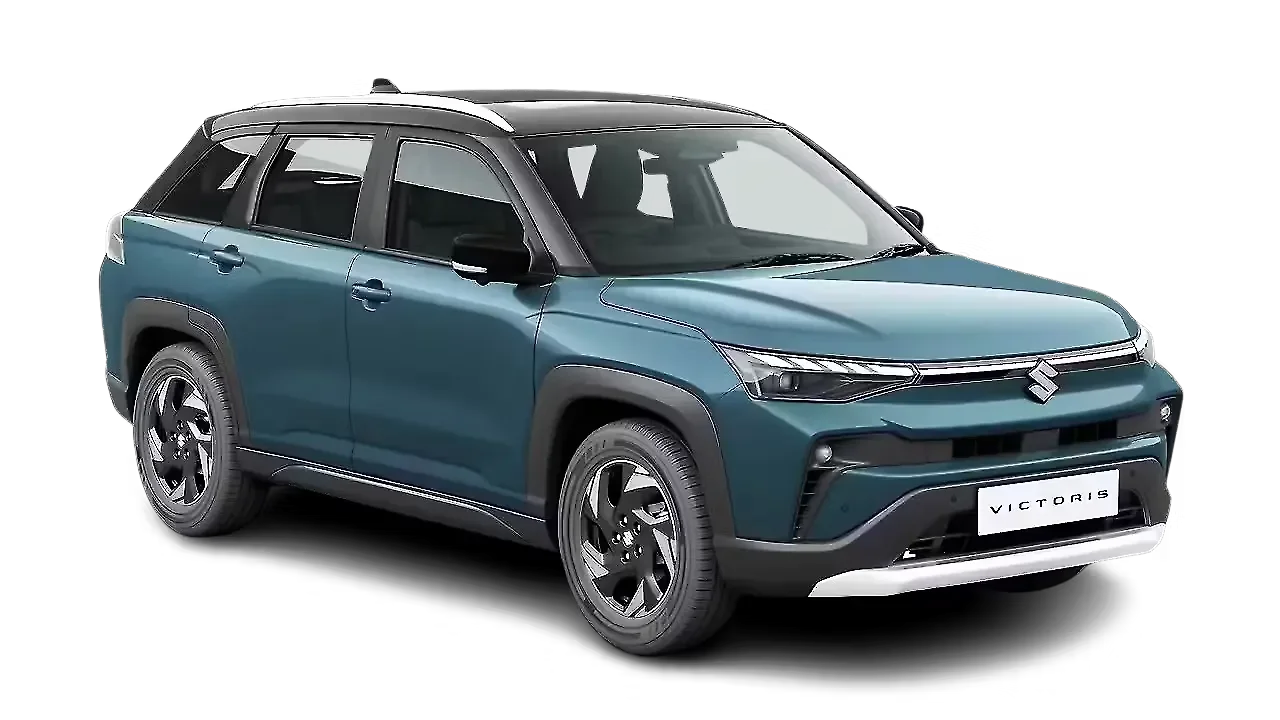
The Victoris takes the Grand Vitara silhouette and gives it a squarer, more European-looking face that most viewers find genuinely appealing. LED projector headlamps with connected DRLs, a satin chrome grille and 17-inch machined alloys lift the kerb appeal. From the A-pillar to the C-pillar it is unmistakably Grand Vitara, and the rear is where opinions split: the arched connected LED tail lamp and the C-pillar treatment strike some as awkward, others as distinctive. At 4.36 metres long with a 2600mm wheelbase, V3Cars notes the overhangs look slightly stretched. Seven single-tone colours plus dual-tone options are on offer. It is a clean, mature design without weird flourishes, which in itself counts as a positive in a segment full of over-styled rivals.
The cabin is the Victoris' biggest step up over the Grand Vitara and its biggest missed opportunity. The new three-layer dashboard, 10.1-inch infotainment, 10.25-inch digital cluster, 64-colour ambient lighting and redesigned steering wheel look modern, and the beige-black theme on the mild hybrid feels genuinely more upmarket than the all-black strong hybrid. However, soft-touch materials are patchy, some switches lack illumination, dummy buttons appear even on the top variant, and there is no dedicated auto AC button. The Infinity by Harman eight-speaker system with Dolby Atmos sounds crisp but not overwhelmingly rich. Front seats are eight-way powered and ventilated with good under-thigh support; the rear is just adequate for a 5'8" passenger, tight beyond that, and reclining seats plus rear sunshades are conspicuously absent.
Build quality is typical Maruti: nothing feels broken or cheap, but nothing feels special either. Namaste Car highlights the high-tensile steel percentage has been increased and the A-pillar and side cells reinforced, contributing to the segment-topping 5-star Bharat NCAP score. Six airbags, ESP, hill hold, 360-degree camera and TPMS are standard on higher variants. The Level 2 ADAS suite works well on Indian conditions, though the strong hybrid variant curiously omits ADAS and the electronic parking brake to keep its ex-showroom under ₹20 lakh. Feature highlights include a panoramic sunroof, wireless charging, heads-up display and Suzuki Connect telematics. Small niggles persist: the infotainment screen crashed during one drive, TPMS readout is buried in settings, and rear wiper is missing on lower variants.
Three powertrains anchor the range. The 1.5-litre K15C mild hybrid petrol produces 101 bhp and 136 Nm, offered with a 5-speed manual or 6-speed torque converter, and claims 21.18 km/l. The strong hybrid pairs a 1.5-litre three-cylinder Atkinson petrol with an electric motor for a combined 115 bhp and 141 Nm, sending power through an e-CVT with a claimed 28.65 km/l. MotorBeam extracted a real-world 19.69 km/l on the highway with the strong hybrid. The CNG produces 86 bhp in gas mode. Across all variants, the recurring theme is adequacy rather than excitement: overtakes require planning, the engine gets vocal when revved, and there is no turbo or diesel option. The strong hybrid feels the peppiest in roll-on acceleration and is the pick for driving pleasure.
Ride quality is where the Victoris shines and where Maruti has quietly improved on the Grand Vitara. The MacPherson strut front and torsion beam rear suspension, running on 215/60 R17 CEAT SecuraDrive tyres, soaks up broken tarmac and expansion joints without transmitting harshness into the cabin. Suspension noise, a known Grand Vitara gripe, has been reduced through revised bushings. High-speed stability at 110 km/h is composed, and the steering, as Karthikeya from Motoring notes, is noticeably more direct and engaging than the Grand Vitara's vague, heavy setup. Body roll is well contained for a soft-riding SUV. NVH is not class-leading; wind noise around the A-pillar and road noise on coarse surfaces still filter in, and a Hyundai Creta remains the quieter cabin.
Priced from ₹10.49 lakh to around ₹20 lakh ex-showroom, the Victoris undercuts the Grand Vitara at every equivalent variant and slots directly against the Hyundai Creta, Kia Seltos, Skoda Kushaq and Honda Elevate. The CNG variant, at ₹11.49 lakh onwards with a 55-litre tank claiming 26.79 km/kg, is the value-for-money star for high-running buyers. The strong hybrid top variant at ₹19.98 lakh ex-showroom looks steep, and V3Cars argues it should have been ₹1-1.5 lakh cheaper. What tilts the equation is the Arena network's roughly six-times-larger reach versus Nexa, plus Maruti's low running and resale reputation. The Grand Vitara facelift is expected in 3-6 months and will likely sit above this.
"A typical Maruti: reliable, practical, sorted on ride, but underpowered and lacking a standout USP versus the Creta."
"The strong hybrid delivered 19.69 km/l in real-world highway testing and drives smoothly, though not excitingly."
"A comprehensive walkthrough highlighting the segment-first under-floor CNG tank and 5-star Bharat NCAP rating as major wins."
"It is the Grand Vitara reborn for Arena, better in small ways, but not the segment-shaker Maruti needed."
"Interior quality has genuinely improved, but the top strong hybrid variant should have been priced ₹1-1.5 lakh lower."