 Image: Hyundai press kit
The most engaging Creta yet, with a genuine manual option and sharper dynamics, though it stops short of being a true hot SUV.
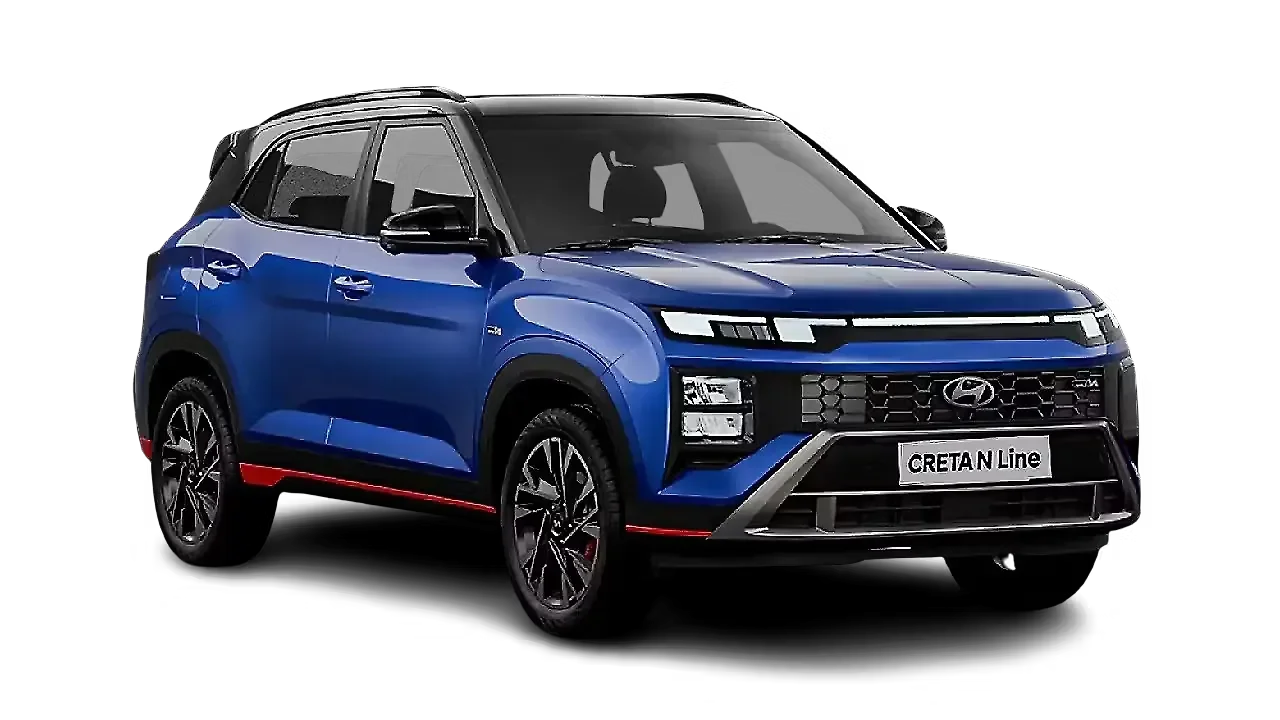
The Hyundai Creta N Line takes the regular Creta's 160 PS 1.5 turbo-petrol and adds stiffer suspension, a weightier steering, 18-inch wheels and red-accented styling. Crucially, it introduces a 6-speed manual gearbox not offered on the standard Creta turbo. The result is a more dynamic, more involving Creta, even if power and exhaust drama remain unchanged.
Visually, the N Line is the most distinctive Creta yet without veering into boy-racer territory. A smaller grille (the Hyundai badge now houses the front parking camera), revised bumpers with faux skid plates, red side skirts, red brake calipers, dual exhaust tips, a larger rear spoiler and 18-inch diamond-cut alloys give it real road presence. The matte grey paint, a Rs 5,000 option, draws unanimous praise. Faisal Khan points out that the design is polarising rather than universally pleasing, but the consensus is that the redesign flows better than the standard Creta. Dimensions are unchanged at 4.3 m long, and ground clearance is unaffected, so the N Line still clears Indian speed breakers without drama.
Inside, it is an all-black cabin with red stitching, red ambient lighting, alloy pedals, an N-badged three-spoke steering wheel and seats with N Line embroidery. The 10.25-inch infotainment and matching digital cluster are crisp, the panoramic sunroof is generous, and dual-zone climate retains physical knobs. However, this is where the package weakens. Hard plastics dominate, settings like the cluster theme reset with the drive mode rather than being independently configurable, and there is no heads-up display, no rain-sensing wipers and no one-touch operation on the rear windows, all of which the related Seltos X-Line offers. The cabin looks sportier; it does not feel materially more premium than a regular Creta.
Fit and finish mirrors the regular Creta, which means a well-screwed-together cabin with a few cost-cutting reminders: the camera UI still shows a generic Creta graphic rather than the N Line, some plastics feel cheap, and the 360-degree camera image colour does not match the car. Equipment is generous: Level 2 ADAS with forward collision warning, lane keep assist, blind-spot view monitor, adaptive cruise, 360-degree camera, ventilated front seats, electric parking brake with auto hold, wireless charging and an 8-speaker Bose system with subwoofer. The dashcam is curiously offered only on the lower N8 variant. Tyres are JK Royale, which several reviewers flag as below par for a performance-oriented variant.
Mechanically, the engine and gearboxes are untouched. The 1.5-litre turbo-petrol still produces 160 PS and 253 Nm, paired to either a 6-speed manual (an N Line exclusive within the Creta lineup) or a 7-speed DCT. Hyundai claims 0-100 km/h in 8.9 seconds for the manual, and reviewers confirm it feels genuinely quick, with a strong mid-range from around 2,500 rpm. There is mild low-end lag and noticeable wheel-spin off the line with traction control off. The manual's clutch is light and the shift is slick, though Gagan Choudhary notes it feels smoother and less raw than the Volkswagen group's 1.5 TSI. The DCT is quicker and more convenient in traffic; the manual is more involving.
This is where the N Line earns its badge. The suspension is firmer (not hard), the steering carries more weight and there is real composure at highway speeds. Body roll is better contained, lane changes feel more confident and the car holds its line through corners with surprising poise. Over sharp bumps and concrete expansion joints, the 215/55 R18 JK tyres and stiffer setup do transmit more into the cabin, and road noise is a touch higher than the standard Creta. But it never crosses into uncomfortable. MotorBeam observes that low-speed behaviour feels close to the regular Creta; the difference reveals itself above 80 km/h. Brakes are progressive with predictable bite from all four discs.
The N Line carries roughly a Rs 30,000 premium over an equivalent regular Creta turbo, which most reviewers agree is justified for the styling, the suspension retune and, critically, the option of a manual gearbox. The 1.5 turbo DCT manual gap is around Rs 1.5 lakh. Claimed efficiency is 18 km/l for the manual and 18.2 km/l for the DCT; real-world highway figures of 15-17 km/l are realistic with sane driving, dropping sharply when driven enthusiastically. Against the Kia Seltos X-Line, the Creta N Line is the better driver's car but loses on features. Against the Skoda Kushaq 1.5 TSI, it feels more refined but less raw.
"An absolute joy with the manual: 8.9-second 0-100, sharper dynamics, but features lag the Seltos X-Line."
"Hyundai softened the N character too much; the badge promises more than the car delivers from inside."
"A comprehensively equipped sportier Creta with Level 2 ADAS, 18-inch alloys and red accents inside and out."
"Cosmetic and suspension tweaks deliver a noticeably more planted highway feel without breaking everyday usability."
"The most European-feeling Korean SUV: fun yet practical, and the better Creta turbo to buy."
"Returned 15.37 km/l tank-to-tank on the highway; sportier than the Creta without sacrificing usability."
"Worth the Rs 30,000 premium over the standard Creta turbo for styling, steering heft and stiffer suspension."