 Image: Tata press kit
A practical, well-engineered city EV let down by modest real-world range, sluggish top-end performance, and patchy after-sales that make the petrol Tiago a smarter buy unless you have heavy daily running.
The 2025 Tata Tiago EV is India's most affordable proper electric hatchback, priced from roughly Rs 8 lakh to Rs 11.8 lakh ex-showroom. It delivers a genuine 170-200 km real-world range on the long-range pack, sorted ride quality, and very low running costs near Rs 1-1.2 per km. But weak top-end performance, missing safety kit, and inconsistent Tata after-sales mean it only makes sense for buyers with predictable, high daily running.
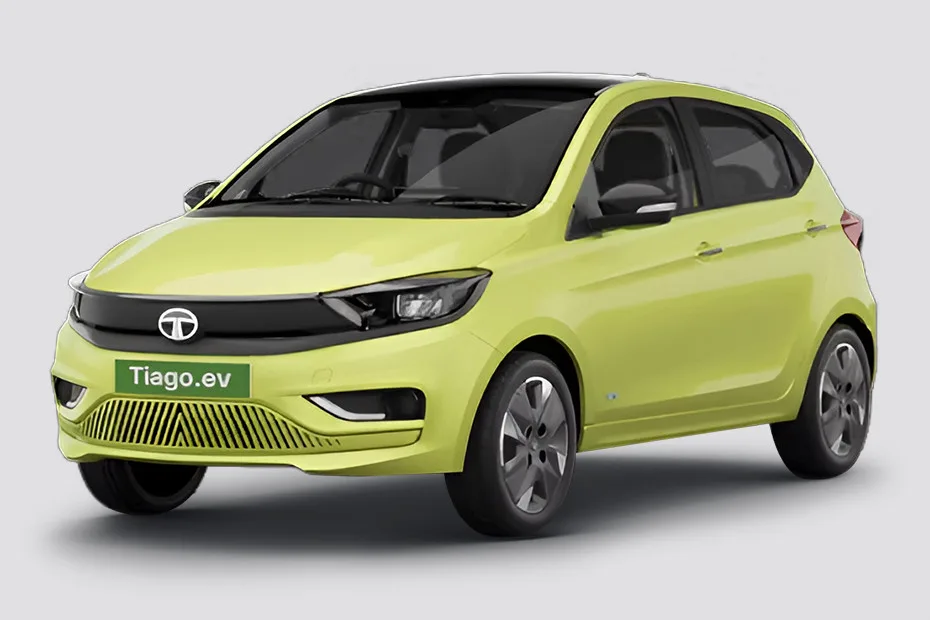
The Tiago EV's exterior tweaks for 2025 are subtle: a closed-off white grille, restyled bumper, sequential LED DRLs and indicators, a shark-fin antenna and EV badging shifted to the doors. Faisal Khan notes that the low-beam, high-beam and DRL are LED but the indicators and parking lights are still halogen, which feels like cost-cutting at this price. The 175/65 R14 steel wheels with caps look undersized for the body, and Apollo Amazer tyres draw criticism for weak grip on loose surfaces and inclines. The new lime-tinged paint option does lift the stance, and black ORVMs, roof and pillar treatment add some freshness. However, the silhouette is unmistakably a 2016-era Tiago with EV jewellery, and there is no rear spoiler, no fog lamps on lower variants, and panel gaps that owners flag as inconsistent. For a car asking up to Rs 11.8 lakh ex-showroom in top trim, the design effort feels incremental rather than transformative.
Inside, the Tiago EV gets a larger 10.25-inch touchscreen, a new digital instrument cluster, the illuminated Tata steering wheel from the Nexon, and revised grey-and-black upholstery with leatherette on the top variant. Dashboard layout is clean and the screen is reasonably quick, with wireless Android Auto and CarPlay as standout additions. But the niggles add up: no auto-dimming IRVM, no rear armrest, non-adjustable rear headrests, no centre-rear headrest, fiddly seatbelt buzzer logic, the AC compressor housing intruding into the front passenger's left knee area, and rear-seat space tight for anyone above 5 feet 8 inches. Vikram Rajera's owner contact reported persistent rattles from dashboard and door rubbers within two years. Boot space is just 240 litres, two litres less than the petrol Tiago, with a bulky charging cable kit eating into usable volume. Material quality is hard plastic throughout, acceptable for the segment but not premium.
Build feels solid where it matters: doors shut with a reassuring thud, the shell is rated 4-star by Global NCAP for the petrol equivalent, and the battery pack is IP67 rated. But the feature and safety package is where Tata cuts corners. Even the top XZ Long Range gets only two airbags, no traction control on lower variants, no auto-dimming IRVM, halogen indicators and parking lamps, no electric tailgate release on lower trims and no boot-lid lock from outside on lower variants. Standard charging is a slow 3.3 kW unit; the 7.2 kW wallbox is a Rs 50,000 option. DC fast-charging tops out at around 18-25 kW in real use, taking under an hour from 10 to 80 percent. Owner reports flag a critical alert error that drops the car into neutral mid-drive, slow body-shop turnaround of 20-25 days, and battery cell-pair degradation affecting the last 15 percent of range after roughly 75,000 km. The 8-year, 1.6 lakh km battery warranty is reassuring on paper.
Two battery options are offered: a 19.2 kWh Medium Range making about 60 bhp and 110 Nm, and the 24 kWh Long Range tested here producing 74-75 bhp and 114 Nm. Off the line the instant torque feels brisk; 0-100 km/h comes up in roughly 12.5 seconds in Sport mode. But top-end is the weak link: the car runs out of breath beyond 100 km/h and tops out near 113-115 km/h, slower than even the Tigor EV which uses the same architecture but makes 170 Nm. In default Drive mode only about 75 percent of torque is available, blunting overtakes. Four regen levels are selectable from the steering, but the so-called single-pedal mode does not bring the car to a complete halt; it creeps. The hill-hold works but the car still rolls back briefly when loaded, and with no traction control on lower variants, wheelspin on damp or loose surfaces is real. Refinement, however, is genuinely good: silent, smooth, and free of the jerky low-speed shifts that plague Tata's ICE autos.
Ride and handling are arguably the Tiago EV's strongest suit. The suspension setup, MacPherson struts in front and twist beam at the rear, soaks up broken Indian roads with composure, and the added battery weight gives it a planted feel at speed that the petrol Tiago lacks. High-speed stability up to its limited top speed is reassuring, and lane changes feel controlled rather than nervous. The steering is light at parking speeds, weighs up adequately on the highway and is easy to place in city traffic. The trade-off is a rearward weight bias from the underfloor battery, which makes the car feel slightly tail-heavy when fully loaded and contributes to occasional struggle on steep inclines, especially with weak Apollo Amazer tyres that lose traction on gravel and wet surfaces. Brake pedal travel is long but stopping power is adequate for the performance on offer. NVH is exceptional by class standards: there is genuine refinement here, with only minor panel rattles emerging over time as some owners report.
On paper, the Tiago EV's Rs 8.42-11.82 lakh ex-showroom span undercuts every other proper electric hatchback bar the MG Comet. Running cost works out to roughly Rs 1-1.2 per km on home charging, and owners report monthly fuel savings of Rs 30,000-40,000 versus petrol cars. But the value equation only stacks up if your daily running genuinely exceeds 100-150 km. Sachinn Rose's calculation is sobering: factor in the Rs 3-4 lakh price premium over the petrol Tiago, eventual battery replacement after the warranty period, and DC fast-charging costs of Rs 21+ per kWh, and the effective per-km cost rises to Rs 4-7 for low-mileage users. The Long Range XT or XZ is the only sensible pick; the Medium Range's 150 km real-world range is too compromised. For buyers with predictable high mileage and home charging, it is a strong value play; for everyone else, the petrol Tiago or a CNG rival like the Grand i10 Nios saves significant money upfront.
TeamBHP's community consensus echoes the long-term ownership concerns surfaced in this review: real-world range settles at 170-200 km on the Long Range pack and drops sharply in winter, after-sales response on critical errors is slow, and the value case only works for owners covering 100+ km daily. Forum members consistently recommend the XZ Long Range over Medium Range variants and advise budgeting for the 7.2 kW home wallbox.
"Calls the XZ Long Range the only sensible variant and confirms 180-200 km real-world range, but flags weak Apollo tyres, missing traction control and a fiddly hill-hold that still lets the car roll back when loaded."
"Reviewed the petrol/CNG Tiago alongside, concluding that for buyers prioritising mileage and fuel cost the Swift is sharper, but the Tata wins on safety perception and high-speed stability."
"Owner-perspective verdict is blunt: factor in the Rs 4 lakh premium, eventual battery replacement and DC charging costs, and the effective running cost rises to Rs 4-7 per km, making the EV worthwhile only for those doing 150+ km daily."
"Positions the Tiago EV as a budget entry point but recommends stretching to the Punch EV Medium Range for better real-world range, more modern design and a born-EV platform."
"Owner Naman has covered 15,000 km in 11 months including a 1,100 km Surat-Delhi run and rates it 9 out of 10, citing Rs 1.2 per km running cost and zero major issues beyond a missing armrest."
"Owner experience flagged disappointing 6-7 month waiting period, mediocre dealer hospitality and only 200 km real range, concluding it works as a secondary city car alongside a larger ICE vehicle."
"Most critical voice: top speed of just 113 km/h, claim range cut to 293 km, halogen indicators, two airbags on the top variant and unreliable Tata charging infrastructure make the petrol Tiago the smarter Rs 3 lakh saving."
"Two-year owner reports clear battery degradation in the last 15 percent of charge after 75,000 km, plus a 25-day body-shop hold, but rates the car as worthwhile thanks to Rs 30,000-40,000 monthly fuel savings."
See also: Tata Punch EV · MG Windsor EV