 Image: Tata press kit
The long range Punch EV finally delivers the performance the petrol Punch lacks, with strong safety, a feature-loaded cabin and competitive pricing, though reliability niggles and missing essentials hold it back from greatness.
The 2025 Tata Punch EV is India's best-selling electric crossover, now offered in 30 kWh and 40 kWh battery options with claimed ranges of 315 km and 421 km respectively. Built on Tata's Gen 2 acti.ev platform, it brings genuine punch to the nameplate with 122 PS, a 0-100 kmph time of around 9 seconds and a feature list that shames cars twice its price. Niggling quality issues and a few baffling cost-cuts stop it short of perfection.
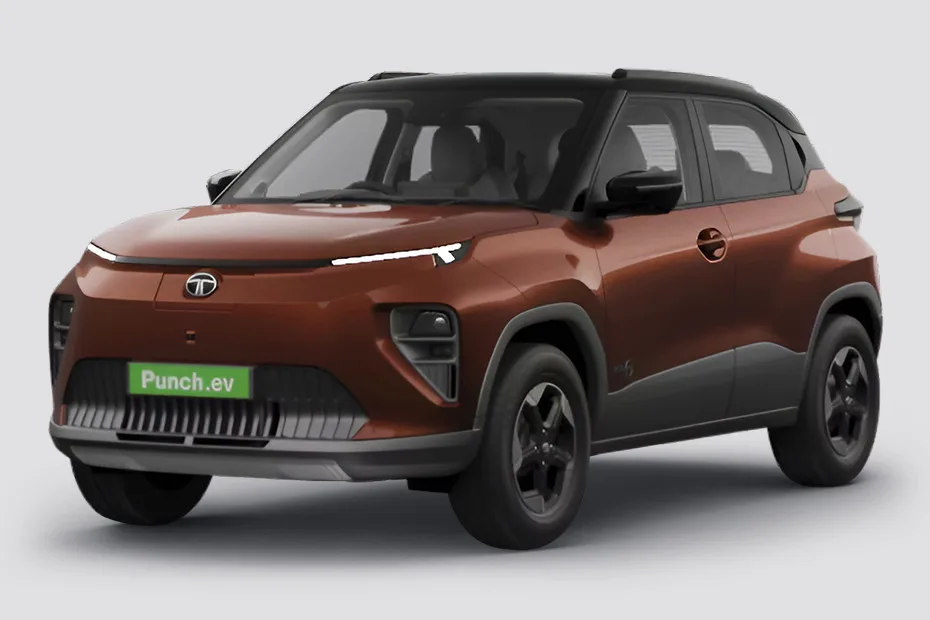
The Punch EV walks the now-familiar Tata family line, with a closed-off grille, sequential DRLs and a faux air curtain at the front bumper. It is 3.8 m long, 1.7 m wide and 1.6 m tall, riding on 16-inch diamond-cut alloys wrapped in 195/60 R16 rubber, with 190 mm of ground clearance and a claimed 350 mm wading capacity. Doors open a near-90-degree, useful in tight Indian parking spots. The blanked grille houses a front parking camera and a functional emblem, while the dual-tone treatment with a floating roof keeps things visually busy. Faisal Khan calls out the tube-light DRL irony given how the Verna was mocked for the same, and points to mismatched panel gaps and a body that flexes when nudged. Colour options span Bengal Ruby Red, Pristine White, Daytona Grey, Fearless Yellow, Empowered Oxide and Supernova Copper. It is handsome enough, if not distinctive.
Inside, the dual-tone beige and black dashboard looks genuinely upmarket for the segment, anchored by twin 10.25-inch screens, a 65 W USB-C fast charger, wireless charging pad, ventilated front seats and an electronic parking brake with auto-hold. Six airbags, ISOFIX, a 360-degree camera, blind-view monitor and TPMS are all present. But the execution is patchy: the seat ventilation switch is awkwardly placed, the rear bench reclines as a single piece rather than 60:40, there are no rear AC vents, no rear charging sockets and no centre headrest at the back. Headroom is just adequate; under-thigh support at the rear is poor and the seat sits upright. Power window switches still feel pulled from the Indica Vista era, and Gagan Choudhary flags how dummy buttons and a fingerprint-prone gloss steering wheel cheapen the vibe. Boot space is 366 litres with a 1 kg hook, and a 14-litre frunk handles the charging cable.
Build quality is the most divisive aspect of the Punch EV. The shell carries Tata's strong crash credentials, IP67-rated motor and battery and an 8-year/1,60,000 km battery warranty alongside a 3-year/1,25,000 km vehicle warranty. The feature sheet reads like a flagship: ventilated seats, sunroof (a 56,000 rupee option only on Adventure, Empowered and Empowered Plus), wireless Android Auto and Apple CarPlay, Arcade.ev app suite, Alexa, JioSaavn, six airbags and a 360-degree camera. Yet the niggles long-time owners report are real: random warning chimes, auto-hold faults, drive-mode selector glitches and screens that occasionally blank out. Panel gaps inside and out, the fingerprint-prone piano-black trim, and lower-variant halogen headlamps undermine the premium pitch. The absence of a spare wheel, rear AC vents and front parking sensors will rankle buyers who expect essentials before gimmicks. Tata clearly understands what to add; it now needs to nail what it leaves out.
The long range model packs a 40 kWh (effective 35 kWh usable) LFP battery with a permanent magnet synchronous motor making 122 PS and 190 Nm, doing 0-100 kmph in around 9.5 seconds and topping out at a limited 140 kmph. The standard 25 kWh version makes 82 PS and 114 Nm with a 13.5-second 0-100 kmph time, broadly mirroring the petrol Punch and best avoided. Three drive modes (City, Eco, Sport) and four levels of regen, including three that enable single-pedal driving, are on offer. Acceleration is linear and refined, but front-wheel torque steer and easy wheelspin are constant companions even with ESP on. The steering is light and feel-free, body roll is pronounced and Arun Panwar notes that the 20-variant lineup spans 315 to 421 km of claimed range. Real-world expect 220-260 km from the long range with the AC running, closer to 290 km in cool, gentle conditions.
Ride quality is where the Punch EV genuinely shines. The suspension, McPherson struts up front and a semi-independent twist beam at the rear, soaks up potholes, expansion joints and bad patches with the kind of composure usually reserved for cars a segment above. The 195/60 R16 tyres are a sensible choice, balancing comfort with reasonable grip, and the platform's added battery weight settles the car nicely on rough surfaces. Handling, however, is a different conversation. There is noticeable body roll, the steering offers no meaningful feedback and the brakes feel grabby with overly sensitive ABS triggering on hard stops. Disc brakes are now front-only on the new platform, with drums at the rear, and the regen, while strong on level three, does not quite achieve true one-pedal driving on downhill stretches. Some test cars exhibit a clunk from the left side suspension that owners have flagged. As a city and intercity cruiser it is brilliant; as a back-road carver, less so.
Pricing starts at 9.99 lakh ex-showroom for the base standard range and climbs to 12.59 lakh ex-showroom for the top Empowered Plus 40, with on-road Mumbai figures stretching from 11.67 lakh to 16.48 lakh once you add the 7.2 kW AC fast charger (around 53,000 rupees on-road), the sunroof and personas. Namaste Car notes that the price gap between standard and long range variants is just 1.1 to 1.4 lakh, making the 40 kWh the obvious pick. Against the petrol Punch the EV commands a roughly 4.5 lakh premium variant-to-variant, recoverable through fuel savings if you do reasonable kilometres. Direct rivals are limited: the MG Comet and Citroen eC3 both fall short on space, features and brand pull, leaving the Punch EV as the default sub-15 lakh electric crossover. In-house overlap with the Tiago EV, Tigor EV and Nexon EV does muddy the lineup, but for buyers who want EV running costs in a tall, city-friendly body, the value equation works.
TeamBHP owners and contributors broadly back the Punch EV's value and ride quality, with multiple long-term threads praising the city-friendly footprint and feature load at the price. The recurring grievance is reliability: random warning chimes, auto-hold and parking-brake errors, and the occasional refusal to engage drive, neutral or park, often resolved by disconnecting the 12V battery. Real-world range fluctuation between summer and winter, and heavier consumption on highways, are also frequently flagged.
"Recommends the long range version unreservedly over the standard range and rivals like the MG Comet and Citroen eC3, but is scathing about the missing essentials, the feel-free steering and Tata's habit of treating cars like gadgets."
"An existing Punch EV owner who praises the safety, ride and price but is honest about reliability niggles, range fluctuation and the slightly disappointing efficiency for a car this size."
"A quick price and variant snapshot: 10.99 to 15.49 lakh ex-showroom, 20 variants, 315 to 421 km claimed range."
"Walks through specs and features in detail, highlighting the 40 kWh long range model's 127 PS, 154 Nm, 9-second 0-100 kmph and 355 km real-world range, plus the 366-litre boot and India's highest-selling EV credentials."
See also: MG Windsor EV