 Image: Mg press kit
A genuinely practical, spacious city EV that undercuts rivals on price and feels a segment larger inside, provided you accept its city-focused range and quirky touchscreen-led ergonomics.
The MG Windsor EV is India's best-selling electric car for a reason: it offers near-MPV space, a feature-rich cabin and a starting on-road price near Rs 15 lakh thanks to MG's Battery-as-a-Service model. It is best understood as a comfort-focused city crossover rather than a sporty SUV, with range and ergonomics being its main compromises.
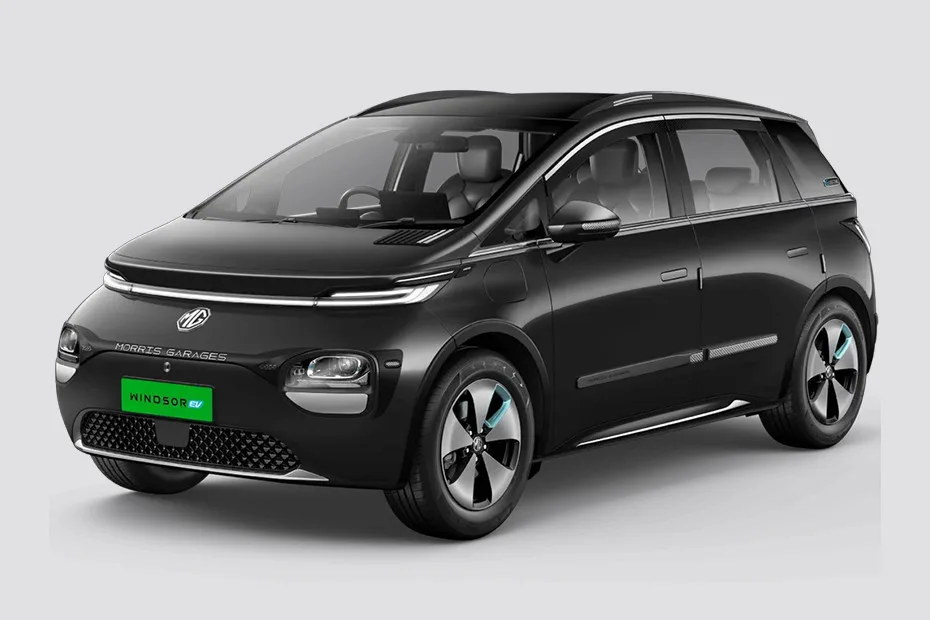
The Windsor's silhouette is divisive: part hatchback, part MPV, part crossover, with a stepped bonnet, near-flush door handles and a fixed panoramic glass roof on most variants. It is not conventionally pretty, but as MotorOctane points out, practical cars rarely are, and the 4.3-metre length, 1.85-metre width and 2,700 mm wheelbase translate directly into cabin space that no rival in this price band can match. Up front you get connected LED DRLs, LED headlamps and Aerotwin wipers; the side gets 18-inch alloys with low-profile 215/55 tyres, and the rear features connected LED tail lamps, a large MG Windsor script and parking sensors. The glass area is unusually generous, helping visibility and making the cabin feel airy. Notable misses include a non-opening sunroof on most variants, fake shark-fin antenna, and the absence of a rear wiper. Ground clearance is a quoted 186 mm, adequate for Indian conditions in real-world driving.
The cabin is the Windsor's strongest argument. The dashboard is dominated by a 15.6-inch touchscreen and an 8.8-inch driver display, with a flat, almost lounge-like layout helped by a completely flat floor. Three adults fit across the rear bench, and the seats recline up to 135 degrees, allowing near-couch posture; boot space is a healthy 604 litres. Material quality is mixed: soft-touch upper dashboard sections and leatherette upholstery feel premium, but lower plastics are hard. As Gagan Choudhary highlights from months of ownership, ergonomics is the weak link: sunroof shade, headlight modes, mirror adjustment and several other functions live inside the screen, and settings like regen level can require multiple taps to access. Physical AC controls were thankfully retained for India. Storage is excellent, with three cup holders up front, a large glovebox, wireless charging and door bins, though the front cup holders lack cooling.
Build quality is the Windsor's most divisive area. Panel fit and the touchpoints, including the gear selector and upholstery stitching, feel reassuring, and reliability has held up well over 10,000-13,000 km of owner use, with no battery errors, screen freezes or charging dramas reported beyond isolated DC charging hiccups. However, the glass panels are noticeably thin, leading to wind noise at highway speeds, and insulation lets in tyre roar from rough surfaces. The decorative grilles flanking the centre console rattle and have required dealer attention. The absence of a rear wiper on a Rs 18-19 lakh car is hard to defend, and the door handles use an electronic latch with no visible mechanical lever, which can feel unusual. Several owners have reported that dealer-fit accessories deform or peel within months and that mandatory accessory packs around Rs 32,000 are pushed at delivery.
A single front-mounted motor produces 136 PS and 200 Nm, fed by either a 38 kWh or 52.9 kWh battery. The 38 kWh pack delivers a real-world 240-280 km in the city and 220-240 km on the highway, while the larger Pro pack stretches to roughly 350-380 km, making it the better choice for highway-heavy users. As King Indian notes from daily use, the car easily handles 280-290 km on a full charge with the AC running. Acceleration is brisk in Sport mode without any meaningful wheelspin, and three drive modes plus adjustable regenerative braking allow good control. There is no start button: press the brake, slot the column-mounted gear selector into D and the car moves. AC charging from 0-100 percent takes around 6.5 hours on a 7.4 kW wallbox, and DC fast charging covers 20-80 percent in roughly 30-40 minutes.
The Windsor rides on a stiffer setup than most family cars, a deliberate choice given that the floor-mounted battery contributes around 30 percent of kerb weight. On smooth roads the suspension feels composed and high-speed stability is genuinely good, helped by the long wheelbase and 18-inch wheels. Brakes are sharp and confidence-inspiring even in panic stops at 70-80 km/h. However, on broken roads the car can shake noticeably, and sharp-edged potholes transmit a clear thud into the cabin. Long-term observation suggests the suspension's manners deteriorate slightly with mileage, with handling feeling less tied-down than expected. The steering is light and easy in the city but the 5-metre turning radius and the car's width demand careful judgement in tight lanes. Tyre noise from the low-profile rubber is audible at speed, and vibrations through the pedal box are a recurring complaint. It is set up for comfort and stability, not driving fun.
Pricing is where the Windsor turns the segment on its head. Outright, the car sits between Rs 15 lakh and Rs 19 lakh on-road depending on variant. Under MG's Battery-as-a-Service model the showroom price drops to around Rs 10 lakh, with the buyer paying roughly Rs 3.5 per km (minimum 1,500 km a month) for the battery, plus saving 60-70,000 rupees on road tax and insurance calculated on the lower price. As V3Cars cautions, the long-term math depends on whether you finance the car through MG's preferred NBFC partners, whose interest rates of 9.5-11 percent can offset some savings versus a standard bank loan. MG offers eight years or 1,60,000 km battery warranty on outright purchase and effectively lifetime coverage under BaaS, plus a 60 percent buyback after three years. One year of free public charging now caps at 1,000 kWh, a downgrade from the original unlimited promise.
TeamBHP's owner community broadly echoes the YouTube consensus: the Windsor is a brilliant city EV with class-leading space and a strong value proposition under BaaS, but ergonomics and the touchscreen-heavy interface remain daily annoyances. Long-term owners crossing 10,000-13,000 km report excellent reliability and running costs, with monthly electricity bills under Rs 1,000, while flagging dealer-pushed accessory packs and the missing rear wiper as the most consistent grievances.
"A practical, spacious family EV ideal for city use and fleet applications, but lacking the fun-to-drive character of rivals like the XUV400 or Nexon EV."
"After months of use, the Windsor is genuinely reliable and feature-loaded, but the suspension feels less composed over time and the touchscreen-led ergonomics remain frustrating."
"An excellent secondary car that needs disciplined planning, with BaaS making genuine financial sense only for buyers who would otherwise need NBFC financing."
"The cabin and pricing are exceptional, but the BaaS structure has too many unanswered questions around resale, finance treatment and per-km caps."
"BaaS is a segment-redefining innovation; the Windsor wins on space, comfort, ride and pricing, with only minor feature omissions like the rear wiper."
"Featuring an owner with 13,000 km in three months, the Windsor proves dependable and cheap to run, with the only real annoyances being dealer-pushed accessories and missing rear wiper."
"An owner with multiple premium cars rates it 9/10, calling out MG's downgrade of free charging from unlimited to 1,000 kWh as a broken promise that needs addressing."