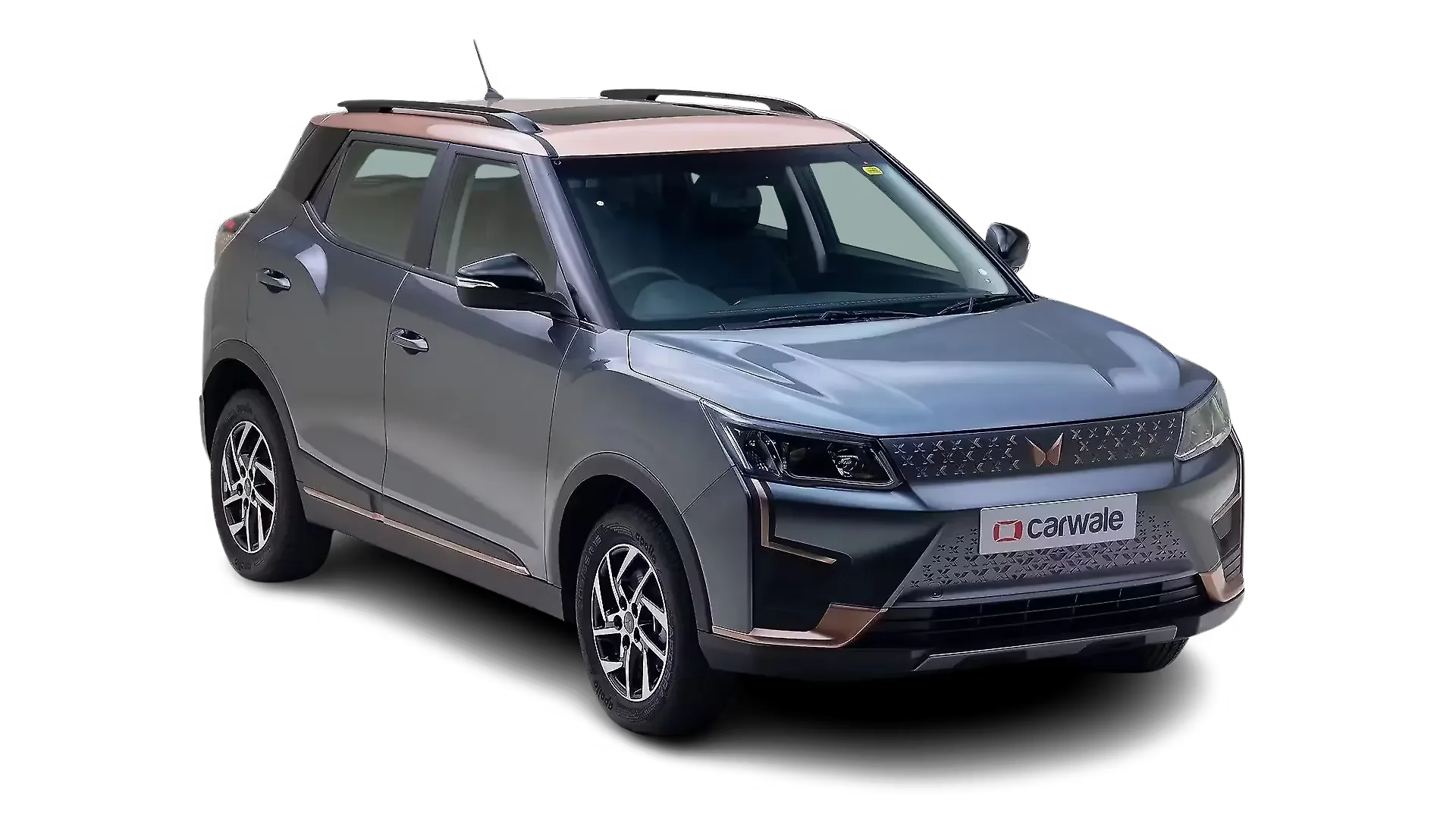
 Image: Mahindra press kit
Strong real-world range and easy performance, but unfinished cabin, soft suspension at speed, and looming next-gen Mahindra EVs make it a tough sell at this price.
The Mahindra XUV400 EV is the brand's first electric SUV, built on the XUV300 platform with a 39.4 kWh battery, 147 hp, and a claimed 456 km range. It delivers strong real-world performance, low running costs, and a roomier boot than its rivals, but feels like a placeholder against the upcoming born-electric INGLO cars.
Visually, the XUV400 is the XUV300 with EV jewellery: a closed grille, copper accents on the bumper, badges, alloys and roof, plus reshaped LED tail lamps. The 16-inch diamond-cut alloys wear 205/65 R16 rubber, and Mahindra offers Everest White, Napoli Black, Galaxy Grey, Infinity Blue and the dual-tone Nebula Blue with copper roof. The problem, as the celTGXQvT3Q review flags, is that this car is meant to lead Mahindra into the EV era yet looks the oldest of the lot, with cringeworthy tail lamps and no connected lighting. It is longer, wider and taller than the Tata Nexon EV and is in fact the widest car in its segment, but the design lacks the wow factor of the newer 3XO or upcoming BE6.
Inside, the XUV400 gets a black and light-grey dashboard with copper and gloss-black inserts, dual 10.25-inch screens, a new shift-by-wire selector, wireless charger, dual-zone climate control, sunroof and a connected car suite with 55-plus features. The dual screens are sharp but menus feel cluttered, and the centre console mixes modern and dated buttons in a clear patchwork. MotorBeam notes the perforated leather seats with blue stitching feel genuinely premium, yet hard plastics dominate the dash, doors and boot lining. Rear seat width is good for three at a pinch, headroom is excellent and the boot grows to 378 litres, but the flat squab, tilted backrest, missing rear AC vents and absent 360 camera at this price are serious omissions.
Mahindra has clearly worked on the safety and structure: six airbags, ESP, traction control, hill-hold assist, ISOFIX, TPMS and impact-sensing auto door unlock are all on board, and the XUV300 base platform carries a Global NCAP five-star crash rating. The motor and battery pack are IP67-rated with liquid cooling and a pyro switch, and Mahindra offers an eight-year or 1,60,000 km warranty on both. As MotorOctane's 10,000 km service experience shows, scheduled maintenance is essentially nil. However, fit and finish inside is uneven: visible panel gaps around the dashboard, a scratchy unlined boot, reflector-only door hazard markers, and a request sensor only on the driver's side reveal cost-cutting that owners notice well before reviewers do.
The XUV400 pairs a 39.4 kWh lithium-ion pack with a permanent-magnet synchronous motor making 147 hp and 310 Nm, driving the front wheels. Mahindra claims 0-100 km/h in 8.3 seconds and a 150 km/h top speed, and on track MotorBeam saw an indicated 160. Three drive modes, Fun, Fast and Fearless, alter throttle, steering and regen, but as Faisal Khan points out the modes are oddly calibrated: Fun caps at 90 km/h, Fast feels unnecessarily aggressive and Fearless is borderline reckless. Regen cannot be manually adjusted and resets with the mode; an L mode enables true one-pedal driving. A 7.2 kW AC charger fills the battery in 6 hours 50 minutes, and a 50 kW DC fast charger gets it to 80 percent in 50 minutes.
Ride and handling are the most divisive parts of the package. At city speeds the frequency-dependent dampers absorb broken tarmac and speed breakers well, and ground clearance is genuinely SUV-like despite the underfloor battery. Push harder, though, and the suspension goes soft: the car pitches, bounces and leans, and the light, feel-free electric steering does not inspire confidence on unfamiliar roads. Body roll is noticeable around corners, and the smaller 3XO is widely considered the more mature chassis. NVH is well contained, with little wind or road noise filtering in. For relaxed highway cruising and daily city use the XUV400 is comfortable and effortless; for enthusiastic driving on twisty roads it simply is not set up to deliver.
At roughly Rs 16 to 19 lakh on-road for the EL Pro, the XUV400 undercuts the MG ZS EV and matches the Tata Nexon EV Max while offering more width, a bigger boot and similar performance. Running costs of Rs 1-2 per km versus Rs 8-12 for petrol, plus near-zero service bills, can save an owner over a lakh in the first year of heavy use. Dealer cash discounts of Rs 50,000 to 90,000 are already on the table. The catch, as Namaste Car's feature walkthrough makes clear, is that key conveniences like ventilated seats, 360 camera, EPB with auto-hold and front parking sensors are missing. Buyers eyeing the future-ready Mahindra BE6 or XEV 9E may prefer to wait.
Genuine VFM at around Rs 18.5 lakh on-road, but conspicuous feature omissions and the looming INGLO line-up make some owners hesitate before signing.
Long-term reality: One owner reported an AC compressor whine on the test car, and Mahindra dealers are already offering Rs 50,000 to 90,000 cash discounts, suggesting softer demand. Most buyers found the package compelling at sub-Rs 19 lakh but worried about resale once LFP variants arrive.
Read the full forum thread on TeamBHP →"Effortless, smooth and silent like every EV, but soulless and reliant on Mahindra's pricing to make sense."
"After 10,000 km the service bill was practically zero; running costs alone have saved over a lakh in six months."
"A feature-packed family EV with eight-year battery warranty and 456 km claimed range across two battery options."
"Performance and space are genuinely good, but the cabin needs more soft-touch materials to justify the price."
"The XUV400 Pro is safer and better-equipped now, but it still feels like Mahindra's first foot forward, not its best."