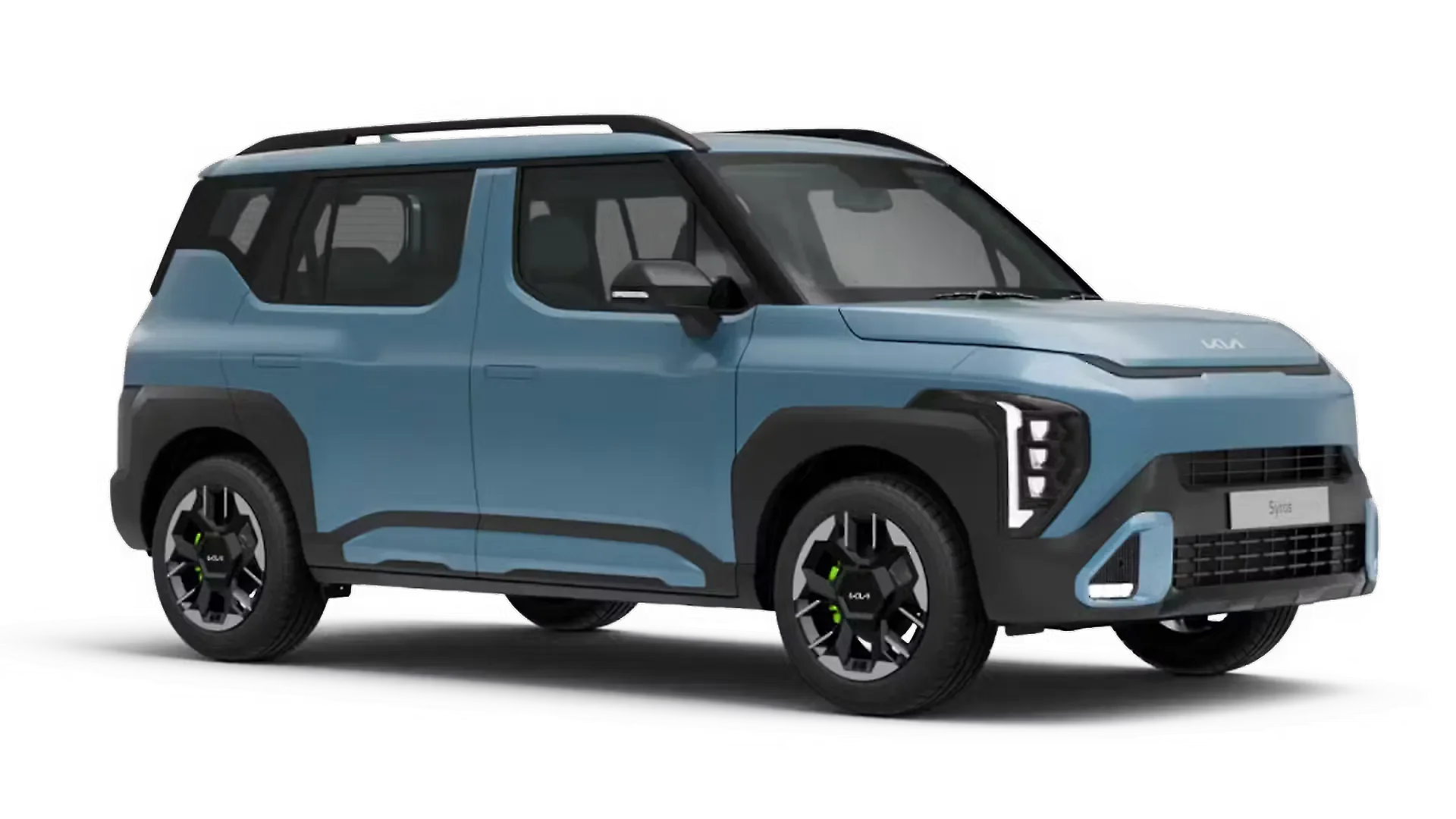
 Image: Kia press kit
A class-leading cabin and feature list let down by inconsistent suspension tuning and a polarising design; test drive before committing.
The Kia Syros is a sub-4-metre SUV that prioritises cabin experience over conventional SUV stance. It delivers a segment-best interior, genuine rear-seat luxury with recline and ventilation, and a feature list that shames cars priced 7-8 lakh higher. But polarising boxy styling and inconsistent suspension tuning hold it back from a clean recommendation.
The Syros wears Kia's most polarising face yet, a tall, slab-sided box clearly inspired by the EV9 with vertical ice-cube LED headlamps and an upright stance. At 3995 mm long, 1805 mm wide and roughly 1680 mm tall with 190 mm of ground clearance, it is wider than rivals and taller than the Sonet. The boxy proportions, chunky cladding and corner-mounted lamps draw stares everywhere, but Car Blog India notes the design is genuinely Marmite: futuristic and head-turning to some, awkward and toy-like to others. The recessed door handles look striking but are impractical with luggage in hand, and the corner-positioned lamps could push insurance and repair costs up after minor knocks.
This is where the Syros makes its case. The triple-screen Trinity Panoramic Display, two 12.3-inch panels flanking a 5-inch climate screen, is paired with genuine physical shortcut buttons for maps, media and AC, an increasingly rare combination. Material quality, soft-touch surfaces and the absence of gloss-black trim make it feel a clear segment above. The rear bench is the standout: it slides, reclines almost flat, gets ventilation, sun blinds, dual USB-C ports and an air purifier, features usually reserved for cars costing 7-8 lakh more like the Hyundai Alcazar. A 64-colour ambient lighting setup, dual-pane sunroof and Harman Kardon 8-speaker system complete the package. Front seats are 10-way adjustable with excellent cushioning, though visual cabin volume feels tighter than the dimensions promise.
Build quality inside the cabin is genuinely premium and arguably the Syros's strongest claim. Plastics, switchgear and tactile buttons all feel a class above, with no rough edges or unfinished surfaces, a clear dig at Tata and Mahindra rivals. The steering wheel uses proper physical buttons rather than capacitive nonsense, the gear selector is a real knob with positive detents, and the AC controls can be operated entirely by feel. Exterior fit is less convincing: V3Cars notes the heavy plastic cladding scratches easily and visible window-frame seams cheapen the 20-lakh impression. Safety is comprehensive with six airbags standard, Level 2 ADAS, ESC, hill-hold, 360-degree camera and blind-view monitor. Kia is yet to release a crash rating but claims significant K3 platform strengthening.
The Syros carries over Kia's familiar engines: a 1.0-litre turbo-petrol making 118 bhp paired with a 7-speed DCT or 6-speed manual, and a 1.5-litre diesel with 114 bhp and 250 Nm driving a 6-speed torque converter or manual. The turbo-petrol DCT is the enthusiast's pick, punchy in Sport mode with quick paddle-shift responses, though Motoring's reviewer found it lethargic in city traffic with a laid-back gearbox calibration. The diesel feels relaxed rather than rapid, with usable low-end torque but no top-end fireworks. NVH is well-contained at idle, though wind noise builds past 100 km/h and the diesel transmits some steering vibration. Sport mode genuinely transforms the petrol's character, which makes the default tuning feel deliberately softened.
Ride quality is the Syros's most contested trait. In the city the suspension feels plush and absorbs broken surfaces well, with the softer tune masking sharp inputs better than the older K2-platform Kias. But the calibration lacks consistency: Motoring's reviewer reports the petrol bounces occupants in the rear while the diesel pitches at the front, and highway composure above 80 km/h gives way to noticeable body roll and a slightly unsettled gait. The tall body and 17-inch wheels with chunky rubber compound the issue. Steering is well-weighted and the car feels nimble through corners thanks to its low-ish height for the class, but anyone prone to motion sickness should drive it back-to-back with a Nexon or Sonet before committing.
Pricing spans roughly 9 to 18 lakh ex-showroom, placing the Syros squarely between the Sonet and Seltos, an awkward overlap Kia will need to manage. Lower variants offer genuine bang-for-buck with a 10-inch screen and six speakers as standard, but fully loaded Syros trims bump against mid-spec Seltos territory where buyers may prefer the more conventional SUV. Real-world fuel economy is acceptable rather than impressive: 10-12 km/l city and 16-19 km/l highway for the petrol DCT, with the diesel returning around 18 km/l. Against the Hyundai Venue, Kia Sonet and Mahindra XUV 3XO, the Syros justifies its premium only if you value the cabin experience and rear-seat luxury above outright SUV stance.
"Best-in-class cockpit design and a punchy DCT, but rear space disappoints given the long dimensions."
"A great set of seats and screens wrapped in a car whose suspension and ergonomics feel from the past."
"Feature-loaded with EV9-inspired design, triple displays and 64-colour ambient lighting genuinely set a new benchmark."
"A near business-class rear seat and premium cabin make it compelling, provided you can accept the polarising looks."
"No other car at this price will match the Syros for cabin experience, but the exterior won't wow everyone."