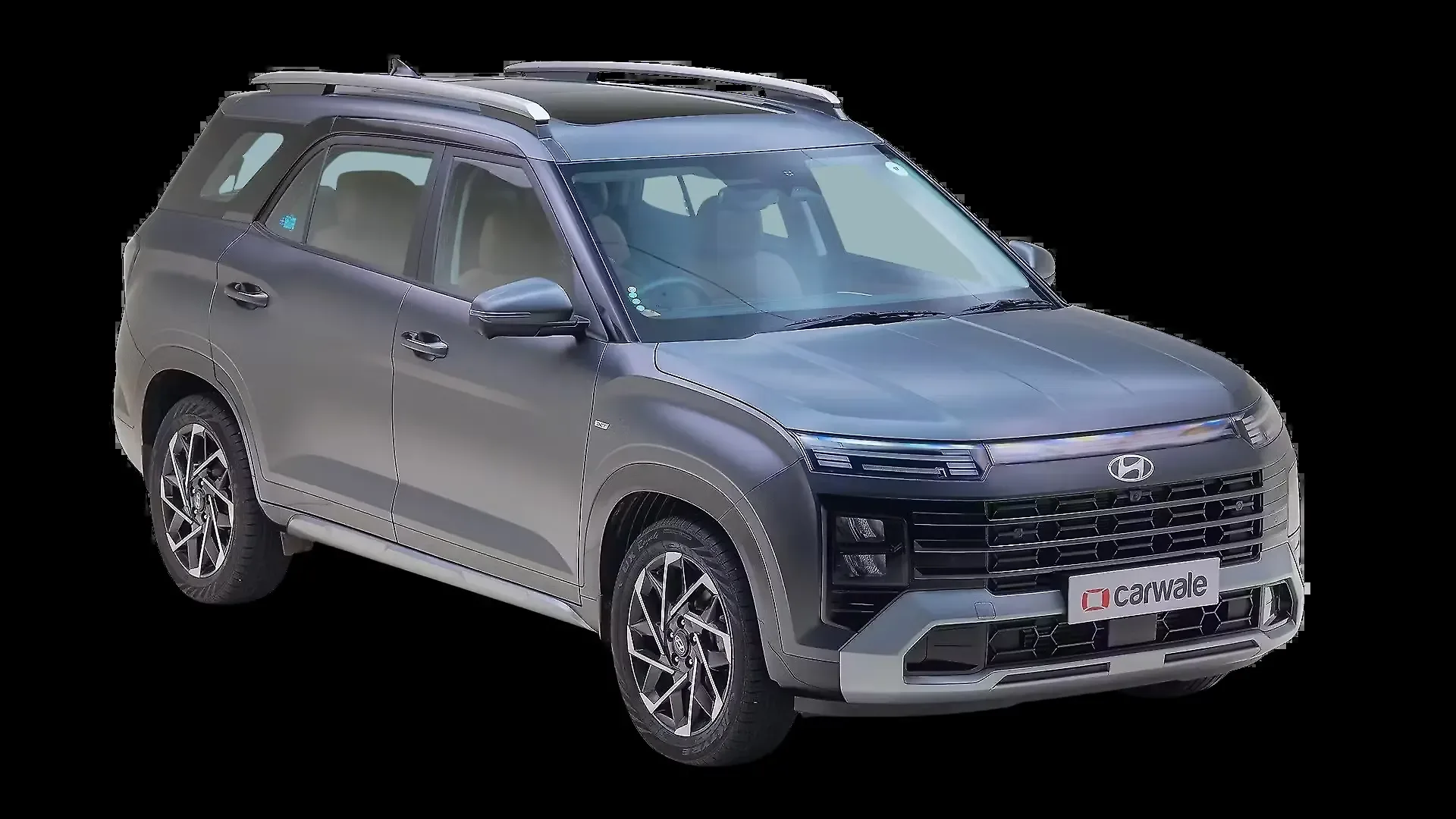
 Image: Hyundai press kit
A premium, feature-rich Creta-plus that works best as a 5+2 family SUV rather than a true seven-seater rival to the Safari or XUV700.
The 2025 Hyundai Alcazar is essentially a stretched, more premium Creta with two extra seats, a longer wheelbase and 200mm ground clearance. It nails the role of a family SUV with its captain-chair second row, feature-loaded cabin and refined turbo-petrol DCT, but the cramped third row and stiff low-speed ride mean it is best understood as a Creta XL rather than a full-blooded seven-seater rival to the Safari, XUV700 or Carens.
The Alcazar finally looks like its own car rather than a stretched Creta. The split-LED headlamp signature, larger cascading grille, H-shaped DRLs, sequential indicators, 18-inch diamond-cut alloys, connected tail lamps and visible dual exhaust tips give it real road presence, even if it cannot match the sheer mass of a Safari, XUV700 or Hector Plus. At 4.5 metres long with a longer wheelbase than before, it sits taller and broader, with 200mm of ground clearance and chunkier cladding. Faisal Khan rates the rear three-quarter as the most photogenic angle, particularly in the matte grey and tan combination. The design is more mature and slightly more global than the Creta's boxier face, though some reviewers still find hints of Endeavour and Tucson in the silhouette. Paint quality and panel fit feel a class above the price point. It is not flashy, but it is cohesive, premium and clearly aimed at urban families who want presence without shouting.
Step inside and the Alcazar feels every bit a 20-lakh-plus SUV. The dual-tone tan and navy cabin, quilted leatherette seats, soft-touch upper dash, twin 10.25-inch screens and ambient lighting deliver a genuinely premium first impression. The captain seats in the second row are the standout: ventilated, with adjustable thigh support, winged headrests, individual armrests, retractable tray tables, sunshades, wireless chargers and a boss-mode switch on the front passenger seat. Front seats are eight-way powered with memory and welcome functions. The bugbears are well documented: V3Cars notes that frequently used climate functions sit on touch-capacitive panels that demand a glance away from the road, and there is no wireless Apple CarPlay or Android Auto despite the price. The third row is the cabin's weak link, accessible only by squeezing between the captain seats with knee room, thigh support and ingress all compromised; the seven-seater bench at least tumbles for easier access. Storage, USB-C ports and rear AC vents across all three rows are well sorted.
Hyundai's mechanical reliability reputation underpins the Alcazar's appeal. Door thunks, panel gaps, switchgear feel and paint finish are all consistently rated above segment average. The feature list reads like a flagship: panoramic sunroof (petrol only on most variants), 360-degree camera with strong night-time clarity, blind-view monitor on indicator, eight-speaker Bose audio, NFC key card that starts the car without a phone, dual-zone climate, voice-controlled sunroof, eight-way powered driver seat with memory, ventilated front and rear seats, and a Level 2 ADAS suite with adaptive cruise and lane keep assist. Hyundai backs this with a 3-year unlimited-kilometre warranty. The compromises are pointed: no powered tailgate at this price, no wireless smartphone mirroring without a dongle, glossy trim that will scratch, a weak horn, and the platform's underwhelming third-party crash record despite six standard airbags, ESC and TPMS. The infotainment has reportedly never hung over a year of daily use, and that long-term dependability is a major draw for the typical buyer.
Two engines are on offer: a 1.5-litre turbo-petrol producing 160PS and 253Nm paired with a 7-speed DCT or 6-speed manual, and a 1.5-litre diesel making 116PS and 250Nm with a 6-speed manual or torque-converter auto. The turbo-petrol is the enthusiast pick. Arun Panwar's drive notes how cleanly the needle climbs once past 1500rpm, with overtakes dispatched effortlessly and Sport mode adding genuine steering weight. NVH is excellent, shifts are quick at higher revs, and 0-100kmph comes up in under 10 seconds. The flip side is fuel economy: the petrol DCT delivers around 10.5kmpl in the city and 13.8kmpl on the highway in tank-to-tank testing, with city figures dropping to 7-8kmpl when driven hard. The diesel is the efficiency champion at 18-19kmpl but feels strained with a full cabin given the car's kerb weight; several reviewers argue Hyundai should have offered a larger-capacity diesel for this body. The DCT can hesitate at crawling speeds and refuses brake-torque launches, but is otherwise smooth and mature.
Ride and handling are deliberately tuned firmer than the Creta, and the result is a split personality. At highway speeds the Alcazar feels planted, stable and confident, with body roll well contained through corners and steering that weights up nicely in Sport mode. High-speed stability with a full cabin is genuinely reassuring, and the car tracks straight without nervousness. Around town it is a different story: sharp-edged bumps, rumble strips and broken patches send audible thuds and a degree of vertical movement into the cabin, an issue Gagan Choudhary suggests could be partly tyre-related on the JK-shod cars. Brakes are progressive with all-four discs, the turning radius is manageable for the size, and visibility from the slightly elevated seat is good. ADAS, including adaptive cruise, lane keep assist and forward collision warning, works convincingly on Indian highways and takes real fatigue out of long drives, though the system can hunt when lane markings disappear. Compared to the plusher Hector Plus or earlier Safari, the Alcazar trades low-speed comfort for highway composure.
The Alcazar range starts at around Rs 17.18 lakh ex-showroom and tops out near Rs 25.69 lakh, with the Signature six-seater turbo-petrol DCT tested here at roughly Rs 25.43 lakh on-road Mumbai. At introductory pricing the proposition is sharp: for roughly a lakh more than a comparable Creta you get the longer wheelbase, captain seats, the more premium cabin and a usable boot even with all rows up. Within the seven-seater set, the Kia Carens undercuts it on price and beats it on outright space, the Tata Safari and Mahindra XUV700 offer more road presence and a stronger crash record, and the MG Hector Plus rides better over broken roads. The Alcazar's case rests on Hyundai's after-sales network, mechanical reliability, feature density and the captain-seat experience. For families who genuinely seat six adults regularly, the rivals make more sense. For those wanting a Creta with more space, more luxury and occasional third-row capability, this is the segment's most polished pick.
TeamBHP's owner community echoes the consensus that the Alcazar is best treated as a premium Creta XL rather than a true three-row SUV, with long-term threads praising the turbo-petrol DCT's refinement and Hyundai's after-sales reliability. Recurring owner gripes mirror the reviewer findings: firm low-speed ride on stock JK tyres, marginal third-row utility for adults, and the absent powered tailgate at this price point.
"Recommends the diesel automatic for buyers who want both efficiency and adequate performance, calling the introductory pricing genuinely attractive."
"Walks through the feature list in detail and treats the Alcazar as a comprehensively equipped family SUV with strong tech and connected-car functionality."
"Argues the Alcazar makes sense only if you want Hyundai reliability with extra boot and occasional 5+2 capability; for genuine seven-seater needs, points buyers to the Carens, Hector Plus, Safari or XUV700."
"Loves the turbo-petrol's punch, the Sport-mode steering weight and the well-calibrated ADAS, but flags the small-displacement diesel as a mismatch for this body."
"Real-world tank-to-tank testing returned 10.44kmpl in the city and 13.81kmpl on the highway for the turbo-petrol DCT, with around 600km of highway range on a full tank."
"Sums it up sharply: Hyundai should have called this the Creta Grand or Creta XL because that is the role it plays best, not a true seven-seater rival to the Safari or XUV700."