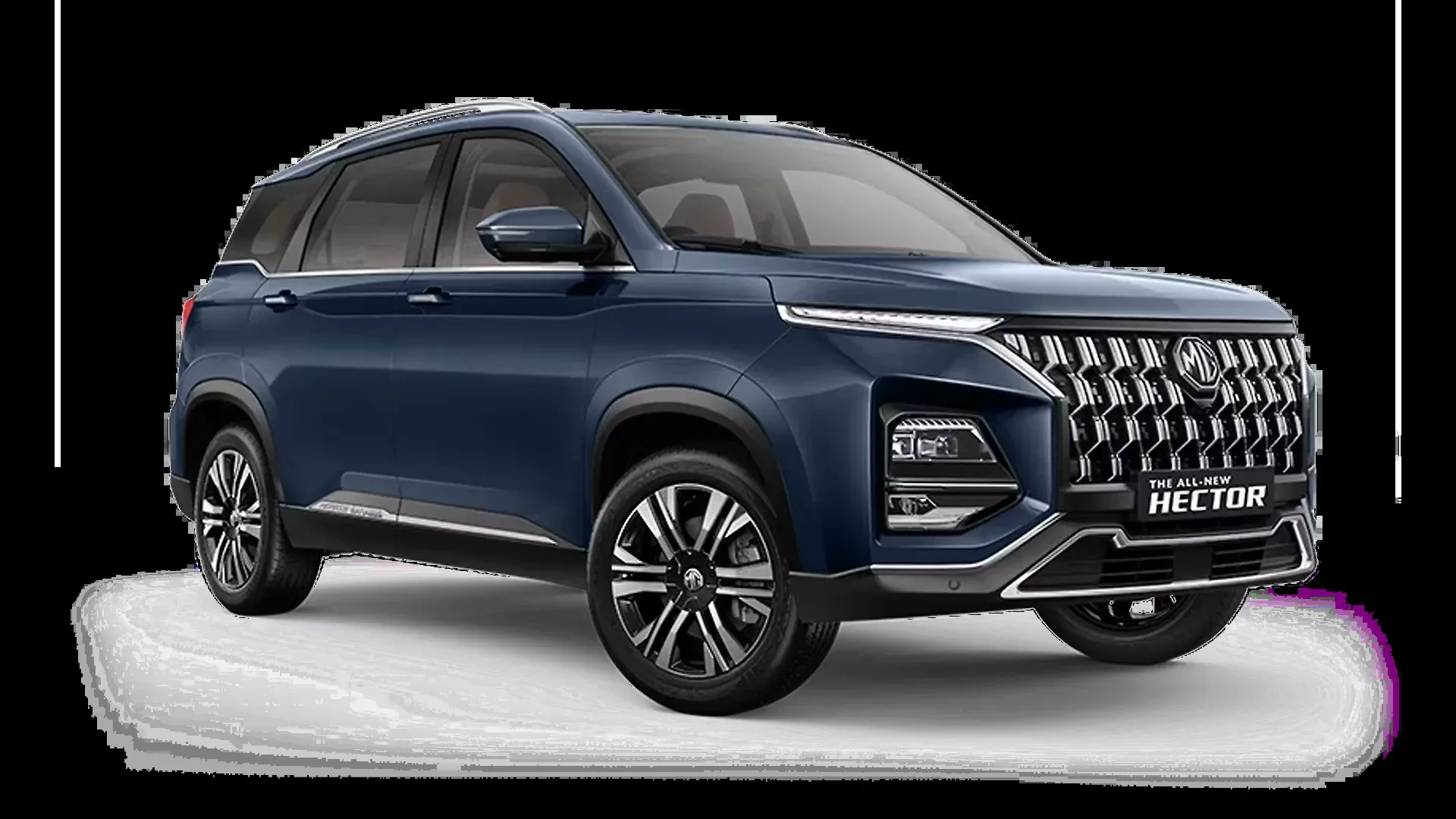
 Image: Mg press kit
The 2025 Hector is a feature-laden, spacious family SUV at an attractive price, but a lacklustre petrol drivetrain, missing diesel automatic, and below-par dynamics keep it behind sharper rivals.
The 2025 MG Hector facelift is India's biggest bang-for-buck large SUV: a 4.7m crossover loaded with a 14-inch HD touchscreen, Level 2 ADAS, panoramic sunroof and class-leading rear space. But its 1.5-litre turbo-petrol with CVT feels strained, the diesel still has no automatic, and dynamics trail rivals like the Tata Safari and Hyundai Alcazar. Buy it for space, features and price; skip it if you actually enjoy driving.
The 2025 facelift is the most resolved Hector yet. The split LED DRLs, larger hexagonal grille with diamond-pattern treatment, dynamic sweeping indicators and reworked bumpers give the 4.7-metre crossover genuine road presence, though the chrome quotient still borders on excessive. In profile, the silhouette is unchanged from the outgoing car: same 18-inch dual-tone alloys wrapped in 215/55 R18 Goodyear rubber, same roof rails, same shark-fin antenna. The rear is where MG has spent most effort, with the connected LED tail-lamp bar, fresh Hector Plus badging on the six-seater and a redesigned bumper that nudges length up marginally. Faisal Khan flags the fake exhaust tips as a letdown, and we agree: a car this expensive should not pretend. Five colours are on offer including a new pearl white, and the 192mm ground clearance plus 1700kg kerb weight underline that this is a big, imposing family SUV rather than a sharp-suited urban crossover.
The cabin is where the Hector lands its hardest punches. A 14-inch portrait HD touchscreen, claimed to be India's largest, dominates the dash and now runs faster than before, though it still is not the quickest unit out there. A 7-inch fully digital cluster, dual-pane panoramic sunroof, eight-speaker Infinity by Harman audio, ambient lighting in eight colours, ventilated front seats with six-way power adjust for the driver, wireless charging, PM 2.5 air purifier and a cooled glovebox round off a feature list that genuinely embarrasses cars at twice the price. Rear seat space is a highlight: generous knee and headroom, dedicated rear blower with five fan speeds, USB charging, recline adjustment and a 60:40 split. Faisal Khan calls out missing one-touch operation on three of four windows and the absence of rear sunshades. Build is mostly soft-touch up top with harder plastics lower down; the odd panel gap and an over-reliance on touchscreen menus for AC controls are the only real letdowns.
Build quality is solid in places, average in others. MG cites high-strength steel in the structure, hot-stamped B-pillars and roll-formed tubular steel door beams, and the doors do shut with a reassuring thud. Six airbags, ESP, hill-hold, TPMS, ISOFIX and a 360-degree camera are standard fare across higher trims, and the Level 2 ADAS pack adds adaptive cruise, bend cruise, traffic jam assist, lane keep, lane departure warning, forward collision warning and automatic emergency braking. In real-world use the ADAS suite is one of the smoother implementations in the segment. MG offers a 3-year unlimited-km warranty, 3 years of roadside assistance and three free labour services. Where the Hector falls short is in fit-and-finish details: occasional panel gaps, plastic quality lower in the cabin that does not match the screen-led dashboard, and a horn that, as Faisal Khan unkindly puts it, sounds borrowed from a hatchback. The connected I-Smart suite with 75-plus features and OTA updates is genuinely deep.
Powertrain is the Hector's weakest link. The sole petrol on sale is a 1.5-litre turbocharged direct-injection four-cylinder making 143 PS and 250 Nm, paired to either a 6-speed manual or an 8-step CVT; the 48V mild-hybrid and DCT options have been dropped. On the move, the CVT delivers the dreaded rubber-band effect: throttle pinned, revs flare to around 5100 rpm and forward progress feels disconnected from the noise. 0-100 kmph in roughly 12 seconds is respectable on paper but the 1700kg kerb weight is always evident, and overtakes on the highway demand a heavy right foot. The 2.0-litre Fiat-sourced diesel, due in 2026 per the launch plan, returns only with a 6-speed manual that has a notably heavy clutch, the same unit shared with the Tata Safari, Tata Harrier and Jeep Compass; the lack of a diesel automatic in 2025 is, as MotorOctane notes from long-term use, the single biggest gap in the lineup.
The Hector rides on MacPherson struts up front and a coil-sprung rear beam, tuned distinctly soft. At city speeds the suspension dispatches broken tarmac and speed breakers reasonably well, helped by the 192mm ground clearance, though the move to 18-inch wheels with shorter sidewalls has taken some plushness out compared to the original 17-inch setup. Push harder and the soft setup shows its limits: there is pronounced vertical movement over undulations at highway speed and noticeable body roll through corners. The steering is light and easy at parking speeds but offers little feedback as pace builds, and brakes, despite all-round discs, feel adequate rather than reassuring. Compared to the Tata Safari, Hyundai Alcazar and Mahindra XUV700, the Hector is the least engaging driver's car in the segment. The 360-degree camera still lags by roughly half a second, which matters in tight Indian parking. This is a relaxed cruiser, not a back-road tool.
Value is the Hector's strongest case. The petrol range opens at roughly Rs 12 lakh ex-showroom and the top Savvy Pro sits near Rs 19 lakh; the six and seven-seat Hector Plus starts around Rs 17 lakh. That undercuts equivalently equipped Tata Safari and Hyundai Alcazar variants while offering more screen real estate, a longer feature list and arguably more rear-seat space. The CVT commands roughly Rs 1.6 lakh over the manual, and the diesel, when it returns, will sit around Rs 3.3 lakh above the petrol manual, a steep premium. MotorOctane's long-term ownership data shows reasonable service costs around Rs 3000 for routine work, but real-world fuel economy of 7-10 kmpl in city and 9-12 kmpl on highway makes running costs the Achilles heel. Resale and service network remain weaker than Tata or Hyundai. For buyers prioritising space, kit and price per square foot, the Hector is unmatched. Also worth a look: the MG Windsor EV from the same brand if running costs matter most.
Long-term ownership reports align with the consensus: the petrol-CVT is best suited to relaxed urban driving and struggles when pushed, while the diesel manual remains the enthusiast pick despite its heavy clutch. Owners consistently praise the rear-seat experience, feature depth and connected-car functionality, but flag fuel economy, occasional electronic glitches and patchy after-sales as ongoing concerns.
"Hector Plus adds a usable third row but compromises boot space to 155 litres; MG urgently needs a diesel automatic and a faster infotainment system."
"Strong value-for-money proposition with class-leading screen and features, but the driving experience remains its weakest link."
"On the used market the Hector holds up well as a feature-rich family SUV, with petrol automatic top variants offering particularly strong second-hand value."
"If you must have an MG SUV, the 2-litre diesel is the powertrain that makes real sense; the petrol simply does not have the legs for this body."
"After 5300km in the petrol-CVT, real-world economy of 8.5-10 kmpl in city and the cabin's space and features make it a genuine long-distance family car."
"The exhaustive feature walkthrough confirms the Hector remains the segment's most equipped SUV, with India's largest 14-inch HD touchscreen and a deep ADAS suite."