Volkswagen Taigun vs
Toyota Hyryder
Choose between a driver's car built for feel or a hybrid built for fuel bills.
Most buyers decide here. Read this before anything else.
- You drive on weekends for the sheer pleasure of it and want a car that rewards effort through corners.
- You frequently use highways and want a refined, punchy engine that makes long runs effortless.
- You have a young family and safety is non-negotiable: five-star Global NCAP matters more than fuel savings.
- You live in a Tier-1 city where petrol pump access is easy and you cover under 1,500 km a month.
- You value build solidity over feature count and prefer a cabin that ages well over one that impresses on spec sheets.
- You plan to keep the car for seven-plus years and want a mechanically robust platform with strong resale credentials.
- You commute daily in stop-and-go city traffic and your monthly fuel bill is a genuine financial concern.
- You want the peace of mind of Toyota ownership and a service network that covers smaller towns.
- You clock 2,000-plus kilometres a month and the real-world 19-20 kmpl will meaningfully offset a higher sticker price.
- You prefer a calm, linear drive experience over an exciting one and rarely push a car hard.
- You drive through areas with patchy petrol supply and the mild-hybrid or CNG option adds a useful backup.
- You want a taller, more commanding SUV stance with 210 mm of ground clearance for occasional rough-road use.
The Taigun scores 7.8/10, the Hyryder 6.6/10. In real life, they are built for different people.
The Hyryder's strong hybrid slips into near-silent EV mode repeatedly in traffic, keeping the engine off for meaningful stretches. MotorBeam confirmed real-world returns of close to 20 kmpl in the city, which translates to a noticeably lower monthly fuel bill. The Taigun's 1.0 TSI is efficient for a turbo petrol but it cannot match that figure in bumper-to-bumper conditions.
The Taigun's 1.5 TSI with seven-speed DSG covers ground with an urgency the Hyryder cannot match. MotorBeam noted the Taigun GT DSG feels planted and alert at triple-digit speeds, with the DSG keeping the engine in its powerband. The Hyryder's CVT is smooth but the combined 114 bhp hybrid system runs out of breath on sustained overtaking manoeuvres.
The Hyryder's 210 mm ground clearance versus the Taigun's 188 mm is a meaningful real-world gap on broken urban roads and during monsoon flooding. Namaste Car highlighted the Hyryder's 5.4-metre turning radius as a bonus in tight lanes. The Taigun rides tidily but its lower belly requires more careful line selection on severely potholed roads.
Toyota's service reputation and hybrid demand keep Hyryder residuals strong, particularly as fuel prices remain volatile. The Taigun's Volkswagen badge and MQB platform command premium resale in metro markets, and its five-star NCAP rating adds buyer confidence. Ownership costs for the Taigun are higher at the service counter, while the Hyryder's hybrid system has proven reliable over three-plus years in market.
Scores shown inline. "Best for" tells you who each result matters to.
| Axis | Volkswagen Taigun | Toyota Hyryder | Best for |
|---|---|---|---|
Design |
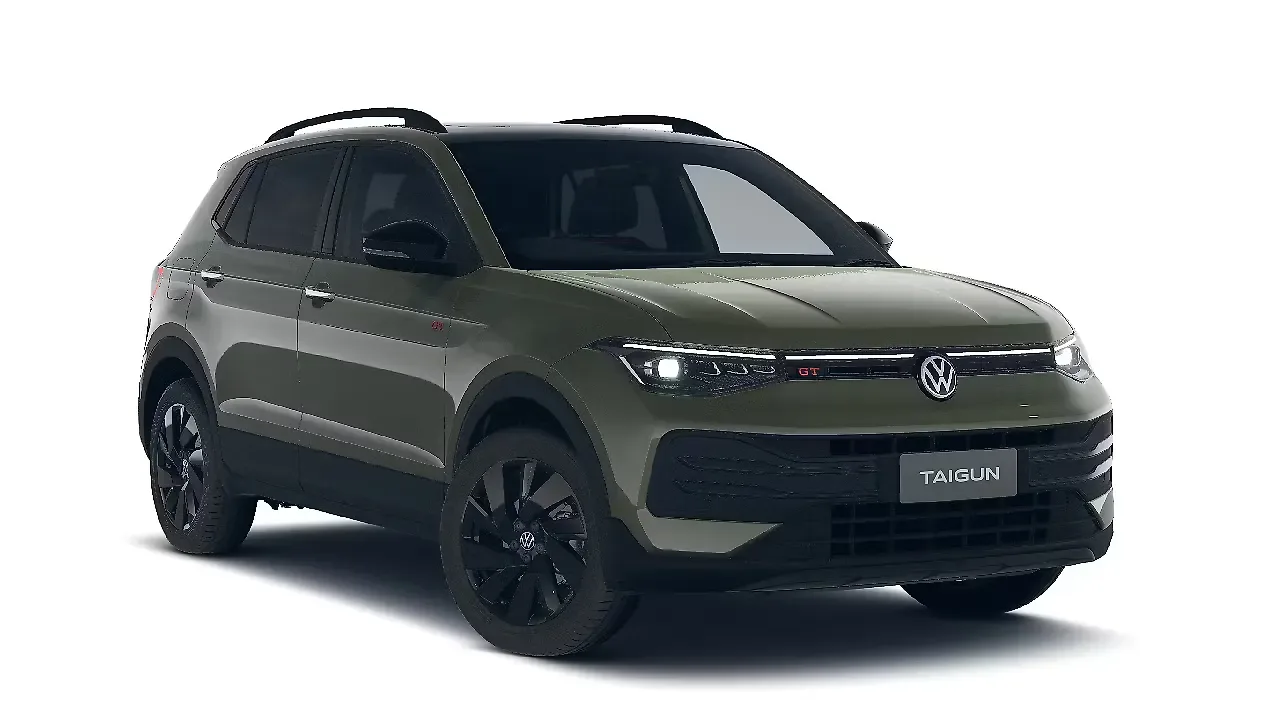
The 2025 facelift gives the Taigun a connected LED light bar, an illuminated VW logo and cleaner bumpers that align it with global VW design. MotorBeam describes the result as minimalistic rather than flashy, which divides opinion. The silhouette is unchanged at 4.22 metres, keeping proportions tight and purposeful. 8.0 / 10 |
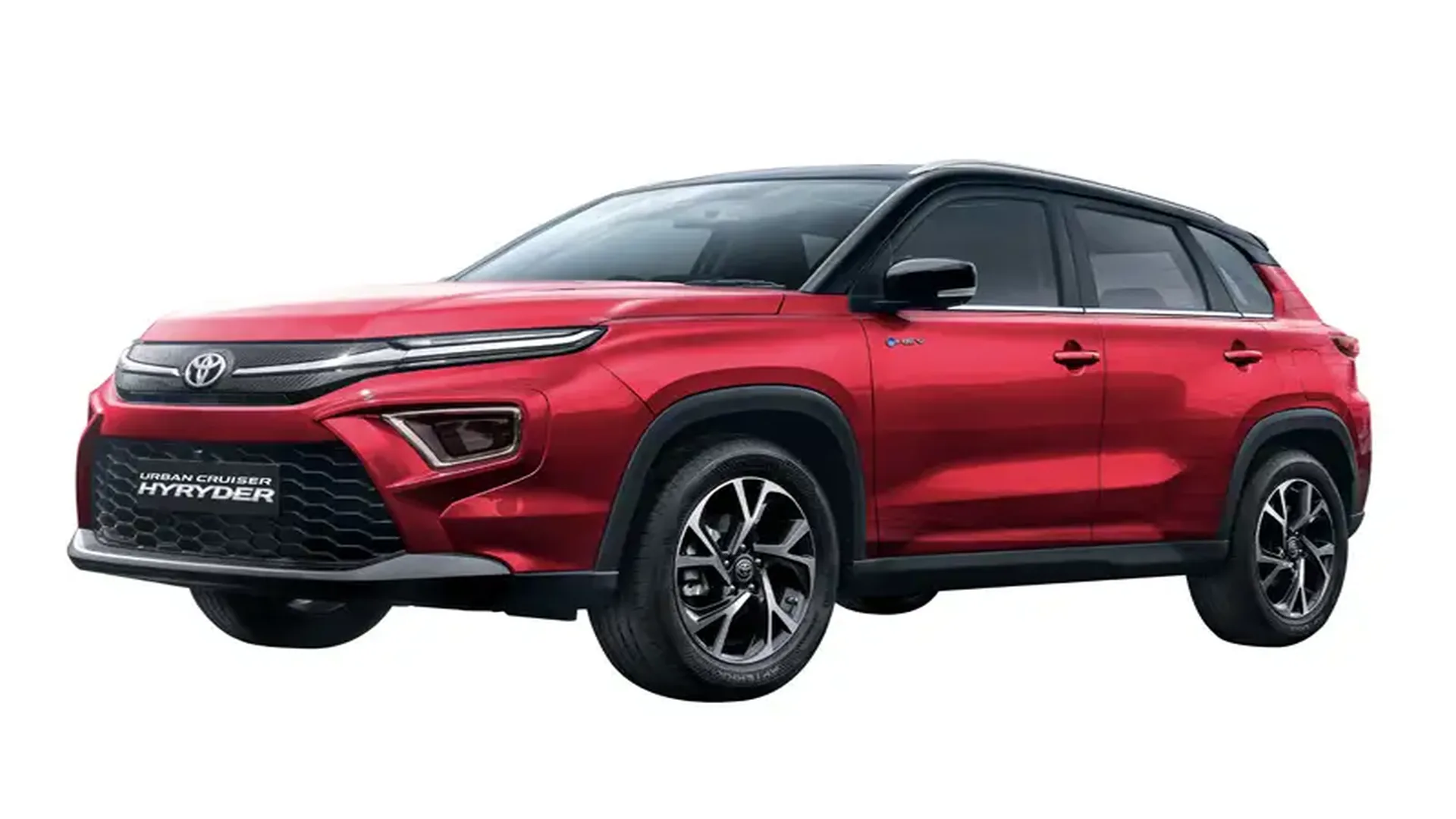
The Hyryder wears a more upright face with a crystal-acrylic grille, sweeping DRLs and a connected rear light bar. MotorBeam notes it has more funky design elements and grabs attention, particularly in bold colours like Curcuma Yellow. The taller stance reads as a proper SUV from the kerb rather than a crossover. 7.5 / 10 |
Statement SUV buyersHyryder's bolder face and taller body reads as a more commanding presence
|
Interior |
The Taigun's cabin is handsome and well-assembled, with a 10.25-inch digital cluster, ventilated seats, wireless charging and a panoramic sunroof on top trims. Hard plastics dominate the lower half of the dashboard, which lets the side down at this price. Build consistency across panels is noticeably better than most rivals. 7.0 / 10 |
The Hyryder pairs a brown-and-black theme with soft-touch dashboard inserts and adds a head-up display and 360-degree camera to its feature list. Gagan Choudhary noted that switchgear and the sunroof shade feel borrowed from Maruti and lack the premium touch the exterior promises. Feature breadth beats the Taigun; tactile quality does not. 7.0 / 10 |
Feature-first familiesHyryder's HUD and 360-cam add genuine daily utility despite softer material quality
|
Performance |
The 1.5 TSI produces 150 PS and 250 Nm through a seven-speed DSG, and Active Cylinder Technology keeps efficiency honest at cruise. The 1.0 TSI now pairs with an 8-speed Aisin torque converter for smoother town driving. Rohit Paradkar consistently calls the TSI-DSG combination the most engaging powertrain in the segment. 8.5 / 10 |
The strong hybrid combines a 91 PS Atkinson-cycle petrol with a 79 PS motor for 114 bhp combined, mated to a CVT. Acceleration is linear and adequate rather than exciting, and the transition between EV and petrol modes is seamless. Faisal Khan noted the Hyryder lacks urgency when pushed hard on an open road. 7.0 / 10 |
Driving enthusiastsTaigun's TSI-DSG pairing delivers a level of engagement the hybrid CVT cannot replicate
|
Ride Quality |
The Taigun rides with composure at highway speeds and handles sharp inputs with European firmness. At low speeds over broken city roads, the suspension can feel taut, which some urban buyers find tiring. The MQB platform keeps body roll well controlled without sacrificing long-distance comfort. 7.5 / 10 |
The Hyryder's softer suspension tune absorbs city road imperfections more willingly, aided by its taller sidewall 215/60 tyres versus the Taigun's 205/55. Namaste Car appreciated the compliance in urban conditions. High-speed stability is acceptable but the body moves more than the Taigun's stiffer setup. 7.5 / 10 |
City daily driversHyryder's softer tune and taller tyres absorb urban potholes with less fuss
|
Build Quality |
The Taigun's MQB-A0-IN platform delivers panel gaps, door-shut feel and overall solidity that reviewers consistently rate as class-leading. Its five-star Global NCAP rating backs up what you sense at the door handle. MotorBeam notes the body-in-white stiffness contributes to both safety and refinement. 8.0 / 10 |
The Hyryder's Toyota co-developed platform is solid and dependable without matching the Taigun's tactile premium feel. Panel fit is good and the structure is proven over three years in market with no significant complaints. It does not carry a five-star NCAP rating, which is a gap buyers should note at this price point. 7.0 / 10 |
Safety-conscious buyersTaigun's five-star NCAP and MQB solidity set the benchmark in this segment
|
Value for Money |
The Taigun starts at Rs. 13 lakh and tops out near Rs. 22.83 lakh, packing strong engines and proven safety into a competitive price. Running costs are higher than the hybrid over a long ownership period. Faisal Khan points out that the feature list at mid-spec variants feels lean compared to Korean rivals at the same price. 7.0 / 10 |
The Hyryder costs more upfront at equivalent trim levels but the 19-20 kmpl real-world return meaningfully reduces total cost of ownership for high-mileage users. Toyota's low maintenance reputation strengthens the value case over three-plus years. For buyers covering under 1,200 km a month, the premium over a petrol Taigun may not pay back quickly enough. 7.5 / 10 |
High-mileage commutersHyryder's fuel savings compound over time for buyers who cover serious monthly distances
|
Practicality |
The Taigun's wheelbase of 2,651 mm is 51 mm longer than the Hyryder's, translating to a more spacious rear bench for adult passengers. Boot space is usable, and the absence of a hybrid battery floor-mounted pack keeps the load area uncomplicated. Ground clearance at 188 mm is adequate for most conditions but limits confidence on rough terrain. |
The Hyryder is longer, taller and wider than the Taigun overall, and its 210 mm ground clearance adds genuine confidence on rough roads. The strong hybrid battery does eat into boot volume, a compromise MotorBeam flagged as meaningful for families who load up on trips. Rear disc brakes on the Hyryder are a safety and fade-resistance advantage the drum-rear Taigun variants lack. |
Rough-road and touring familiesHyryder's clearance and disc brakes suit those who occasionally venture off smooth tarmac
|
The Taigun scores 7.8/10 and the Hyryder 6.6/10, from 9 independent creators. The overall number is only part of the story here: the dimension breakdown is where the real comparison lives.
MotorBeam: Toyota Urban Cruiser Hyryder vs Volkswagen Taigun - What To Buy For Rs. 22 Lakh | MotorBeam