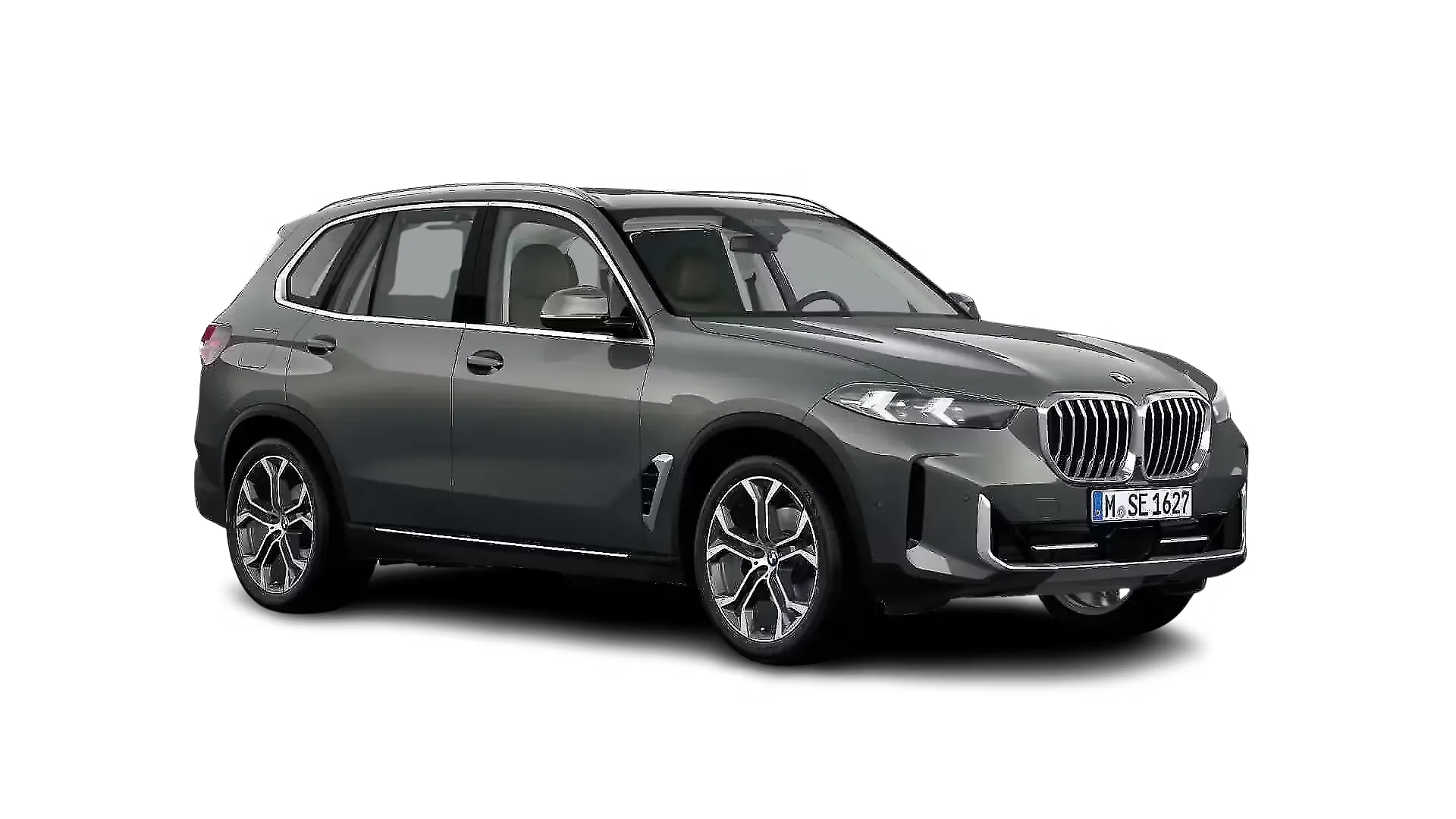
 Image: BMW press kit
End-of-cycle pricing, a fast-revving diesel, air suspension and genuine driver engagement make the X5 the most complete luxury SUV in its segment right now.
The BMW X5 is nearing the end of its G05 life cycle but remains the segment's most driver-focused luxury SUV. A 286 hp straight-six diesel, standard air suspension and sharp dynamics let it shame cars that weigh less. Cabin niggles and ageing UI are the only real complaints.
The X5 has aged gracefully because BMW has not yet polarised it the way newer models like the 7 Series or XM have been. The kidney grille is sensibly sized and illuminated at night, the adaptive LED headlights pulsate on unlock, and the M Sport bumpers add visual aggression without descending into caricature. Standard 21-inch Y-spoke alloys with staggered 275/40 front and 315/35 rear rubber give it a near-supercar stance. The split tailgate, quad-look exhausts on petrol variants and 3D LED tail lamps round out a design that still draws looks. Faisal Khan rightly flags the fake fender vents as a minor cheat, but in this segment, against an ageing GLE and the bulkier Q7, the X5 remains the most resolved-looking SUV.
The cabin is the X5's most divisive area. The 12.3-inch instrument cluster and 14.9-inch curved touchscreen, crystal-cut iDrive controller, gear selector and start button all feel suitably premium, and BMW Individual Comfort seats with extendable thigh support, heating and ventilation are excellent. But the iDrive 8.5 UI is cluttered, AC controls have migrated almost entirely into the touchscreen, the panel below the screen has shrunk and feels flimsier than before, and the digital key replaces the previous display key that let owners adjust ride height remotely. Rear seat space is adequate for a 5'8" passenger but knee room tightens for taller adults, and the backrest angle is fixed. Four-zone climate, panoramic sunroof and a 464W 16-speaker Harman Kardon system are standard kit highlights.
Fit and finish is largely up to BMW standards but not flawless. Test cars showed a loose dashboard panel with a visible gap, a hanging thread on the steering wheel, and AC vents that feel flimsier than the outgoing layout. Soft-close doors, adaptive LED headlights with welcome animations, gesture control and a heads-up display with AR navigation are all present. The feature list is exhaustive: 360-degree camera with drive recorder, wireless charging, eight airbags, ADAS with lane keep and AEB, automated parking. Some legacy party tricks are gone: the display key, the auto-retracting parcel shelf, and certain electric rear-seat functions have been deleted. The 468-page owner's manual hints at depth, but a few cost-cuts are visible to anyone who knew the earlier car.
The 30d's 3.0-litre straight-six diesel with 48V mild hybrid assistance produces 286 hp and 650 Nm, paired with a ZF 8-speed torque converter. BMW claims 6.1 seconds to 100 km/h; testers consistently matched it. The diesel revs to nearly 5,800 rpm, which is extraordinary for an oil-burner, and the mid-range punch is genuinely shove-you-into-the-seat strong. The petrol 40i makes 381 hp and does 0-100 in a claimed 5.4 seconds, but for India, the diesel's 8-10 km/l real-world economy and 900 km tank range make far more sense. Launch control is reportedly unreliable, a niggle multiple owners have flagged. Gagan Choudhary notes the 48V system fills turbo lag so seamlessly that power arrives before the diesel clatter does.
The X5 rides on standard two-axle air suspension with five height modes, automatically dropping to level three above 60 km/h. High-speed composure and stability are exceptional thanks partly to the massive staggered rubber. But those same 21-inch low-profile run-flats are the car's biggest ride compromise on broken Indian roads: low-speed thuds and sharp-edge intrusions are noticeable. Where the X5 genuinely separates itself from the Q7 and XC90 is handling. The steering is beautifully weighted with real feedback, body roll is contained for a 2,400 kg vehicle, and the rear-biased xDrive system makes it feel playful rather than ponderous. Driven+ confirms that even the petrol M60i with air suspension out-rides and out-handles the firmer X5M for daily use.
On-road Mumbai pricing for the 30d M Sport sits at around Rs 1.37 crore, with ex-showroom variants ranging from roughly Rs 94 lakh to Rs 1.08 crore. The price difference between xLine and M Sport is around Rs 16 lakh, and the M Sport is worth it for the bumpers, wheels and trim. Critically, the X5 undercuts the Mercedes GLE by a couple of lakh and is heavily discounted as BMW prepares the next-gen G65. Against the Audi Q7 and Volvo XC90, the X5 offers sharper dynamics; against the smaller Porsche Macan, it offers far more space and a usable boot. For a buyer who actually wants to drive their luxury SUV, it is the segment's strongest value proposition right now.
"Easily the best car in the segment; engaging to drive, loaded with kit, and now heavily discounted before the next generation arrives."
"Still his favourite SUV but flags loss of party tricks like the display key, auto parcel shelf and the touch-heavy AC panel."
"Walkaround confirms feature parity with X7 on most kit; diesel claims 11 km/l, petrol 8.3 km/l with 80-83 L tanks."
"Skip the X5M, the M60i with air suspension is the sweet spot: nearly as fast, far more comfortable, 30,000 pounds cheaper abroad."
"Praises the curved 12.3+14.9 inch display, hexagonal steering and refined power delivery from the straight-six with xDrive."
"A clean 2018 pre-owned 30d at around Rs 50 lakh is half the new price and still delivers the core X5 driving experience."