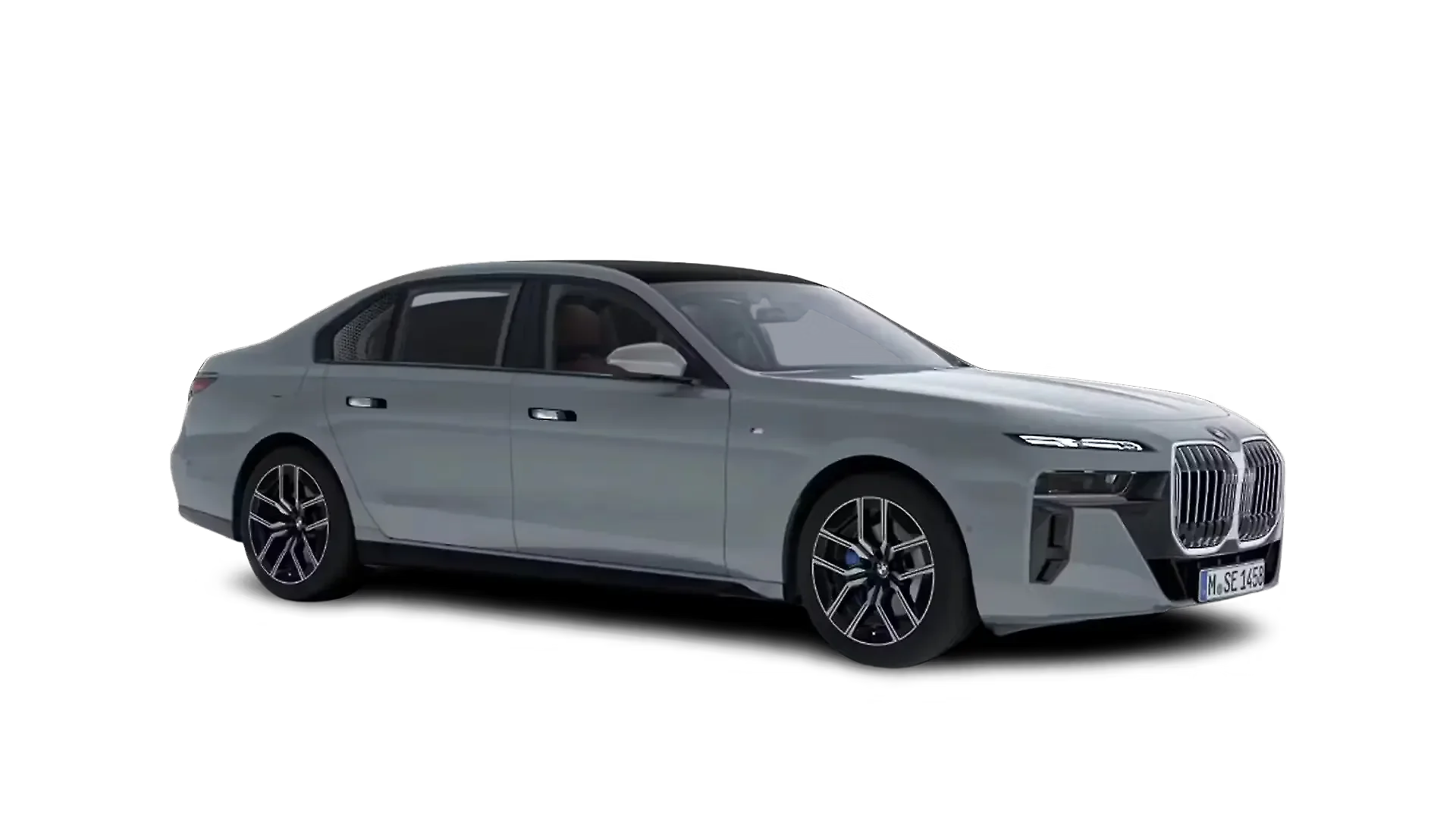
 Image: BMW press kit
A genuinely path-breaking flagship that drives like a BMW while pampering rear occupants with theatre-grade tech, justifying its import-led pricing for buyers who want both worlds.
The 2026 BMW 7 Series is sold in India as the petrol mild-hybrid 740i and the fully electric i7, priced from around Rs 1.70 crore to over Rs 2 crore ex-showroom. It blends a chauffeur-grade rear cabin headlined by a 31.3-inch theatre screen with surprisingly nimble driving manners. The i7 in particular emerges as the more compelling pick for tech-forward luxury buyers.
The new 7 Series is unapologetic about its presence. At over 5 metres long, it wears split LED headlamps, the controversial oversized kidney grille with optional crystal iconic glow, and 21-inch M-badged alloys on the i7. MotorOctane notes the body is engineered for aerodynamic efficiency, particularly on the electric variant where every detail aids range. There is a front-mounted camera with its own washer, flush door handles, automatic doors that open and close at the press of a button, and a sleek shark-fin antenna. The rear treatment carries heavy chrome that not everyone will love, but the connected tail-light signature looks striking at night. The 740i M Sport adds twin chrome exhausts. It looks like nothing else on Indian roads.
This is where the 7 Series leaps ahead. The dashboard mixes crystalline glass switchgear, open-pore wood, brushed aluminium and soft-touch surfaces in genuinely contrasting fashion. The headline act is the 31.3-inch 8K rear theatre screen that drops down from the roof, paired with Amazon Fire TV, Netflix, YouTube and a Bowers and Wilkins audio setup. Activate Theatre Mode and the sun-blinds close, the front passenger seat slides forward, the rear seat reclines into a true lounge, and the footrest deploys. Each rear door has a 5.5-inch touchscreen for controlling lights, blinds, climate and massage. The front gets a curved display housing the instrument cluster and iDrive. Faisal Khan notes the cabin is more tech-forward than the outgoing model, even if the touch-heavy approach buries some basic functions in menus.
Fit and finish are befitting the price. Doors are frameless, soft-close as standard, and can open and shut automatically using sensors that detect obstacles. The crystalline switchgear, glass-finished iDrive controller and ambient lighting feel genuinely special. Safety kit includes multiple airbags, surround-view cameras with washer for the rear unit, ADAS with adaptive cruise and lane-keep, parking assistant with remote parking via the key fob, and BMW's connected drive suite. Both the 740i and i7 get four-zone climate, panoramic glass roof, executive lounge rear seating with massage, heating, ventilation and memory, plus a Bowers and Wilkins 3D surround system. Faisal Khan flags that the older S-Class still pips it on outright rear pampering depth, but the BMW counters with superior cabin technology.
Two very different powertrains. The 740i uses a 3.0-litre inline-six petrol with 48V mild-hybrid assistance, making 381 hp and 520 Nm, good for 0-100 km/h in around 5.4 seconds. The i7 xDrive60 uses dual motors fed by a 101.7 kWh battery, producing roughly 544 hp and dispatching 0-100 km/h in 4.56 seconds despite weighing 2,600 kg. Press the Boost button on the steering and the i7 launches like a proper sports sedan, eerily silent throughout. Gagan Choudhary confirms the 740i feels effortless across modes, with the eight-speed ZF gearbox shifting unobtrusively. The i7 claims 500-550 km of real-world range and supports 240 kW DC fast charging, with a 22 kW AC charger taking five to seven hours for a full top-up at home.
The 7 Series rides on standard adaptive two-axle air suspension that automatically lowers at speed for aerodynamics and can be raised for bad roads. On smooth tarmac, ride quality is genuinely plush and noise insulation is excellent. The car shrinks around you once you learn its dimensions: visibility is good, the steering is light at parking speeds yet weights up nicely on the highway, and body roll is well controlled for such a long sedan. The weaknesses appear over sharp speed breakers and broken patches, where the suspension can transmit a thud to occupants. Ground clearance, even when raised, demands care over aggressive Indian bumps. Brakes are strong and progressive. Handling is competent rather than playful, which is appropriate for a flagship limousine.
The 740i starts around Rs 1.70 crore ex-showroom while the i7 stretches past Rs 2 crore, making it among the most expensive sedans on sale. Both are CBU imports, which explains the premium over locally assembled rivals. The direct competitors are the Mercedes-Benz S-Class and EQS plus the Audi A8 L. For buyers genuinely choosing between the 740i and i7, the i7 wins on outright performance, smoothness, running costs and badge-of-the-future appeal, though India's fast-charging infrastructure outside metros remains a consideration. If your BMW journey is just starting, the brand also offers the X1 and X3 SUVs at far gentler price points. As a flagship statement that you can also enjoy from the driver's seat, the 7 Series justifies its sticker.
"Genuinely path-breaking electric flagship; if choosing between 740i and i7, the i7 is the more complete car."
"740i petrol mild-hybrid is refined and effortless, though air suspension could absorb sharp bumps better."
"Feature-stuffed flagship with iconic glow grille, theatre screen and full ADAS suite justifying its flagship billing."
"Rear seat is excellent but S-Class still leads on outright pampering, footrest design and tray functionality."
"If your BMW budget is tighter, the 3 Series or 2 Series Gran Coupe make more rational sense."