Porsche Taycan vs
Audi e-tron GT
Choose the Taycan for driver purity, or the e-tron GT for grand-tourer range and visual drama.
Most buyers decide here. Read this before anything else.
- You track your car at least twice a year and want the most surgically tuned chassis in the segment, not just the quickest straight-line number.
- You already own a family SUV and the Taycan is your personal driving machine, so the tight rear seat is irrelevant to your daily life.
- You value the Porsche badge as a signal of driver focus over luxury grandeur, and that distinction matters to you at every valet stand.
- You prioritise tactile, physical driving feedback over interior screen count, and you want a steering wheel that actually communicates the road.
- You do most of your charging at home overnight and rarely depend on public DC fast chargers, so real-world range anxiety is a manageable trade-off.
- You want the Turbo S 0-100 in 2.8 seconds as a conversation-starter, and you want it from a brand with decades of sports car credibility behind the number.
- You regularly drive 400 to 500 km in a single day between cities and need a performance EV where range is not a constant mental calculation.
- You want the most visually striking car in a hotel drop-off queue, and you believe the e-tron GT's long, low silhouette achieves that more effortlessly than anything else in the segment.
- You use public fast chargers frequently and the 320 kW peak charging speed means a meaningful difference to your schedule on a long drive.
- You prefer physical climate controls and a less screen-saturated dashboard, and the e-tron GT's retained buttons feel like a more considered daily-use decision.
- You want supercar acceleration but also want a car that feels settled and quiet on a five-hour motorway run without feeling like a compromise.
- You are drawn to the RS Performance's 2.5-second sprint as a headline figure that technically edges the Taycan Turbo S, and that margin matters to you.
The Taycan scores 9.3/10, the e-tron GT 9.1/10. In real life, they are built for different people.
The e-tron GT's updated 97 kWh battery and 592 km WLTP figure give it a meaningful real-world buffer over the Taycan, whose 420 km claim shrinks noticeably at motorway speeds. MotorOctane noted the e-tron GT's 320 kW peak charging as a genuine game-changer for tour drivers. The Taycan suits buyers who charge overnight; the e-tron GT suits those who depend on en-route top-ups.
Porsche's chassis tuning on the Taycan is more deliberately communicative, with the two-speed rear gearbox and Porsche-calibrated adaptive suspension giving a tighter, more connected feel through elevation changes. Faisal Khan called it a car that rewards commitment on a demanding road in a way few four-door EVs can match. The e-tron GT is fast and planted but is tuned more for composure than conversation.
Both cars share the J1 platform's rear-seat constraint, so neither is generous for adult passengers in the back. The e-tron GT's physical climate buttons and slightly less screen-dense cabin make mundane daily tasks feel marginally less fussy, as V3Cars highlighted in their usability assessment. For pure solo commuting, the difference disappears entirely.
The Porsche badge has historically held stronger residual values in India's ultra-premium segment, supported by a smaller buyer pool and stronger aspirational pull at the used-car level. The Audi RS e-tron GT is newer in its updated form and has fewer comparable resale data points in India at this price. Buyers who plan a three-year ownership cycle should factor that asymmetry into the total cost equation.
Scores shown inline. "Best for" tells you who each result matters to.
| Axis | Porsche Taycan | Audi e-tron GT | Best for |
|---|---|---|---|
Design |
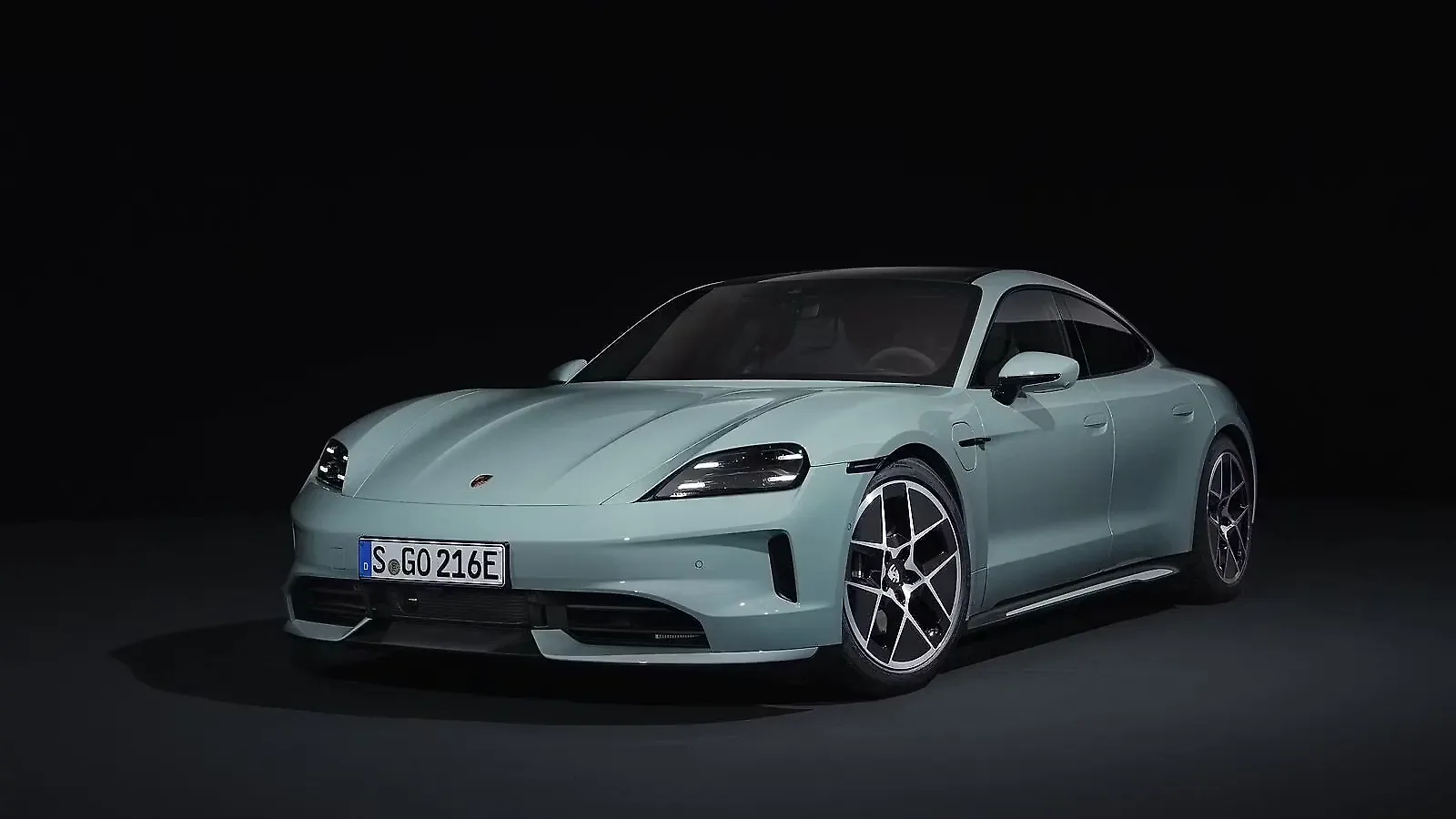
The Taycan is unmistakably a Porsche: four-point Matrix LED headlights, frameless doors, pop-out handles and a deployable rear spoiler that rises 135 mm at 90 km/h. Namaste Car noted its coupe-like roofline gives it the road presence of a much more expensive machine. The 21 or 22-inch wheels and 305/30 rear rubber make it look planted before it even moves. 8.8 / 10 |
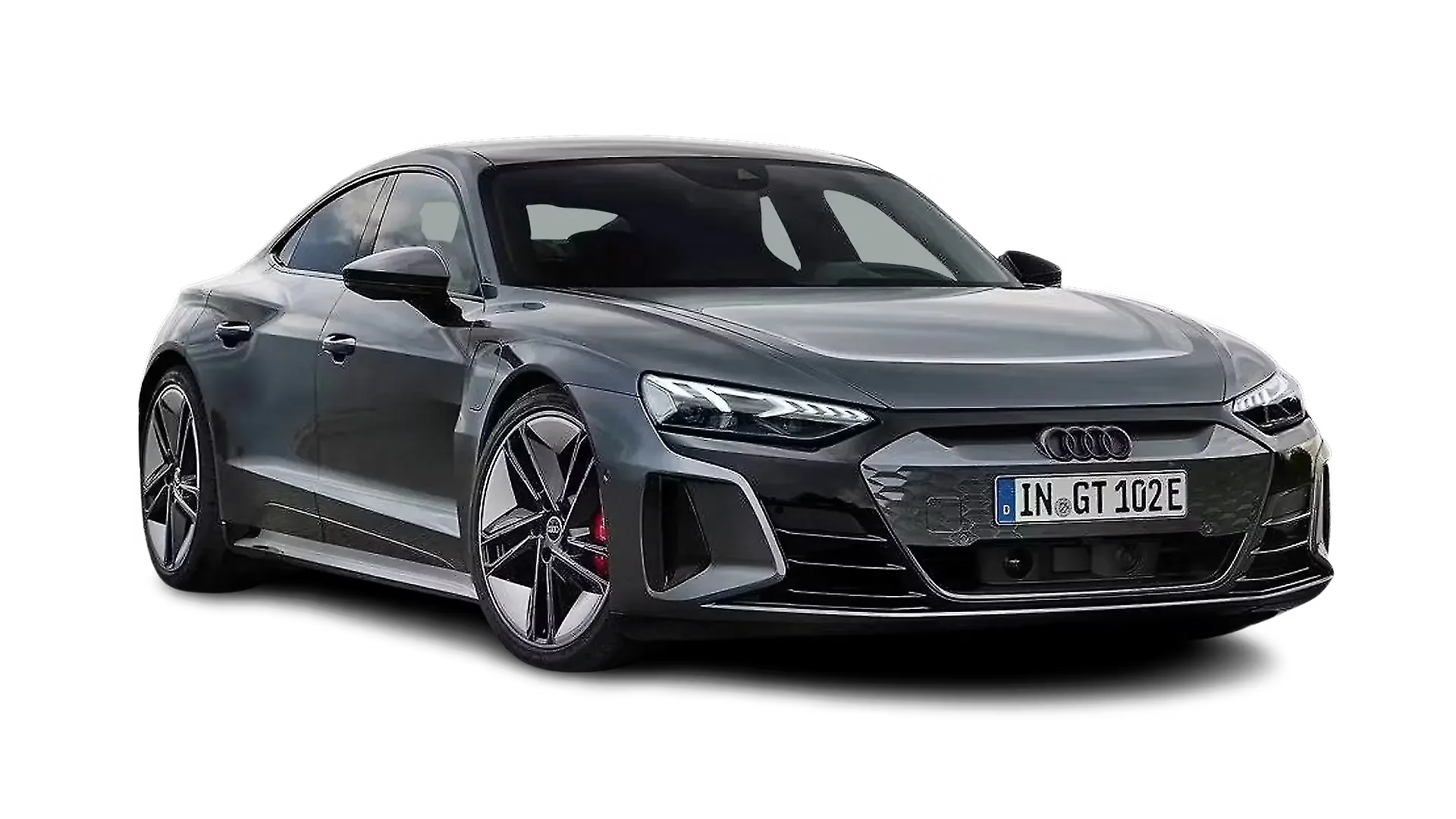
The e-tron GT is the most visually arresting sedan Audi currently sells, with a closed single-frame grille, matrix laser LED headlights and a carbon-fibre roof that lowers the visual centre of gravity. The facelift adds bumper revisions that visually separate the S, RS and RS Performance trims clearly. MotoWagon described it as looking like a production concept that somehow made it to the road. 9.0 / 10 |
Statement car buyerse-tron GT reads as more overtly dramatic from the kerb
|
Interior |
The Taycan's curved 16.8-inch digital cluster flanked by 10.9-inch displays is among the richest cabin experiences in any EV. Leather, Alcantara and double-stitching are standard on the Turbo S. The annoyance is AC vent direction buried in menus, a compromise MotorBeam flagged as a daily irritant. 7.8 / 10 |
The e-tron GT retains physical climate and drive mode buttons, which V3Cars rated as a genuine usability advantage over more touchscreen-heavy rivals. The 10.1-inch central screen and 12.3-inch virtual cockpit are functional without being theatrical. Carbon-fibre accents and a new flat-bottomed steering wheel lift the cabin feel on the facelifted car. 7.5 / 10 |
Tactile usability seekersPhysical controls make the e-tron GT easier to use without looking down
|
Performance |
The Turbo S produces 751 hp on overboost and 1050 Nm, covering 0-100 km/h in 2.8 seconds and 0-200 in 9.6 seconds. The two-speed rear gearbox is the engineering story here: it shifts at around 68 km/h to maintain pull at high speed where single-speed EVs fade. Gagan Choudhary described the Turbo S mid-range surge as physically disorienting. 9.5 / 10 |
The RS Performance variant produces 925 PS under launch control with a 10-second, 90 hp push-to-pass boost, and its 2.5-second 0-100 claim is one testers consistently match or beat. In the carwow drag race, the e-tron GT and Taycan Turbo traded lengths depending on conditions, with the RS Performance holding a marginal edge. MotorOctane described it as the quickest Audi badge in history by a significant margin. 9.5 / 10 |
Drag strip regularsRS Performance's 2.5-second figure edges the Taycan in peak launch conditions
|
Ride Quality |
Porsche's adaptive air suspension on the Taycan manages the tightrope between sports-car firmness and daily comfort with genuine skill. MotoWagon noted it absorbs broken urban surfaces better than the car's visual stance suggests it should. In Comfort mode it is a proper grand tourer; in Sport+ it becomes something noticeably sharper. 8.5 / 10 |
The e-tron GT is tuned with a slightly softer, more GT-oriented character than the Taycan, which suits long motorway runs. Namaste Car described it as a car that never lets the road feel like an obstacle. The trade-off is marginally less feedback when you push it hard through a corner sequence. 8.5 / 10 |
Long-distance cruiserse-tron GT's softer tune makes multi-hour runs less fatiguing
|
Build Quality |
Porsche's build quality on the Taycan is reference-level: panel gaps are tight, materials are consistent across the cabin, and the frameless doors seal with a satisfying solidity. MotorBeam rated it among the best-assembled cars they have tested in India at any price. Nothing flexes, rattles or disappoints on close inspection. 8.8 / 10 |
The e-tron GT matches premium Audi standards with excellent fit and finish, carbon-fibre trim that feels structural rather than decorative, and a body that sits flush and even all around. V3Cars noted the facelift improved panel consistency on the lower bumper sections. It is not behind the Taycan in any meaningful way; the gap is one of perception rather than reality. 8.5 / 10 |
Detail-obsessed buyersTaycan's assembly precision is a fractional step ahead on close inspection
|
Value for Money |
At its price point, the Taycan Turbo S is hard to justify purely on rational grounds. Faisal Khan acknowledged that the Porsche badge and chassis tuning carry a premium that numbers alone cannot explain. Buyers who understand what they are paying for will feel it is worth it; those who want maximum specification per rupee will not. 6.8 / 10 |
The e-tron GT RS Performance's superior range, faster charging, slightly higher peak performance and marginally lower entry point create a stronger value argument within this segment. MotorOctane pointed out that the updated battery and charging hardware represent a genuine generational step up, not just a refresh. For buyers who measure value in usable real-world capability, the e-tron GT wins the calculation. 7.0 / 10 |
Rational luxury buyerse-tron GT delivers more measurable capability per rupee spent
|
Range and Charging |
The Taycan Turbo S claims 420 km on WLTP, but real-world usage at motorway speeds brings that closer to 300 to 340 km in Indian conditions. The 270 kW peak DC charging is strong but trails the e-tron GT's updated hardware. For buyers who charge at home and drive under 250 km daily, this is not a problem; for long-distance touring, it requires more planning. |
The updated 97 kWh battery and 320 kW peak charging are the e-tron GT's most significant upgrades over the outgoing model. WLTP range of 592 km on the RS Performance is the headline, and while Indian real-world figures will be lower, the buffer is genuine. MotorOctane called the charging speed the most practical superpower in the segment for buyers outside metro charging networks. |
Inter-city tour driverse-tron GT's range and charging speed remove tour anxiety the Taycan cannot
|
The Taycan scores 9.3/10 and the e-tron GT 9.1/10, from 7 independent creators. The overall number is only part of the story here: the dimension breakdown is where the real comparison lives.
carwow: Audi RS e-tron GT v Porsche Taycan v Tesla Model S: DRAG RACE