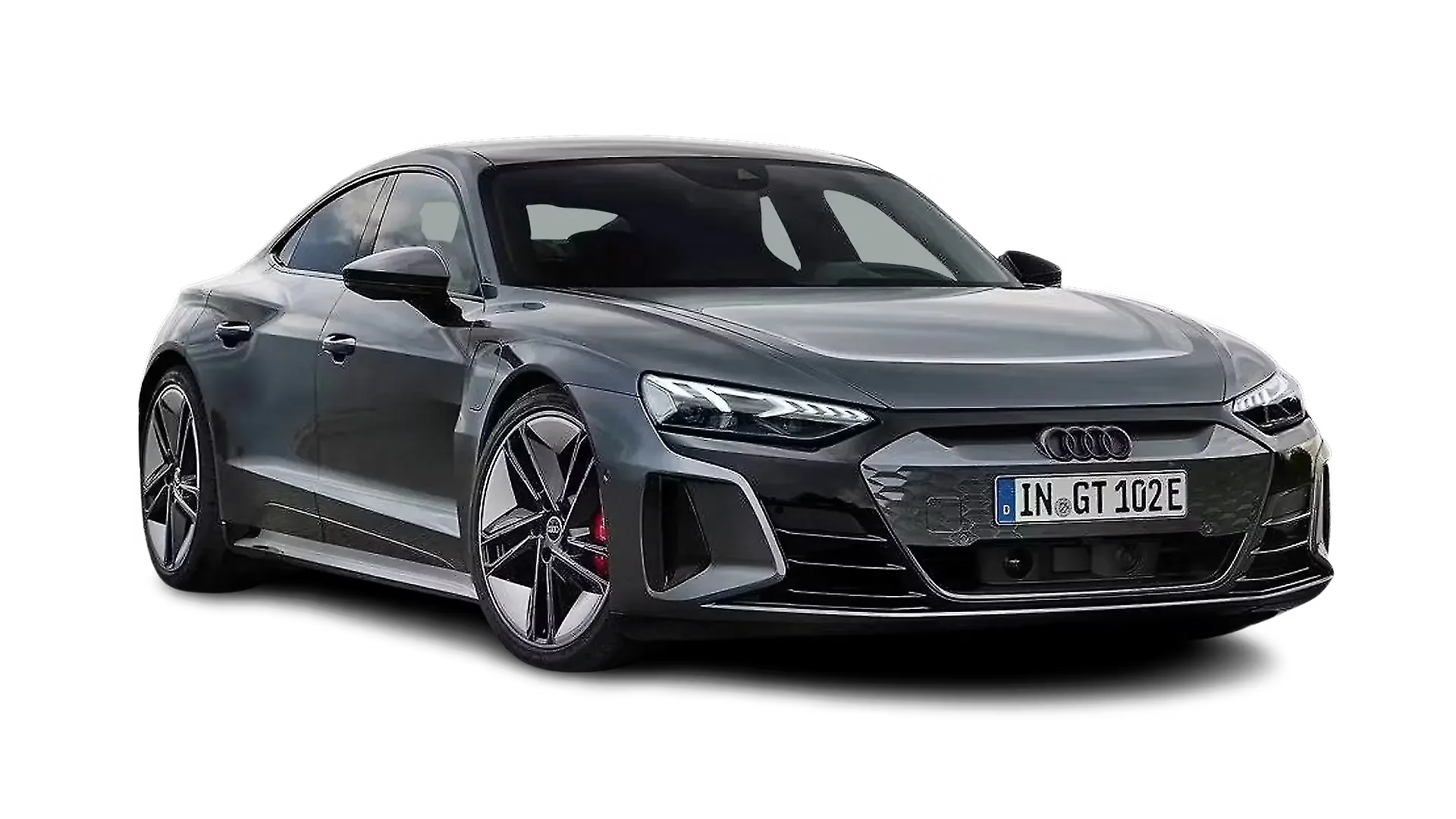
 Image: Audi press kit
For buyers chasing Bugatti-level acceleration with German GT comfort and engineering, the e-tron GT is unmatched at its price band.
The 2026 Audi e-tron GT is the brand's fastest accelerating car ever, hitting 100 km/h in 2.5 seconds in RS Performance trim. Sharing its J1 platform with the Porsche Taycan, it pairs supercar pace with genuine grand-tourer comfort. But a tight rear cabin and a price tag near Rs 2.5 crore keep it a focused, two-buyer-plus-luggage proposition.
Five metres long, low-slung and squatted on 21-inch wheels, the e-tron GT is the most visually arresting sedan Audi sells. The single-frame grille is closed off, matrix LED laser headlights flank a body-coloured nose, and the facelift adds bumper revisions that differentiate the S, RS and RS Performance trims. Frameless doors, a carbon-fibre roof, an active rear spoiler and functional aero vents along the flanks reinforce the grand-tourer intent. Faisal Khan notes the camouflaged carbon weave on the RS Performance gives it a unique signature versus the regular RS. Compared to the Porsche Taycan it shares its bones with, the Audi looks softer and more elegant; against the Mercedes-Benz EQS, it is dramatically more athletic.
The cabin is the e-tron GT's most carried-over element. A 10.1-inch central touchscreen, 12.3-inch virtual cockpit and heads-up display do the job without the dual-screen theatre of the newer Q6 e-tron. Physical buttons for climate and drive modes are a genuine win for usability, and fit-finish is excellent, with carbon-fibre accents, a new flat-bottomed steering wheel and supportive sports seats with extendable thigh support. Rear accommodation is where the GT label bites: the sloping roof eats headroom, the window line is high, knees sit up because of the battery floor, and door pockets are tiny. The 16-speaker Bang and Olufsen 3D system, ventilated and massaging front seats, and Audi Exclusive customisation soften the blow.
Built at Audi's Neckarsulm plant in Germany on a unitary steel body, the e-tron GT feels every bit the flagship. Panel gaps are tight, the soft-close doors thud shut with luxury-car authority, and material quality, from the brushed aluminium inserts to the Dinamica headliner, is consistently premium. Safety kit covers eight airbags, ESC, hydraulic brake assist, tyre pressure monitoring, a 360-degree camera, front and rear parking sensors with self-park, and Audi's Matrix LED laser lights with high-beam assist. The intelligent thermal management is engineered to sustain repeat launch-control runs without power derating, and the battery housing forms a structural element. ADAS hardware is present, though Indian-spec feature availability will depend on local tuning.
This is where the e-tron GT redefines what an Audi badge means. The RS Performance variant produces a combined 925 PS with launch control, a 10-second 90 hp push-to-pass boost, and a claimed 2.5 second 0-100 km/h time that testers consistently beat. A new battery chemistry lifts usable capacity to 97 kWh, charging peaks at 320 kW, and WLTP range climbs to 592 km on the RS Performance, with the S e-tron GT and RS e-tron GT offering longer legs and 0-100 times of 3.4 and 2.8 seconds respectively. The two-speed gearbox locks into first under launch control for repeatable sub-2.6 second runs. Stopping power from the carbon ceramics, however, does not quite match the forward thrust.
The standout engineering story is the optional active air suspension, which physically leans the car into corners up to 80 km/h in Comfort mode, eliminating body roll and the nausea that usually comes with hard cornering. MotorOctane found the new PPE-adjacent J1 platform sheds the heavy, bogged-down feel of older VW Group EVs; the car turns in quickly despite its mass, and the Bridgestone tyres developed specifically for it offer huge grip. Steering is light and a touch slack on-centre but weights up convincingly at speed. Comfort, Dynamic, RS1, RS2 and RS Performance modes meaningfully change throttle, suspension and steering character. On Indian roads, the adaptive height function easing the car up over speed breakers will be a daily blessing.
Faisal Khan estimates the RS Performance will land near Rs 2.5 crore in India when launched, which positions it above the Mercedes-Benz EQS but in the same arena as the Porsche Taycan it shares mechanicals with. For that money buyers get the fastest-accelerating Audi ever, genuine grand-tourer comfort, 592 km WLTP range and 320 kW charging, plus carbon ceramic brakes, active suspension and a carbon roof as part of the kit. The catch is rear-seat practicality, which is poorer than an EQS, and the absence of the R8's drama for ex-supercar owners. As a status statement and a daily-usable performance EV for two, it makes sense; as a chauffeur-driven sedan, it does not.
"A spec-rich flagship with serious presence, but tight rear space and a steep price keep it niche."
"The new platform finally makes a heavy VW Group EV feel light and fun, with city manners to match."
"Real-world range of around 400 km on public charging, but suspension comfort and instant response justify the premium."