 Image: Porsche press kit
The Taycan Turbo S is the most driver-focused luxury EV on sale in India, justifying its price for buyers who prioritise dynamics over range or rear space.
The Porsche Taycan is the brand's first series-production EV and, in Turbo S guise, the fastest-accelerating car on sale in India. It pairs a 93.4 kWh battery and 751 hp dual-motor setup with proper Porsche chassis tuning, but pays for that focus with tight rear space and a real-world range well short of the 420 km claim.
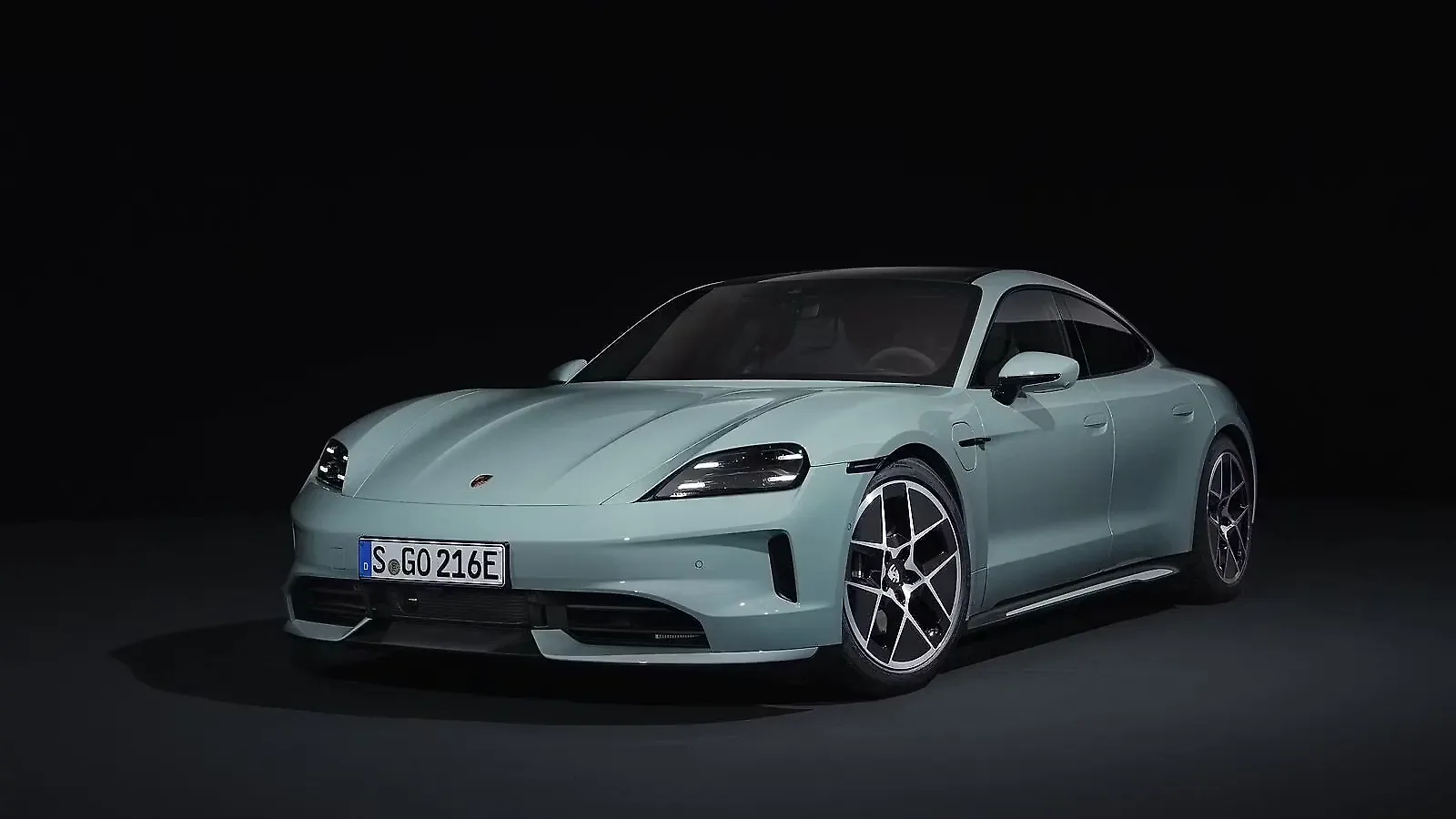
The Taycan is unmistakably a Porsche, with four-point LED Matrix headlights, frameless doors, pop-out handles and a deployable rear spoiler that raises 135 mm at 90 km/h. At nearly five metres long with a 2.9 metre wheelbase, it has serious road presence, helped by 21 or 22-inch wheels wrapped in 265/35 front and 305/30 rear rubber on the Turbo S. Active aero flaps, a sloping coupe-like roofline and one of the lowest drag coefficients in the segment all contribute. Namaste Car notes the optional carbon exterior pack alone costs Rs 6.75 lakh, and even the colour-matched key is a Rs 54,000 extra. Ground clearance is a low 126 mm, but the standard nose-lift function raises it 20 mm below 30 km/h.
Cabin quality is exceptional: leather, Alcantara, double-stitching and a curved 16.8-inch digital cluster flanked by 10.9-inch central and optional passenger displays. The dashboard is dense with screens, but ergonomics largely work because Porsche retained physical switches on the steering and doors. Annoyances remain: AC vent direction is buried in a touchscreen menu, there is no sun blind for the panoramic roof (replaced by a Rs 7.46 lakh switchable-tint glass), and rear USB-C ports are awkwardly hidden. The Bose 14-speaker 710W system sounds excellent. Rear space is the bigger issue: the sloping roof, narrow door aperture and large central hump make it best for two adults under 5'8". Foot garages in the floor preserve legroom, but headroom is tight.
Build is what you would expect for a car that can cross Rs 2.66 crore on-road. The body shell is 37% aluminium, paint quality is exceptional, panel gaps are tight and the frameless doors shut with reassuring solidity, though soft-close is missed at this price. Double-glazed windows deliver class-leading NVH. Equipment includes Matrix LED headlights, four-zone climate, 360-degree camera, 10 airbags, ISOFIX mounts, head-up display and a heat pump. The J1 platform is shared with the Audi e-tron GT, but Porsche's tuning makes the Taycan feel distinctly sharper. Niggles: no rear wiper, no boot-floor storage thanks to the space-saver and 11 kW charger occupying the 400-litre boot, and the front 82-litre frunk is the more usable load space.
The Turbo S uses a dual-motor setup producing 751 hp on overboost (617 hp sustained) and 1050 Nm, fed by a 93.4 kWh battery (83.7 kWh usable). The rear axle gets a two-speed gearbox that shifts around 68 km/h for better top-end and efficiency, while the front runs a single-speed unit. The result is 0-100 km/h in 2.8 seconds, 0-200 in 9.6 seconds and a 260 km/h limited top speed, comfortably quicker than the Mercedes EQS 53 AMG's 3.4 seconds. Faisal Khan confirms repeated launches do not degrade battery performance thanks to aggressive cooling. The lower 4S and rear-wheel-drive base variants sacrifice outright pace but feel lighter and arguably sweeter to steer.
Adaptive air suspension, electromechanical anti-roll bars (the Rs 4.76 lakh PDCC Sport pack) and rear-wheel steering that turns up to 2.8 degrees combine to hide the 2,295 kg kerb weight remarkably well. Body roll is virtually absent, the steering is direct and properly weighted, and grip from the 21-inch rubber is immense. Ride quality is genuinely good for 30-profile tyres, absorbing most urban imperfections, though sharp bumps still register. The car automatically drops 10 mm at 90 km/h and a further 12 mm at 190 km/h for stability. Brake feel from the carbon-ceramic 420 mm front and 410 mm rear discs is the standout: natural, progressive and free of the regen-induced rubberiness that plagues most EVs.
Pricing starts at Rs 1.69 crore ex-showroom for the rear-wheel-drive base variant and stretches to Rs 2.66 crore on-road Mumbai for the Turbo S tested, before options. MotorBeam highlights that the test car carried Rs 37.6 lakh in extras, including Rs 7.46 lakh for the switchable-tint roof and Rs 3 lakh for rear-axle steering. The Mercedes EQS 53 AMG undercuts it by around Rs 8 lakh and offers more luxury and range, while the Audi e-tron GT shares the platform for less money. Value depends entirely on priority: as a luxury cruiser, rivals make more sense, but as a driver's EV, nothing in India matches the Taycan. The 8-year/160,000 km battery warranty is reassuring.
"The best electric car to drive, period, with brake feel and steering precision that genuinely echo a 911."
"Engaging dynamics, sorted ergonomics and a sound profile that finally makes an EV feel emotionally connected."
"Hard to beat for handling and acceleration, though optional kit costs inflate the on-road price significantly."
"Strong regen calibration and chassis composure make it the pick among 800V luxury EVs."
"Feature-loaded with up to 626 km claimed range on lower variants, but the options list adds up fast."