 Image: Jeep press kit
A genuinely premium, rugged SUV that rewards highway and enthusiast drivers, provided you accept its city quirks and patchy after-sales network.
The 2025 Jeep Compass remains the segment's most rugged, premium-feeling SUV with class-leading build quality and highway composure. Powered by a 170 hp 2.0-litre Multijet diesel or 163 hp 1.4-litre petrol, it shines on the open road but feels bulky in cities. Priced from around Rs 20 lakh to Rs 30 lakh, it asks a premium for a real Jeep experience.
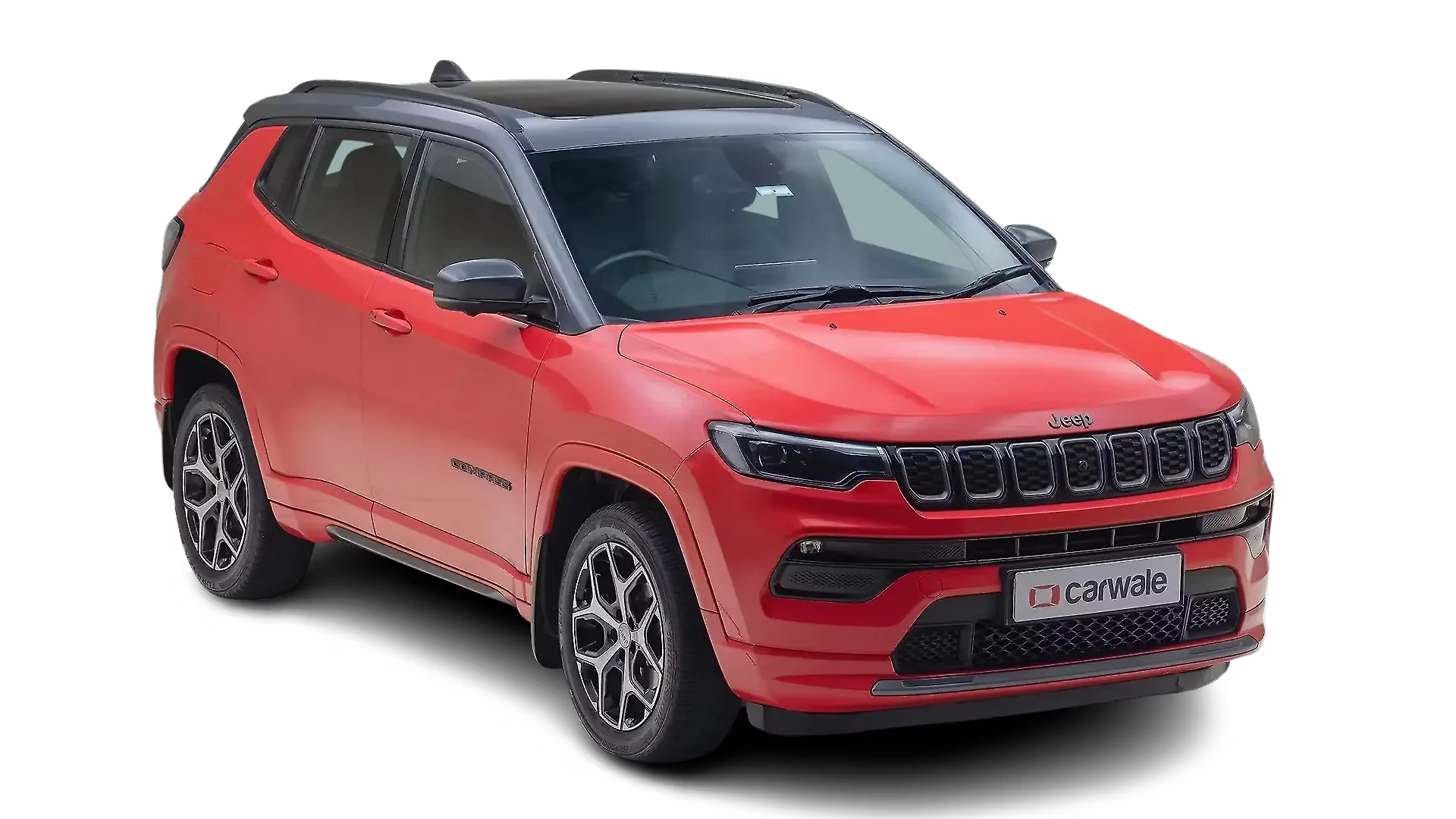
Eight years on, the Compass still looks unmistakably Jeep. The seven-slot grille, square wheel arches, sloping roofline and chrome trim across the mirrors carry the rugged identity, while the facelift adds sharper LED projector headlamps, redesigned tail lamps and a cleaner front bumper. Side cladding, roof rails and a shark-fin antenna lift the visual stance, though at 4.4 metres long with 170 mm of ground clearance, it now looks compact next to the Harrier or XUV700. MotorBeam notes it is the most aerodynamic Jeep ever produced. Seven colours are offered, including Brilliant Black and Magnesio Grey. Wheels measure 17 or 18 inches depending on trim. The Compass remains a looker, particularly in black, even if it no longer turns heads the way it did in 2017.
The cabin is the Compass's strongest card. The facelift introduced a 10.1-inch touchscreen, a 10.25-inch digital instrument cluster, redesigned steering wheel and significantly richer materials. Soft-touch surfaces dominate the dashboard and door tops, the leather upholstery feels properly premium, and details like the Jeep logo embossed in the speakers and footwell reflect genuine attention. Front seats are ventilated, power-adjustable with memory, and shaped for long-distance comfort with firm cushioning. The rear bench seats only two adults comfortably; three is a squeeze and six-footers will find knee room tight because feet do not slide under the front seats. Glaring omissions remain: no rear sunshades, no seat-back recline, and the panoramic sunroof eats into headroom. Boot space is taller than wider, useful for luggage but no class leader.
Build quality is the single biggest reason buyers walk into a Jeep showroom, and the Compass does not disappoint. The doors shut with a reassuring thud, the sheet metal feels thick, and 70 percent of the body uses high-strength steel. Equipment is generous on top trims: dual-pane panoramic sunroof, ventilated front seats, wireless charging, 9-speaker Alpine audio with subwoofer, 360-degree camera, TPMS, electronic parking brake with auto-hold and an electronic roll mitigation system. Six airbags, ESP, traction control, hill-hold and Hill Descent Control are part of the safety suite. MotorBeam flags the absence of ADAS as a notable omission in 2025. The infotainment, while sharp and responsive, still demands a few extra taps for routine functions, and the front bumper flap scraping over speed breakers is a recurring irritant.
Two engines are on offer: a 1.4-litre turbo-petrol with 163 hp paired to a 6-speed manual or 7-speed DCT, and the headline 2.0-litre Multijet-II diesel making 170 hp and 350 Nm, mated to either a 6-speed manual or a 9-speed automatic. The diesel is the one to have. It feels effortless on the highway, cruising at 100 km/h at just 1,600 rpm in 9th gear, and pulls hard from 1,700 rpm onwards. Below that, there is noticeable turbo lag and audible diesel clatter at idle. The 9-speed automatic divides opinion: smooth when cruising but slow to respond when pushed, which is why MotorOctane and TeamBHP both recommend the manual. Fuel economy ranges from 8-9 km/l in the city to 16-18 km/l on the highway.
This is where the Compass justifies its price. Frequency Selective Dampers, a feature unmatched in the segment, deliver a ride that absorbs broken roads without becoming floaty at speed. The chassis is rigid, the independent multi-link rear suspension keeps the car planted through corners, and high-speed stability is genuinely confidence-inspiring. The steering is light at parking speeds and weights up nicely on the highway, though the large turning radius makes U-turns and tight parking a chore. The unknown reviewer notes the Compass feels trapped in narrow city lanes, agile only when the road opens up. Brakes are strong with discs all round, and 4x4 variants add Auto, Snow, Sand and Mud terrain modes. Tyre roar from the Bridgestones is the main intrusion in an otherwise composed cabin.
Value depends heavily on which Compass you pick. The base Sport manual at roughly Rs 20 lakh on-road is genuine value: real Jeep DNA, the punchy diesel, electronic parking brake, TPMS and excellent build for XUV700-sunroof money. The top 4x4 diesel automatic at around Rs 30 lakh is harder to justify when it costs Rs 10-11 lakh more than a Seltos and Rs 5-6 lakh more than a Harrier sharing the same engine. Service costs of Rs 20,000-30,000 per visit at 15,000 km or annual intervals add up, and Jeep's dealer network remains thin compared to Hyundai or Toyota. Resale is the other concern. For enthusiasts who value driving dynamics and segment-leading cabin quality, the Compass earns its premium; for everyone else, rivals deliver more space and features per rupee.
A genuine driver's SUV that fixes a midlife crisis: the manual Compass is the best-handling, best-built car you can buy under Rs 30 lakh.
Long-term reality: Dealer experience at Landmark Jeep South Delhi was seamless with free mats, ceramic coat and BH-number assistance. The owner used a backup car strategy to offset reliability worries and still calls it the best manual car under Rs 1 crore on-road in India.
Read the full forum thread on TeamBHP →"A comprehensive feature walkthrough showing the Compass remains feature-rich with genuine off-road hardware and segment-first electronic roll mitigation."
"Build quality, ride and 170 hp diesel make this more complete than a BMW X1 in terms of value-for-money."
"Buying a Compass for city use is a waste; it only reveals its magic on highways and broken roads."
"The dynamic suspension and steering feedback at high speeds remain the Compass's calling card over rivals."
"Fantastic ride, refined diesel and tank-like cabin let down only by patchy after-sales and missing ADAS."