 Image: Maruti press kit
India's most sensible seven-seater MPV with the new CNG option making running costs unbeatable, though premium features remain limited.
The 2025 Maruti Ertiga remains India's default affordable seven-seater MPV, now bolstered by an updated CNG variant in the ZXI trim. With the 1.5L K15B petrol, light controls, genuine three-row practicality and Maruti's service network, it nails the family-plus-occasional-load brief. The cabin and feature list still trail newer rivals, but on running cost and ownership ease, nothing in the segment touches it.
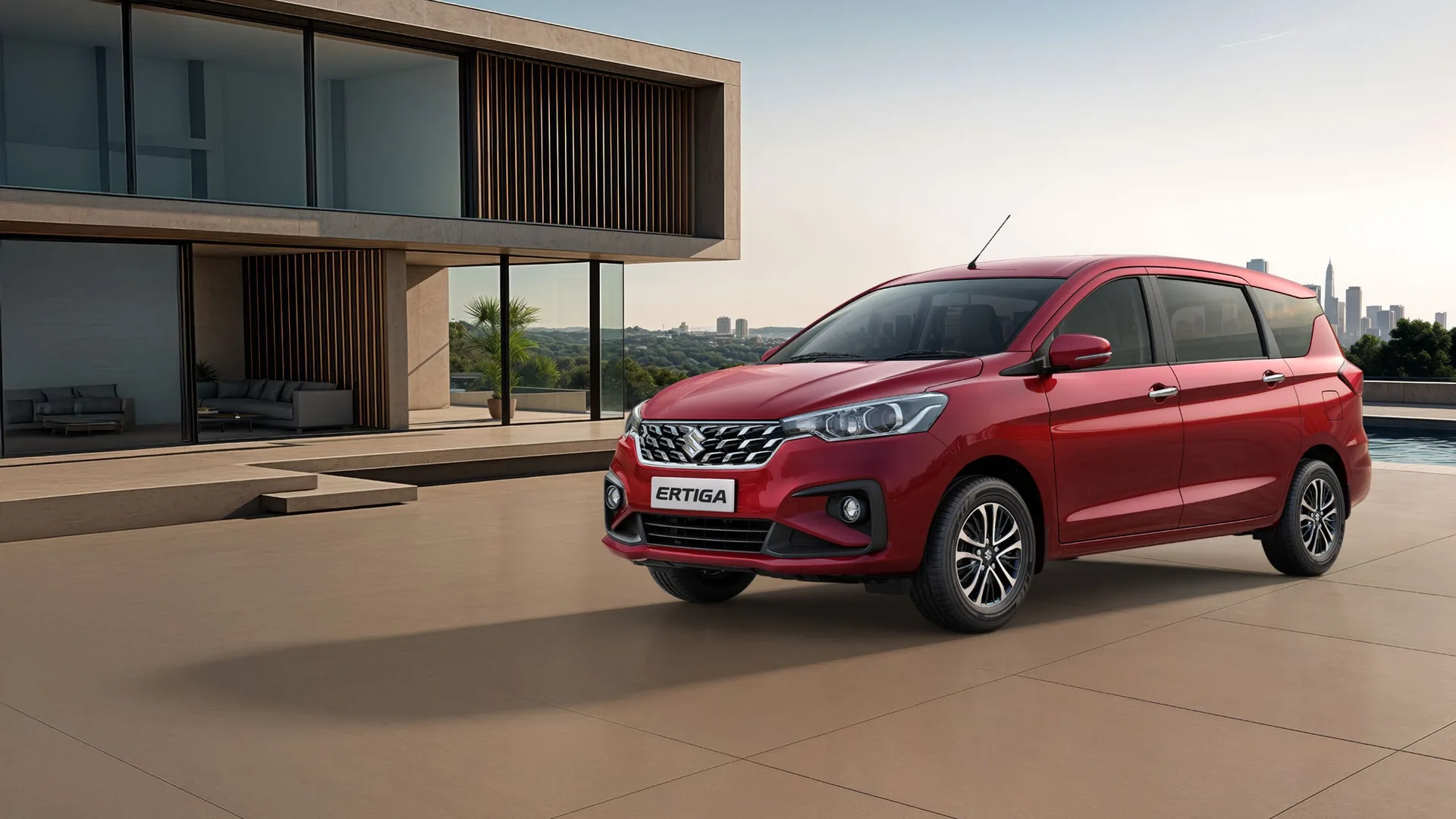
The 2025 update is evolutionary. The front gets additional chrome on the grille and yellow projector headlamps with yellow indicators, while the bumper has been mildly restyled. The 15-inch alloys carry over, door handles get chrome, and keyless entry is offered. The silhouette stays recognisably Ertiga: a tall, glassy MPV with a large rear door for easy third-row ingress. Faisal Khan notes design cues borrowed from multiple cars, small waves on the flanks and a bold shoulder line. There is no spoiler, but the high-mounted brake lamp and a subtle chrome strip across the tailgate lift the rear. The CNG ZXI variant skips roof rails, distinguishing it from the SHVS petrol. Overall, inoffensive and family-friendly rather than striking.
The dashboard layout has been refreshed with a darker theme, beige inserts on the sides and a 7-inch SmartPlay Pro+ touchscreen with wireless Apple CarPlay and Android Auto. Plastics remain hard throughout, though the new colour combination lifts the ambience. Front seats are wide and softly cushioned. The middle row offers proper recline, slide and good knee room with rear AC vents and a USB charging point. The third row, accessed via the tumble-and-slide second row, is realistically a two-child or one-adult bench with a flat floor. With all three rows up, boot space is tight but expandable. The CNG variant mounts a fire extinguisher under the front passenger seat as mandated. Cooled cup-holders and ISOFIX anchors continue.
Maruti has visibly improved sheet metal thickness and panel fit over the previous generation, and the 2025 Ertiga is expected to perform better in the upcoming Bharat NCAP tests. Six airbags, ESP, hill-hold and ISOFIX are standard. The cabin still relies on hard plastics across the dashboard, doors and lower halves, and feature gaps remain: no sunroof, no ventilated seats, no auto-dimming IRVM, and the reverse camera is restricted to higher trims. The TeamBHP community flags refinement as merely adequate for a million-rupee vehicle and notes the absence of features routinely offered by rivals. Build quality is a clear step up for Maruti, but the Kia Carens still sets the segment benchmark for cabin perceived quality.
The 1.5L K15B petrol produces 103 PS and 138 Nm, paired with a smart-hybrid system and offered with a 5-speed manual or 6-speed torque converter. The manual is the pick: light clutch, slick shifts, eager mid-range and a top-end that genuinely revs out. The CNG variant drops noticeably in pickup, particularly on inclines, but the petrol-CNG switch via a steering button is instant and the digital cluster shows both fuel levels. Faisal Khan rates the manual's mid-range and top-end as the best of the lineup. For city duties the engine is tractable and refined; on highways it cruises calmly without feeling strained. CNG running costs are roughly 40-50 percent lower than petrol, the strongest case for this variant.
Ride quality is the Ertiga's quiet trump card. The suspension soaks up broken tarmac, expansion joints and patchy roads with composure, and even with passengers loaded the ride stays settled. Low-speed plushness is excellent and high-speed stability is acceptable for the segment. The trade-off is body roll: the Ertiga leans noticeably through corners, expected given the wheelbase, height and MPV brief. The steering is one of the lightest in its class, fingertip-easy in traffic and tight parking, but it does not weigh up adequately at highway speeds, leaving the car feeling slightly nervous above 100 km/h. Brakes are adequate with discs at the front and drums at the rear; tyres squeal under hard braking but the ABS intervenes cleanly.
On-road pricing for the CNG ZXI variant works out to around Rs 13.26 lakh in Mumbai, which keeps the Ertiga firmly the most affordable proper seven-seater in India. The CNG variant's running cost advantage, combined with Maruti's service network reach and strong resale, makes the ownership maths near-impossible to argue with for taxi operators and value-led families alike. The Kia Carens offers more features, a turbo-petrol option and a plusher cabin, but commands a meaningful premium. Within the Maruti stable, buyers wanting an SUV alternative can consider the Brezza, while EV-curious shoppers might look at the e-Vitara when launched. For the seven-seat, low-running-cost brief, the Ertiga is genuinely unmatched.
TeamBHP rates the Ertiga as practical value for families prioritising space and affordability, with a usable third row and efficient powertrains. The forum flags merely adequate refinement, hard plastics and missing features like auto-dimming mirrors as the cost of that affordability.
Read full forum review →"The CNG ZXI is the smartest Ertiga to buy today; build quality is improved and running costs are unbeatable."
"Reviewed the e-Vitara stablemate; flags Maruti's growing feature gap versus rivals as a concern across the lineup."
"Bulk-bought 27 used Ertigas as taxis, proof of the MPV's resale strength and durability in commercial use."
"Petrol manual is the pick of the range with punchy mid-range and slick shifts, ride and handling balance is great."
"Over 8 lakh units sold in India, also badged as Toyota Rumion, designed by a Suzuki-led international team."